Deconstructing the Seido-Nuri Silhouette: Lacquer, Locust, and the 2026 Haute Couture Line
Introduction: An Archaeological Fragment of the Edo Aesthetic
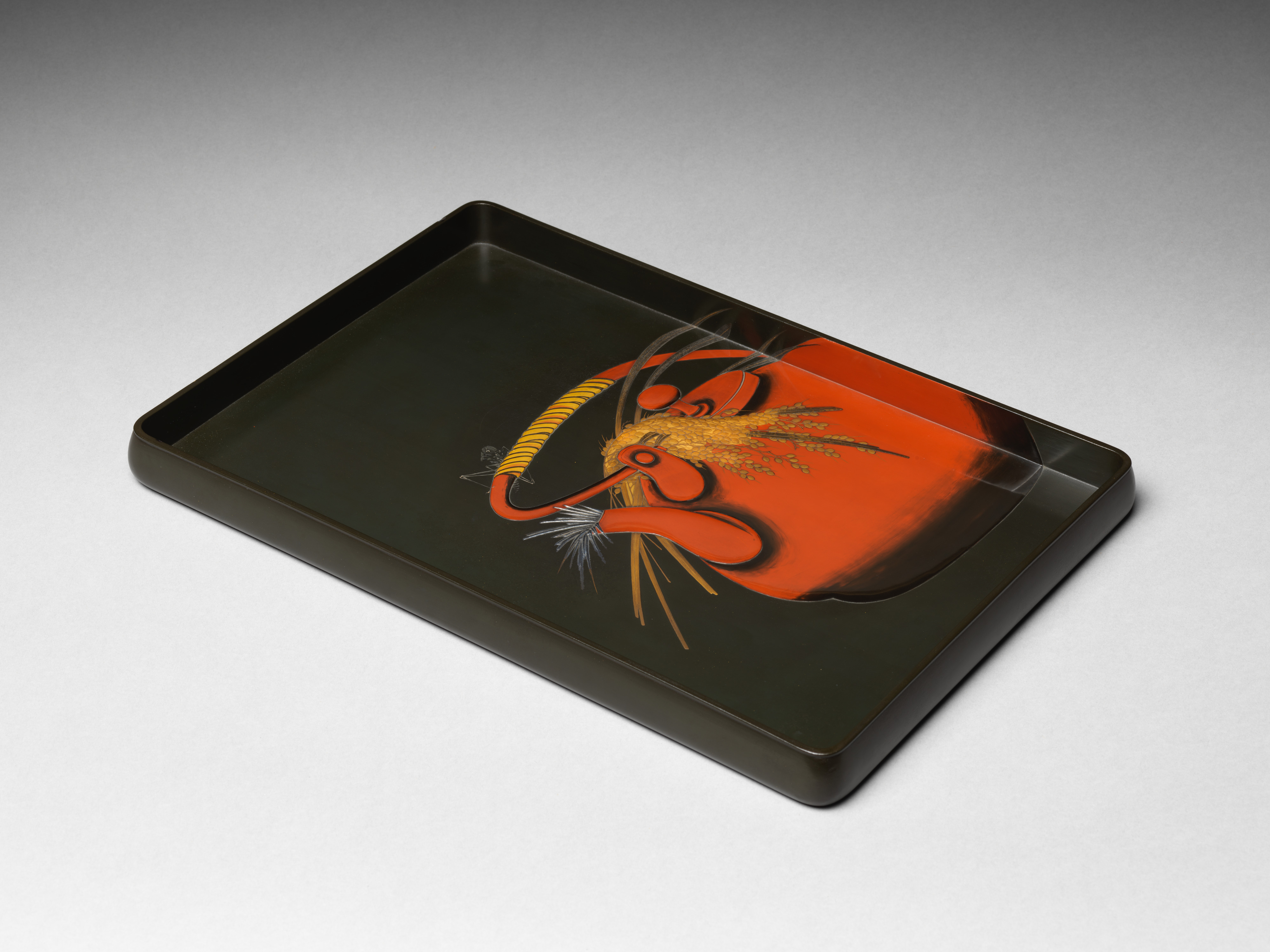
The artifact under analysis—a lacquered wood tray depicting a tea kettle, rice stalks, and a grasshopper, executed in hiramaki-e (flat sprinkled picture) and takamaki-e (built-up sprinkled picture) on a seido-nuri (bronze imitation) ground—represents a pinnacle of Japanese urushi craftsmanship. For the 2026 collection of Natalie Fashion Atelier, this piece serves not as a literal motif, but as a structural and chromatic DNA. The interplay of its materiality—the cold, metallic illusion of the bronze ground against the organic warmth of the rice stalk—and its narrative stillness inform a new architectural language for the female silhouette. This research paper deconstructs the artifact’s four key technical and aesthetic pillars: Chromatic Duality, Textural Stratigraphy, Narrative Compression, and Spatial Negation, translating them into actionable design parameters for luxury silhouettes.
Chromatic Duality: The Seido-Nuri Ground as a Structural Base
The seido-nuri ground is the artifact’s foundational paradox. It is a black lacquer rendered to imitate the patina of aged bronze, achieving a surface that is simultaneously deep, reflective, and opaque. For the 2026 silhouette, this translates into a new category of “metamorphic fabric”—a base textile that shifts between a matte, charcoal-black and a high-gloss, metallic pewter depending on the light angle. This is not a simple color; it is a chromatic state.
The design implication is a double-shell construction. The outer shell, a structured gazar or double-faced duchesse satin, is treated with a micro-pigment lacquer finish that mimics the seido-nuri’s depth. This outer layer is cut to create a rigid, almost architectural carapace. The inner shell, visible only at the neckline, hem, or a strategic slit, is a contrasting raw, un-dyed silk organza—the equivalent of the wooden substrate beneath the lacquer. The silhouette becomes a study in revealed construction, where the bronze illusion is the armor, and the raw silk is the vulnerable, human core. The gold, silver, red, yellow, and black of the maki-e are not applied as prints but as discrete, embroidered “inlays”—a single, sharp line of gold bullion thread tracing the collar, a cluster of red and yellow silk floss suggesting the rice grains at the hip.
Textural Stratigraphy: Hiramaki-e and Takamaki-e as Fabric Topography
The mastery of the artifact lies in its textural hierarchy. Hiramaki-e (flat relief) provides the delicate, linear contours of the rice stalks and the grasshopper’s legs. Takamaki-e (high relief) builds the volumetric mass of the tea kettle’s body and the grasshopper’s thorax. This is a stratified surface—a flat plane that rises into sculpture.
For 2026, this informs a topographical tailoring technique. The silhouette is not just draped; it is sculpted in layers. A base layer of black, lacquered crepe forms the hiramaki-e plane—smooth, flat, and reflective. Onto this, a second layer of appliquéd, hand-molded leather or resin creates the takamaki-e relief. The tea kettle’s rounded form, for example, is translated into a sculptural shoulder pad that rises organically from the bodice, its surface burnished to a high shine. The rice stalks are rendered as fine, metallic thread embroidery that lies flat (hiramaki-e), while the grasshopper becomes a three-dimensional, articulated brooch of carved horn and silver (takamaki-e) perched on the shoulder. The silhouette’s movement is dictated by these relief zones: the fabric is rigid where the takamaki-e elements are placed, and fluid where the hiramaki-e surface prevails, creating a dynamic tension between stillness and motion.
Narrative Compression: The Tea Kettle, the Rice Stalk, and the Grasshopper
The artifact’s iconography is a masterclass in narrative compression. A single tray contains a complete ecosystem: the human-made (kettle), the cultivated (rice), and the wild (grasshopper). This is not decoration; it is a philosophical statement on harmony and transience. For the 2026 silhouette, this translates into narrative architecture—a garment that tells a story through its structural logic.
The silhouette is designed as a triptych. The left shoulder and sleeve represent the “kettle”—a rounded, bulbous, and metallic form, achieved through draped, heat-set silk gazar that holds a permanent, spherical volume. The bodice represents the “rice stalk”—a vertical, linear, and structured column of pleated, black faille that rises from the waist to the neck, its pleats mimicking the stalk’s nodes. The right hip and trailing skirt represent the “grasshopper”—a sharp, angular, and kinetic form, created by a single, asymmetrical cut that juts out from the body, finished with a metallic, wire-rimmed edge. The wearer becomes the living canvas for this compressed narrative, with each body part assigned a distinct character from the artifact.
Spatial Negation: The Void as a Design Element
Perhaps the most sophisticated lesson from the artifact is its use of negative space. The tray’s composition is not crowded; the grasshopper is isolated, the kettle is grounded, the rice stalks rise in a sparse, calligraphic line. The seido-nuri ground is not a background; it is an active, breathing void that gives the motifs their power. In the 2026 silhouette, this becomes a principle of “spatial negation”—the deliberate creation of voids within the garment’s structure.
This is executed through strategic cutouts and floating panels. A floor-length gown in black lacquered crepe features a large, circular void at the midriff, echoing the empty space around the kettle. The void is not empty; it is framed by a fine, gold thread edge (the hiramaki-e line) and reveals a layer of nude, sheer tulle beneath—the “bronze imitation” ground rendered as skin. A second void is cut into the back of the shoulder, revealing the takamaki-e grasshopper brooch as if it has landed in an empty field. The silhouette breathes through these architectural absences, making the garment a study in what is absent as much as what is present. The 2026 client is not just wearing a dress; she is inhabiting a spatial composition.
Conclusion: The 2026 Silhouette as a Lacquered Artifact
The translation of this Japanese lacquer tray into a 2026 haute couture silhouette is a process of aesthetic archaeology. We do not copy the grasshopper; we internalize its structural logic—its precise placement, its textural contrast, its narrative weight. The final silhouette is a black, metallic carapace that reveals raw silk, a sculptural shoulder that rises like a kettle, a vertical pleat that grows like a rice stalk, and a sharp, angular cut that leaps like a grasshopper. The garment is a lacquer object for the body, a piece of wearable archaeology that carries the stillness, the harmony, and the technical mastery of Edo-period Japan into the luxury landscape of 2026. The result is a silhouette that is at once armored and vulnerable, static and kinetic, ancient and futuristic—a true artifact of the future.