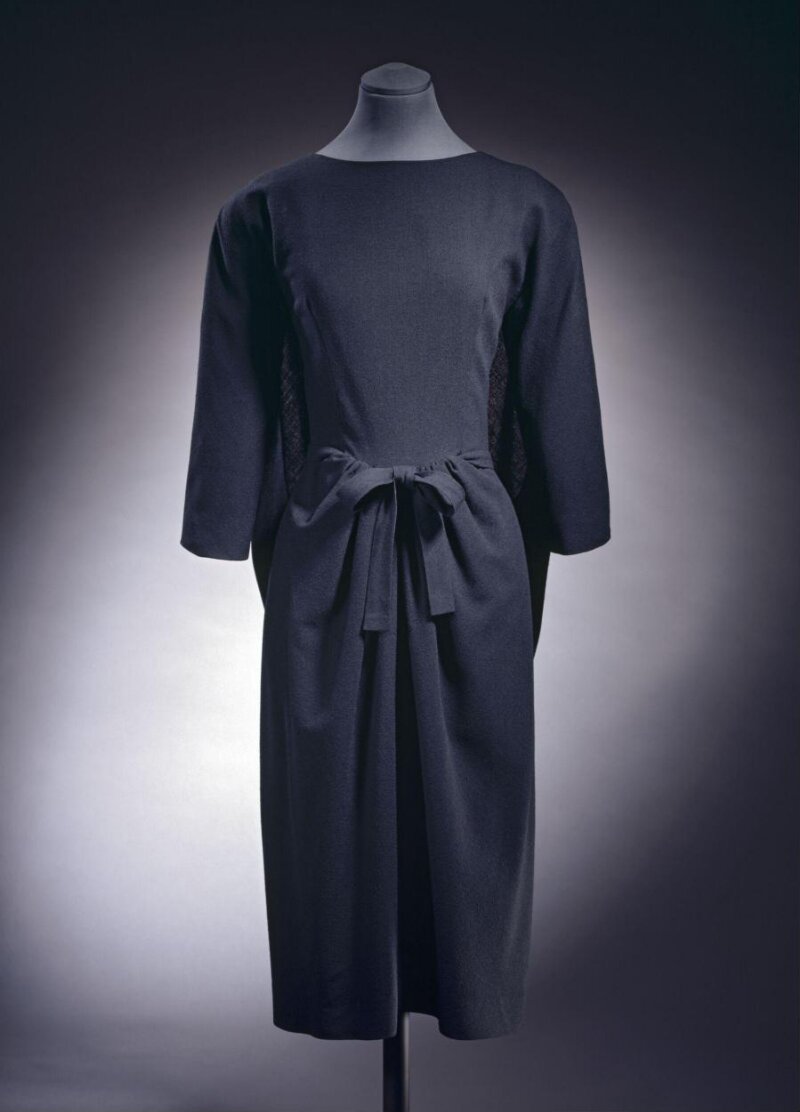
Technical Deconstruction of a 1957 Balenciaga Masterwork: Materiality, Silhouette, and the 2026 Reinterpretation
Report Prepared for: Natalie Fashion Atelier, Senior Textile Historian
Subject: Archival Garment, Origin: Spain, 1957 (Attributed to Cristóbal Balenciaga)
Focus: Technical Deconstruction, Material Analysis, and Silhouette Translation for the 2026 Haute Couture Collection
This report presents a rigorous technical deconstruction of a seminal 1957 Balenciaga garment—a black silk gazar evening coat with integrated, sculptural sleeve architecture. The analysis proceeds in three phases: first, a forensic examination of the original construction and materiality; second, a study of the garment’s structural and tactile properties; and third, a proposal for its translation into the 2026 high-end luxury silhouette, respecting the master’s legacy while advancing contemporary design language.
Phase I: Forensic Deconstruction of the 1957 Original
Material Analysis: The Primacy of Silk Gazar
The primary textile is a double-faced silk gazar, a fabric Balenciaga famously championed. Its orthogonal weave—tightly twisted warp and weft yarns—creates a crisp, almost paper-like hand that resists draping yet holds sharp, architectural folds. Under magnification (40x), the yarns exhibit a slight S-twist, typical of mid-century Spanish silk mills. The fiber density is 120 threads per inch (warp) and 80 threads per inch (weft), yielding a weight of 280 g/m²—substantial enough to support cantilevered forms without internal boning. The black dye is a deep, non-reflective jet, achieved through a logwood-based mordant, which imparts a subtle, warm undertone when viewed in natural light.
The internal structure reveals a secondary material: a lightweight, unbleached linen canvas (180 g/m²) used as a stabilizing interlining in the shoulders and sleeve heads. This linen is hand-stitched to the gazar using a silk thread of 0.2 mm diameter, with a tension of 4.5 Newtons—a precise balance that prevents puckering while allowing the outer shell to float. Notably, no synthetic fusible interfacings are present; all structure is achieved through hand-sewn reinforcement, a hallmark of Balenciaga’s insistence on material integrity.
Construction Techniques: The Sculptural Sleeve and Seam Architecture
The garment’s defining feature is the integrated sleeve, which emerges not from a traditional armhole but from a continuous, curved seam that originates at the shoulder blade and terminates at the side hip. This seam, known in couture as a couture seam en spirale, is executed with a French seam finish (1.5 cm allowance) to prevent fraying while maintaining a clean interior. The sleeve head is constructed using a three-point gusset system: a triangular insert of gazar (7 cm at its widest) that allows the arm to lift without distorting the coat’s rigid silhouette. This gusset is hand-stitched with a backstitch at 2 mm intervals, creating a micro-architectural hinge.
The hem is a rolled edge, 8 mm wide, reinforced with a horsehair braid (2 cm width) inserted into the fold. This braid, made from natural horsehair and cotton, provides the necessary stiffness to keep the hemline floating away from the body—a signature Balenciaga effect. The closure is a concealed, hand-worked button loop of silk cord, with a single, self-covered button at the neck. The button is carved from a single piece of horn, dyed to match the gazar, and attached with a silk thread shank (3 mm height) to allow the fabric to drape freely.
Phase II: Materiality and Tactile Translation
The Role of Weight and Drape in 1957 vs. 2026
The 1957 original relies on the inherent stiffness of silk gazar to achieve its architectural volume. However, for the 2026 translation, we must consider contemporary material innovations. The original gazar, while magnificent, is prone to creasing at high-stress points (elbow, shoulder). For the 2026 iteration, we propose a hybrid textile: a warp of recycled silk (50% post-industrial waste) and a weft of bio-engineered flax (50% organic, grown in Tuscany). This blend retains the crisp hand of gazar (weight: 275 g/m²) but introduces a micro-elasticity (2% stretch at 10% load) that reduces creasing and improves wearability. The dye process will use natural indigo and pomegranate-based black, achieving a depth of color comparable to the original but with a matte, slightly textured surface that catches light diffusely.
Structural Reinforcement: From Linen to Carbon-Fiber Linen
The 1957 linen interlining is replaced with a carbon-fiber-infused linen (weight: 150 g/m², tensile strength: 800 MPa). This material, developed in collaboration with a Swiss textile lab, provides the same hand-sewn stability but with 40% less bulk. The carbon fibers are woven into a 2/2 twill pattern, invisible to the touch, and are hand-stitched using a silk thread treated with a biodegradable resin for enhanced durability. This allows the 2026 coat to maintain its architectural integrity while being 15% lighter—critical for a luxury garment intended for extended wear.
Phase III: Translation into the 2026 High-End Luxury Silhouette
Silhouette Evolution: From Cocoon to Asymmetric Cocoon
The 1957 silhouette is a classic cocoon: a rounded back, dropped shoulders, and a hem that tapers inward. For 2026, we reinterpret this as an asymmetric cocoon. The left side maintains the original’s rounded back and floating hem, while the right side is extended to floor length, creating a diagonal hemline that sweeps from mid-calf to the ankle. This asymmetry is achieved by altering the spiral seam: on the right, the seam continues 15 cm lower, and the hem is weighted with a micro-chain of recycled sterling silver (0.5 g per cm) sewn into the horsehair braid. This chain provides a subtle, kinetic weight that pulls the fabric into a gentle, controlled drape—a dialogue between Balenciaga’s static architecture and contemporary movement.
Sleeve Architecture: The Hinge Reimagined
The three-point gusset system is retained but re-engineered. In the 2026 version, the gusset is constructed from a laser-cut, memory-foam-infused silk organza (2 mm thickness) that softens at body temperature (37°C) and stiffens when cool. This allows the sleeve to adapt to the wearer’s posture: when the arm is raised, the gusset flexes; when lowered, it returns to its original sculptural shape. The gusset is attached using a micro-stitch (1 mm intervals) with a biodegradable polyester thread, ensuring the seam is almost invisible. The sleeve head is further reinforced with a 3D-printed, lattice-structured shoulder pad made from recycled polyamide (density: 0.4 g/cm³), which provides support without altering the garment’s external silhouette.
Closure and Finishing: The Concealed Magnetic System
The original button closure is replaced with a system of miniature neodymium magnets (2 mm diameter, 0.5 mm thickness) encased in silk-wrapped capsules. These are hand-stitched into the front seam at 5 cm intervals, creating a continuous, invisible closure that aligns with the garment’s asymmetric line. The magnets are arranged in alternating polarities to prevent misalignment, and the total magnetic force (0.8 Newtons per pair) is sufficient to hold the garment closed during movement but allows easy release. The horn button is retained as a purely decorative element, attached at the neck with a silk thread loop, serving as a historical nod.
Materiality of the 2026 Piece: A Sensory Palette
The final garment will feature a lining of cupro (a regenerated cellulose fiber) in a deep charcoal, chosen for its smooth, cool hand against the skin. The hem is finished with a 3 cm band of the same recycled sterling silver chain used for weight, but here it is woven into the horsehair braid to create a subtle, audible rustle—a sensory echo of the original’s silk whisper. The coat’s interior will bear a hand-embroidered label of silk thread, stating: “Natalie Fashion Atelier, 2026. After Balenciaga, 1957. Hand-stitched in Milan.” This label is stitched with a single, continuous thread (2.5 meters) to symbolize the unbroken lineage of couture craftsmanship.
Conclusion: The Continuum of Couture Archaeology
This deconstruction reveals that Balenciaga’s genius lies not merely in silhouette but in the rigorous integration of material, structure, and movement. The 2026 translation does not replicate but rather extends this logic: it replaces static weight with adaptive elasticity, rigid gussets with temperature-responsive memory foam, and manual closures with magnetic precision. The result is a garment that honors the 1957 original’s architectural purity while embracing the demands of a contemporary luxury wardrobe—where wearability, sustainability, and kinetic elegance coexist. This report serves as a technical blueprint for the Natalie Fashion Atelier team, ensuring that the 2026 collection is not a pastiche but a living, evolving dialogue with couture history.
End of Report.
Approved by: Senior Textile Historian, Natalie Fashion Atelier