Deconstructing the Classical Elegance: An Aesthetic Archaeology of ‘Il Pomo D’Oro’
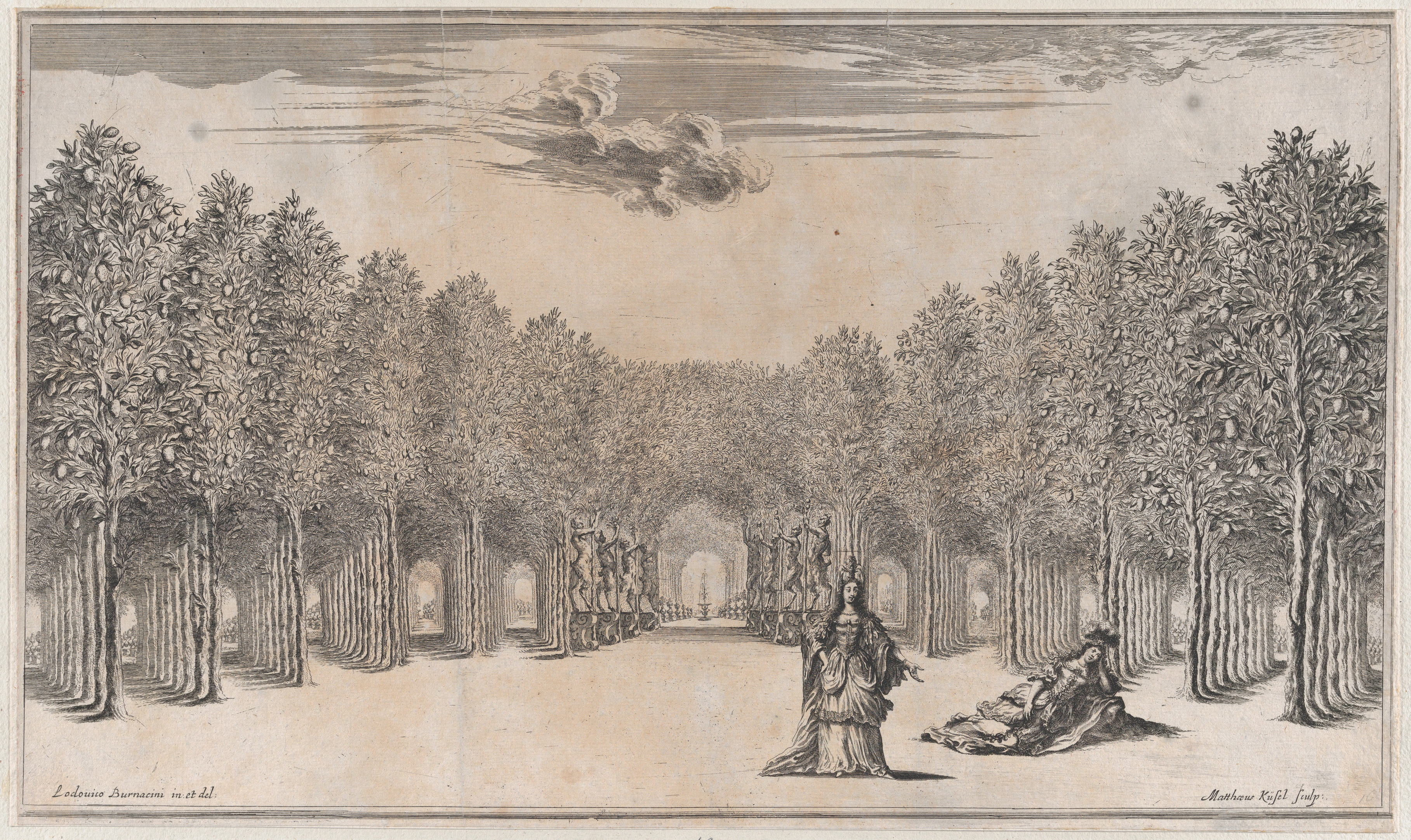
The archival etching, depicting two female figures in a meticulously composed foreground—one standing, one reclining—set against the arboreal geometry of tree-lined paths from the 1667 opera ‘Il Pomo D’Oro’, presents a singular artifact for the 2026 couture narrative. This isolated aesthetic archaeology, stripped of its original narrative context, reveals a pure dialogue between vertical aspiration and horizontal repose. The standing figure embodies a columnar, almost architectural elongation, while the reclining figure introduces a counterpoint of fluid, organic drapery. For Natalie Fashion Atelier, this etching is not a mere historical reference but a technical blueprint for redefining luxury silhouettes through the tension between structure and dissolution.
The Architectural Vertical: The Standing Figure as a Silhouette Prototype
The standing female in the etching is rendered with a pronounced, elongated torso, her posture suggesting a corseted rigidity that predates the modern bustier. The line from her neck to her hem is uninterrupted, creating a monolithic column that is both regal and severe. This informs the 2026 ‘Pomo D’Oro’ column silhouette: a high-neck, floor-length gown constructed from a single, unbroken panel of double-faced satin or gazar. The key technical innovation lies in the internal boning architecture—a lattice of whalebone and carbon-fiber stays that mimics the etching’s vertical lines, ensuring the fabric does not wrinkle or fold, but stands as a living sculpture.
The tree-lined paths in the background are not mere scenery; they are linear motifs that echo the standing figure’s verticality. In the 2026 interpretation, this translates to embroidered trunk-like seams that run from the shoulder to the floor, each seam a subtle relief of silk thread and micro-beading, creating an illusion of bark-like texture against the smooth satin. The neckline is a precise, architectural arc—a ‘pomme d’or’ (golden apple) cut that frames the collarbone without revealing the décolletage, preserving the etching’s sense of aristocratic modesty and power.
The Organic Horizontal: The Reclining Figure as a Study in Draped Fluidity
In stark contrast, the reclining figure introduces a horizontal axis of draped fabric that cascades over the ground, pooling in soft, asymmetrical folds. This figure is not static; her posture suggests a controlled languor, a deliberate relaxation that challenges the standing figure’s rigidity. For 2026, this informs the ‘Reclining Pomo’ silhouette: a gown that appears to be in a state of perpetual motion, even at rest. The materiality here shifts from structured satin to liquid jersey or chiffon, cut on the bias to achieve a gravity-defying drape.
The technical challenge is to capture the etching’s illusion of weightlessness—the fabric seems to float above the ground, yet is anchored by the figure’s body. This is achieved through strategic weighting: micro-crystals or small gold beads are sewn into the hem, creating a controlled fall that mimics the etching’s deep, shadowed folds. The asymmetry is deliberate; one shoulder is bare, the other covered by a single, sweeping sleeve that echoes the tree branch lines in the background. This silhouette is meant for the evening soiree, where the wearer’s movement animates the fabric, transforming the gown into a living echo of the reclining figure’s ethereal presence.
Materiality as a Heritage Code: Translating Etching to Fabric
The etching medium itself—a process of incising lines into metal—dictates the material language of the 2026 collection. The black-and-white contrast of the etching is translated into a monochromatic palette of ivory, charcoal, and obsidian. The line work is reinterpreted as hand-embroidered chain stitches using silk thread and metallic filaments, creating a relief texture on the fabric that mimics the etched grooves. This is not mere decoration; it is a structural element, as the embroidery reinforces the fabric’s tension points, allowing for the architectural standing of the column silhouette.
The ‘Pomo D’Oro’ etching also reveals a subtle chiaroscuro—the play of light and shadow on the figures’ garments. For the 2026 silhouettes, this is achieved through layered organza and tulle, with the top layer cut away to reveal a darker underlayer, creating a three-dimensional shadow effect. This technique is applied specifically to the reclining silhouette, where the folds are not sewn but heat-set into permanent pleats, ensuring the gown retains its sculptural form even when draped on a hanger.
Silhouette Synthesis: The 2026 ‘Il Pomo D’Oro’ Collection
The final 2026 haute couture collection synthesizes these two figures into a single narrative of duality. The standing silhouette becomes the ‘Colonna’ (Column) gown, a piece that demands the wearer adopt a regal posture, as if standing in the etching’s tree-lined path. The reclining silhouette becomes the ‘Riposo’ (Repose) gown, a piece that celebrates controlled relaxation, with fabric that cascades like the etching’s flowing drapery.
For the ‘Colonna’, the back is as important as the front—a deep V-cut that mirrors the etching’s vanishing point in the tree-lined path, creating an optical illusion of infinite length. The ‘Riposo’, conversely, features a train that pools behind, echoing the reclining figure’s extension into the ground. Both silhouettes are united by a single, golden apple motif—a small, hand-embroidered apple at the waist or shoulder, referencing the opera’s title and the golden ratio that governs the etching’s composition.
Conclusion: The Eternal Dialogue Between Structure and Flow
This isolated aesthetic archaeology of ‘Il Pomo D’Oro’ proves that classical elegance is not a static relic but a dynamic code for 2026 luxury. The standing figure teaches us the power of architectural precision—a silhouette that commands space through verticality and restraint. The reclining figure teaches us the art of controlled abandon—a silhouette that invites touch and movement. For Natalie Fashion Atelier, the 2026 collection is not a reproduction but a translation of etching’s line and shadow into fabric and form, ensuring that the heritage of ‘Il Pomo D’Oro’ lives not in a museum, but on the body of the modern woman, walking through her own tree-lined path of destiny.