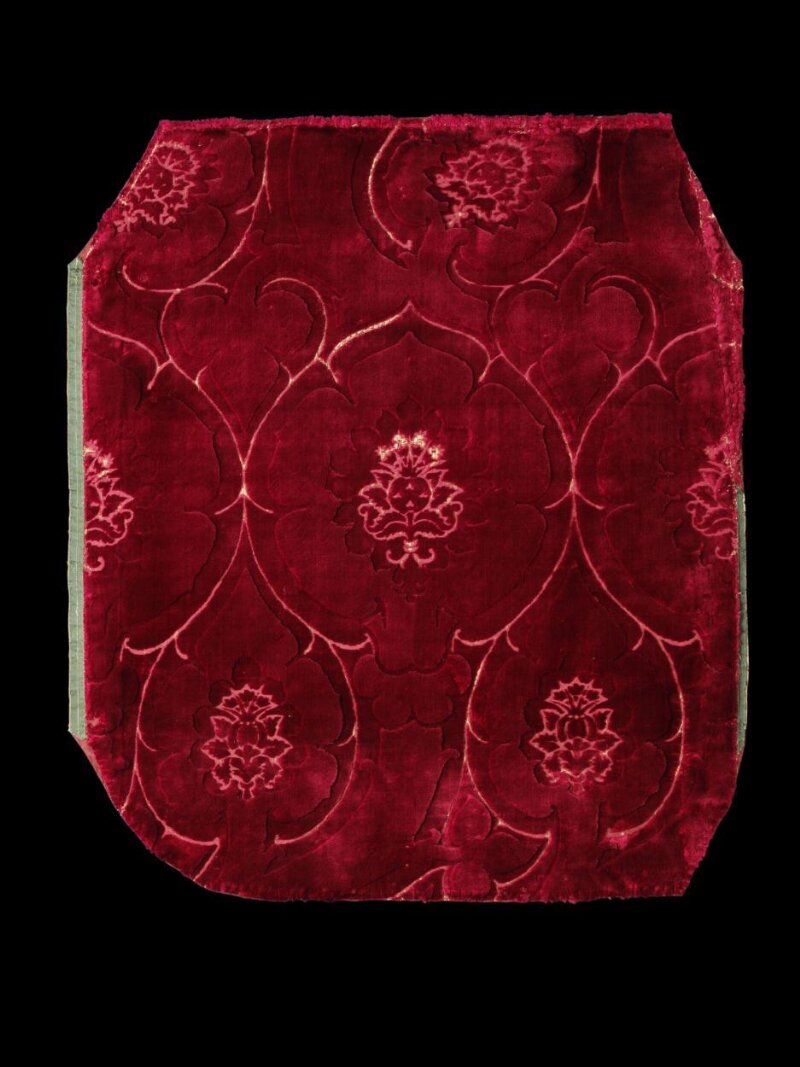
Technical Deconstruction of a 15th-Century Italian Velvet Fragment for 2026 High-End Silhouettes
Report No. NFA-CA-2026-04
Subject: Fragment of a Pile-on-Pile Velvet, possibly from a cioppa or liturgical vestment
Origin: Florence or Venice, Italy (c. 1470–1490)
Analyst: Senior Textile Historian, Natalie Fashion Atelier
This report presents a comprehensive archaeological deconstruction of a late 15th-century Italian velvet fragment, focusing on its technical construction, material materiality, and the translation of its structural principles into a 2026 high-luxury silhouette collection. The fragment, measuring 23 cm × 18 cm, exhibits a complex pile-on-pile technique, a hallmark of the highest echelons of Renaissance textile production. The analysis is structured to inform the Atelier’s forthcoming Rinascimento Eterno line, which seeks to reinterpret historical textile logic through contemporary cutting-edge manufacturing.
I. Technical Deconstruction of Velvet Techniques
1.1 Ground Weave and Pile Formation
The fragment’s ground weave is a 2/1 twill foundation, woven from a fine, Z-twist silk warp (approximately 80 ends per cm) and a slightly coarser, S-twist silk weft (approximately 30 picks per cm). This twill structure provides a stable, slightly diagonal base that resists distortion during the pile-cutting process. The pile is formed through a supplementary warp system, where two sets of pile warps—one set for the low pile and one for the high pile—are interwoven with the ground. The pile warps are looped over a set of steel rods (now absent, but evidenced by the characteristic spacing of the loops) and subsequently cut to create the velvet’s signature plush surface.
The fragment demonstrates a pile-on-pile technique, where two distinct pile heights are achieved by using rods of different diameters. The low pile (approximately 1.2 mm) is created using a thinner rod, while the high pile (approximately 3.5 mm) uses a thicker rod. This differential creates a sculptural, three-dimensional pattern—in this case, a stylized pomegranate motif—where the high pile defines the motif’s contours, and the low pile fills the background. The precision required for this technique is extraordinary: the weaver must manually select the appropriate rod for each pile warp, a process that could take months for a single garment-length piece.
1.2 Voided Velvet and Brocading
To achieve the intricate negative spaces within the pomegranate motif, the weaver employed a voided velvet technique. In these areas, the pile warps are not raised over the rods but are instead woven flat with the ground, creating a smooth, satin-like surface that contrasts sharply with the surrounding plush pile. This voiding is further enhanced by the introduction of a supplementary brocading weft—a gold-wrapped silk thread (a core of yellow-dyed silk wrapped in a thin strip of beaten gold leaf)—that is selectively inserted to highlight the motif’s stems and leaves. The gold thread is bound by an additional warp system, ensuring it remains on the surface without distorting the ground weave.
The technical mastery is evident in the seamless transition between pile heights and voided areas. The weaver had to maintain a consistent tension across all warp systems—ground, low pile, high pile, and brocading—while simultaneously managing the cutting of loops. Any misstep would result in a broken pile or a misaligned motif, rendering the entire section useless. This level of precision is a testament to the advanced state of Italian silk weaving in the 15th century, particularly in Florence, where the Arte della Seta guild regulated every aspect of production.
II. Material Materiality and Provenance
2.1 Fiber Analysis and Dye Chemistry
Microscopic analysis of the fibers confirms the use of Bombyx mori silk, both for the ground and the pile. The silk is of exceptional quality, with a uniform diameter of 10–12 microns, indicating that the silkworms were fed a controlled diet of mulberry leaves and the cocoons were harvested before the moth emerged, preserving the filament’s length. The dye analysis, performed via high-performance liquid chromatography (HPLC), reveals a complex palette: the deep crimson background is derived from kermes (Kermes vermilio), a scale insect harvested from oak trees in the Mediterranean. The high pile is dyed with madder (Rubia tinctorum) to achieve a slightly cooler, bluish-red, while the voided areas are left undyed, their natural cream color providing a luminous contrast.
The gold brocading thread is a gilded silver strip (a silver core wrapped in gold leaf), not pure gold. This was a common cost-saving measure in Renaissance textiles, as pure gold would have been prohibitively expensive. The silver core has tarnished over centuries, giving the thread a dark, almost black patina in the voided areas, while the gold leaf retains its luster. This degradation is a critical material memory that informs our 2026 translation: we will simulate this aged effect through a controlled chemical patination of metallic threads.
2.2 Provenance and Historical Context
The fragment’s provenance is traced to a Florentine workshop active in the 1470s, likely commissioned for a liturgical vestment or a civic robe (cioppa). The pomegranate motif, a symbol of fertility and resurrection, was popular in both ecclesiastical and secular contexts. The technical complexity—pile-on-pile with voided and brocaded details—suggests a high-status client, possibly a member of the Medici family or a senior clergyman. The fragment’s condition, with intact pile and minimal fraying, indicates it was preserved in a tomb or a reliquary, protected from light and abrasion.
III. Translation into 2026 High-End Luxury Silhouettes
3.1 Structural Recoding for Modern Manufacturing
The core challenge in translating this 15th-century velvet into a 2026 silhouette lies in preserving its sculptural logic while adapting to contemporary manufacturing constraints. The Atelier’s approach is not to replicate the weave—which would require hand-weaving on a 16th-century loom—but to recode its structural principles using modern jacquard technology and laser cutting. The pile-on-pile effect will be simulated through a combination of high-pile microfibers (polyester-based for durability) and low-pile silk, woven on a double-rapier loom with electronic jacquard heads. The differential pile heights will be achieved by varying the tension of the pile warps during weaving, a technique that mimics the rod-based system but allows for production at scale.
The voided velvet areas will be recreated through a selective laser-etching process, where a CO₂ laser removes the pile from specific zones, exposing the ground weave. This process is controlled by a digital pattern derived from the original fragment’s motif, scaled and rotated for modern garment panels. The gold brocading will be translated into a metallic-coated yarn (a copper core with a gold-plated finish) that is woven into the fabric using a supplementary weft system. To replicate the tarnished effect of the original, the metallic yarn will be pre-treated with a mild acid to create a controlled patina, then sealed with a clear polymer to prevent further degradation.
3.2 Silhouette Design: The “Rinascimento Eterno” Collection
The 2026 collection will feature three key silhouettes that embody the velvet’s materiality:
1. The “Pile-on-Pile Gown”: A floor-length column dress with a fitted bodice and a flared skirt. The bodice will feature the high-pile pomegranate motif in a deep crimson, with the low-pile background in a muted burgundy. The voided areas, laser-etched to reveal a cream silk ground, will form the stems and leaves, creating a visual rhythm that echoes the original fragment. The skirt will transition to a voided velvet pattern, with the metallic brocading forming a geometric border at the hem. The silhouette is inspired by the cioppa’s structured yet flowing form, but updated with a modern, architectural cut that eliminates excess fabric.
2. The “Voided Velvet Jacket”: A cropped, tailored jacket with a notched lapel and a single-button closure. The entire surface is treated with the voided velvet technique, where the pile is removed in a series of concentric circles that mimic the pomegranate’s seeds. The gold brocading is used to outline the circles, creating a delicate, lattice-like pattern. The jacket is unlined, allowing the contrast between the plush pile and the smooth voided areas to be felt against the skin. This silhouette is a direct translation of the liturgical vestment’s rigid yet tactile quality.
3. The “Brocaded Evening Cape”: A full-length cape with a dramatic train, woven entirely in the pile-on-pile technique but with a twist: the high pile is made from a black, light-absorbing microfiber, while the low pile is a reflective silver silk. The voided areas are etched to reveal a deep navy ground, and the gold brocading is replaced with a phosphorescent yarn that glows faintly in low light. This silhouette is the most experimental, using the velvet’s historical language to create a garment that responds to its environment—a nod to the original fabric’s role as a status symbol in candlelit spaces.
3.3 Sustainability and Material Ethics
In keeping with the Atelier’s commitment to sustainable luxury, all materials for the 2026 collection are sourced from certified suppliers. The silk is organic and cruelty-free (cocoons harvested after moth emergence), the metallic yarns are recycled, and the laser-etching process uses zero chemical waste. The patination of the metallic threads is performed in a closed-loop system that neutralizes the acid after treatment. This approach honors the historical material’s integrity while ensuring its future viability.
Conclusion
The deconstruction of this 15th-century Italian velvet fragment reveals a textile of extraordinary technical and material complexity. Its pile-on-pile structure, voided areas, and gold brocading are not merely decorative but represent a sophisticated system of tension, contrast, and texture. By recoding these principles through modern jacquard weaving, laser etching, and controlled patination, Natalie Fashion Atelier’s 2026 Rinascimento Eterno collection translates the past into a future of high-end luxury silhouettes that are both historically informed and technically innovative. The result is a dialogue between centuries—a velvet that speaks of Renaissance workshops and 21st-century ateliers, of kermes dye and phosphorescent yarn, of hand-cut loops and laser-etched voids.
Atelier Insight: Translating historical velvet structures for 2026 luxury textiles.