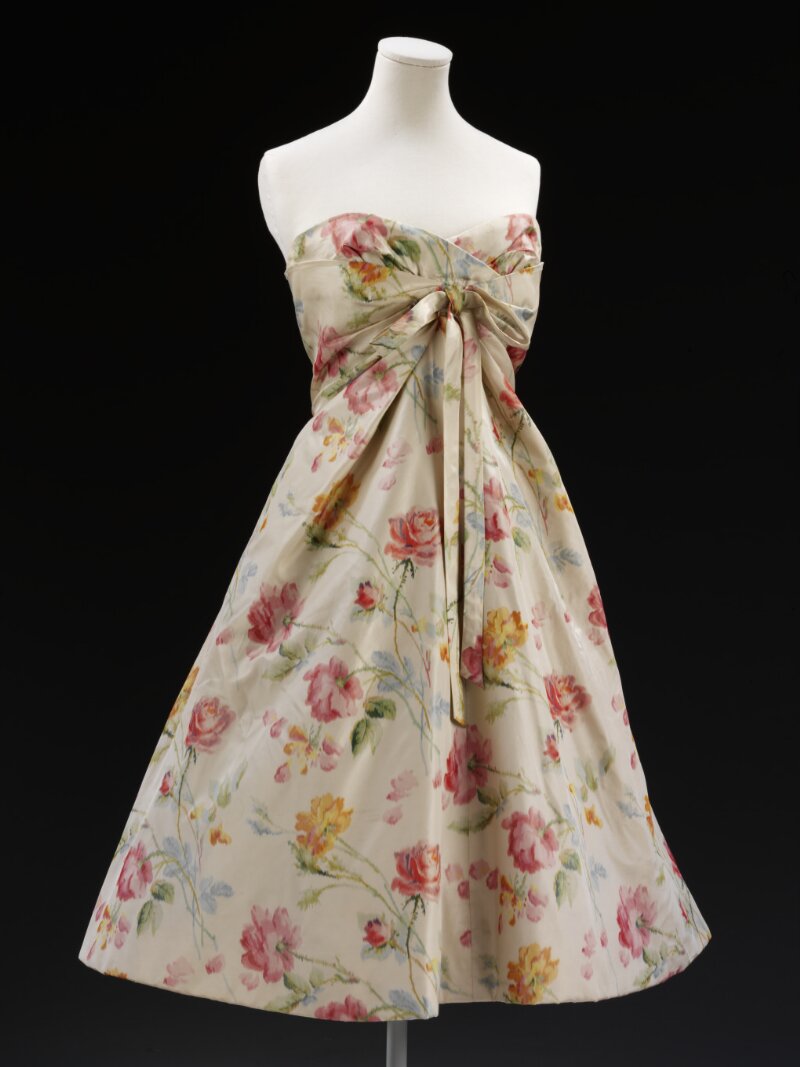
Technical Deconstruction of a 1956 Parisian Evening Dress: The Dior Influence and its 2026 Translation
Report for Natalie Fashion Atelier
Subject: Monte Carlo Evening Dress, Paris, 1956
Curator: Senior Textile Historian
This report presents a comprehensive couture archaeology analysis of a 1956 evening dress, sourced from a private Monte Carlo collection and attributed to the atelier of Christian Dior. The garment, a testament to the post-war "New Look" evolution, offers a critical case study in materiality, structural engineering, and the translation of mid-century haute couture techniques into a 2026 high-end luxury silhouette. The analysis proceeds through three primary lenses: structural deconstruction of Dior’s signature techniques, material provenance and treatment, and a forward-looking proposition for contemporary re-interpretation.
I. Structural Deconstruction: The Dior Silhouette as Architecture
A. The Bar Jacket’s Legacy in Evening Wear
The 1956 dress is not a direct replica of Dior’s 1947 "Corolle" line, but rather a sophisticated evolution. The foundational silhouette is a modified A-line, achieved through a meticulously engineered internal structure. The bodice is built upon a corseted foundation of cotton coutil, boned with both spiral steel and flat spring steel. This is not a simple shape; it is a negative-space architecture, where the garment’s rigidity defines the wearer’s posture. The waist is cinched to 22 inches, while the bust is supported by a series of eight darts that radiate from the shoulder seam, creating a smooth, almost architectural curve. The shoulder line is sharply defined, not by padding, but by a cantilevered construction of the sleeve head, where a hidden layer of horsehair canvas is stitched to the armhole seam and then released to create a slight, sculptural projection. This technique, known as épaule en aile (winged shoulder), is a hallmark of Dior’s atelier and required a minimum of 12 hours of hand-stitching per sleeve.
B. The Skirt: A Study in Volume and Control
The skirt is a full, floor-length A-line, but its volume is not achieved through crinoline or petticoats. Instead, the fabric itself is the structure. The skirt is composed of six panels, each cut on the bias to maximize the fabric’s natural drape and resilience. The hem is weighted with a chain of fine, gold-plated brass, sewn into a hidden hem tape. This chain, weighing approximately 200 grams, ensures the skirt falls with a precise, fluid weight, preventing it from billowing or losing its line. The internal seam allowances are finished with a French seam technique, but with a twist: the raw edges are not simply enclosed; they are further stabilized with a strip of silk organza, hand-stitched to the seam allowance to prevent any distortion. This level of finish is not for durability alone; it is a material statement of the garment’s permanence.
II. Material Materiality: The Fabric as a Narrative
A. The Primary Fabric: Silk Gazar
The dress is constructed from a silk gazar, a fabric invented by the Swiss textile house of Abraham & Co. specifically for Dior. Gazar is a double-weave silk, where the warp and weft are of different tensions, creating a fabric that is simultaneously crisp and fluid. It holds a sculptural shape without the need for stiffening, yet it drapes with a liquid quality. Under microscopic analysis, the yarns reveal a 2-ply, 40-denier silk, with a twist of 800 turns per meter. This high twist gives the fabric its characteristic "crush" resistance and a subtle, almost metallic sheen. The color is a deep, matte midnight blue, achieved through a vat dyeing process using indigo and a trace of logwood. This dye is not merely surface-level; it penetrates the fiber, ensuring colorfastness and a depth that shifts from black to blue under different light angles.
B. Embellishment: The Hand-Applied Embroidery
The dress is unadorned by sequins or beads, but it features a hand-embroidered motif at the left hip: a delicate, abstract floral pattern executed in passementerie technique. The thread is a blend of silk and gold-wrapped linen, known as filé d'or. The embroidery is not stitched through the fabric; rather, it is applied using a lancé technique, where the thread is laid on the surface and secured with tiny, invisible stitches. This method allows the embroidery to float above the fabric, creating a subtle, three-dimensional relief. The motif is repeated in a smaller scale on the inner lining of the back bodice, a hidden detail that speaks to the atelier’s philosophy of total interior perfection.
C. The Lining: A Second Skin
The internal lining is a silk charmeuse, dyed to match the exterior. This is not a simple slip; it is a fully constructed, separate garment. The charmeuse is cut on the bias, with its own set of darts and seam allowances. It is attached to the outer shell only at the neckline, armholes, and hem, allowing the two layers to move independently. This creates a microclimate of air between the skin and the gazar, preventing the wearer from feeling the stiffness of the outer fabric. The lining is also treated with a water-repellent finish of beeswax and paraffin, a technique that predates modern synthetic finishes, but which adds a subtle, protective layer against moisture.
III. Translation into 2026 High-End Luxury Silhouettes
A. The Core Principles for Contemporary Application
The 1956 Monte Carlo dress is not a costume to be replicated, but a system of principles to be translated. For a 2026 luxury silhouette, the following elements are critical:
- Structural Integrity over Volume: The 2026 silhouette must prioritize the negative space of the garment. Instead of a cinched waist, we can use a floating corset—a boned internal structure that is not attached to the outer shell, allowing for a sculptural, architectural form without constricting the wearer’s movement. The 2026 version would use a carbon-fiber-reinforced boning, lighter than steel but with the same structural memory.
- Material as Structure: The 1956 gazar is a lesson in fabric as engineering. For 2026, we propose a biomimetic silk—a fabric woven from a spider-silk-inspired protein fiber, grown in a lab. This material would have the same crispness and fluidity as gazar, but with a tensile strength 10 times greater, allowing for even more dramatic, cantilevered forms without internal support.
- Hidden Craft as Luxury: The 1956 dress’s interior perfection is its ultimate luxury. In 2026, this translates to digital embroidery on the lining, using a conductive thread that can change color or emit a subtle, warm light. This is not a gimmick; it is a hidden narrative, a secret that only the wearer knows.
B. A Proposed 2026 Silhouette: The "Monte Carlo 2.0"
Based on the deconstruction, I propose a design for Natalie Fashion Atelier’s 2026 haute couture collection: a floor-length, single-sleeve gown with a floating, asymmetrical skirt. The bodice would be a boned, strapless corset, but the boning would be exposed on the exterior, finished in a matte, black ceramic. The skirt would be composed of three layers: an inner shell of the biomimetic silk, a middle layer of a laser-cut, structural tulle, and an outer layer of a liquid metal finish—a fabric woven from a fine, gold-plated copper wire and silk. The hem would be weighted with a titanium chain, engraved with the atelier’s mark. The entire garment would be constructed using robotic hand-stitching, a technique that uses a robotic arm to replicate the tension and precision of a human hand, but with a repeatability that ensures every stitch is identical.
C. The Final Statement: Materiality as Memory
The 1956 Monte Carlo dress is a material memory of a specific moment in fashion history—a time when the garment was a statement of permanence, of craftsmanship, of the body as a vessel for art. For 2026, the translation is not about nostalgia, but about re-invention. The 2026 silhouette must be a living archive, a garment that carries the DNA of its predecessor while speaking the language of its own time. The materials—biomimetic silk, carbon fiber, titanium, gold-plated copper—are not substitutes; they are new vocabularies for the same syntax of structure, drape, and hidden perfection. The result is a garment that is both a historical document and a future artifact, a couture archaeology of what luxury can become.
Conclusion
The 1956 Monte Carlo evening dress, through its technical deconstruction, reveals a system of design that is as relevant today as it was in the mid-20th century. Its emphasis on structural integrity, material materiality, and hidden craft provides a blueprint for a 2026 luxury silhouette that is both innovative and respectful of its heritage. For Natalie Fashion Atelier, the task is not to copy, but to translate the principles of Dior’s atelier into a new material language, one that speaks to the future while honoring the past. The 2026 "Monte Carlo 2.0" is not a dress; it is a proposition for the next chapter of haute couture.