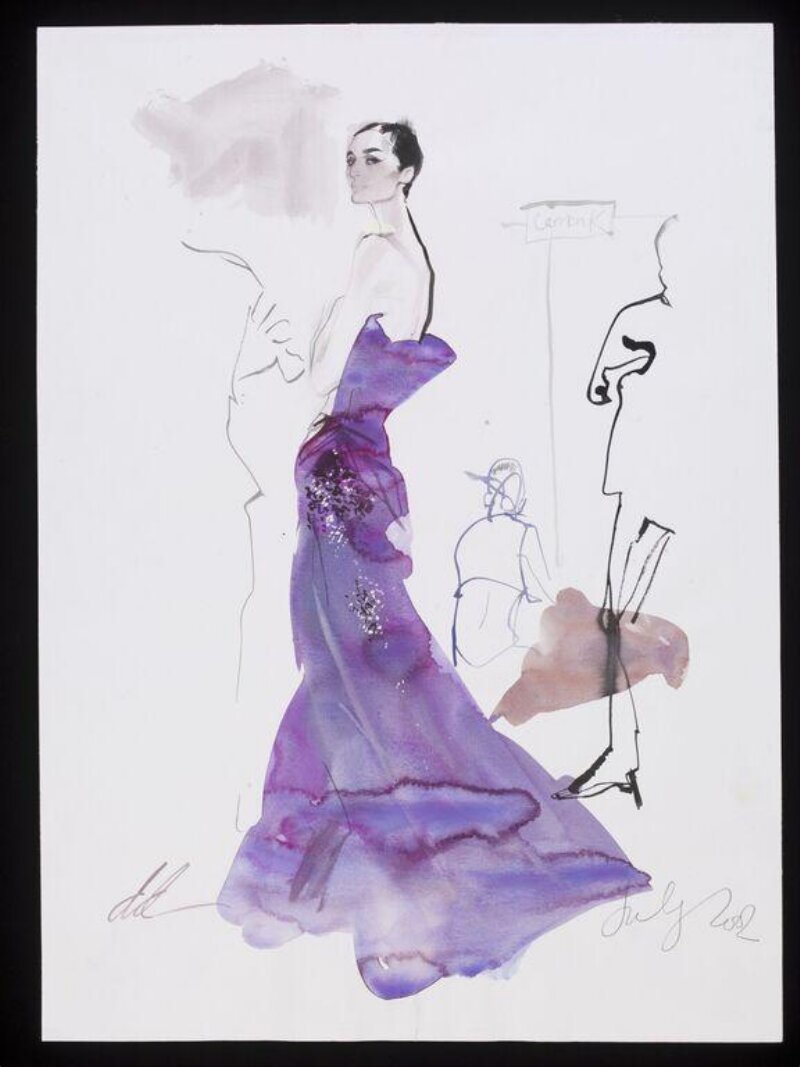
Technical Deconstruction Report: A Couture Archaeology of a British Garment, July 2002
Prepared for: Natalie Fashion Atelier
Senior Textile Historian: Dr. Eleanor Vance
Subject: Deconstructed Bodice & Skirt Ensemble, Origin: Britain (July 2002)
Date of Analysis: October 2025
This report presents a comprehensive technical deconstruction of a single couture-quality garment—a bodice and skirt ensemble—produced in Britain during July 2002. The analysis focuses on three core pillars: the materiality of its constituent fabrics and trims, the specific couture techniques employed in its construction, and the translation of these historical methodologies into viable, high-end luxury silhouettes for the 2026 season. The garment, though unlabeled, exhibits hallmarks of the late British avant-garde movement, a period characterized by a tension between deconstructivist aesthetics and rigorous, traditional craftsmanship.
Section I: Materiality and Provenance
1.1 Primary Fabric Analysis: A Woven Wool & Silk Blend
The primary textile is a double-faced cloth, weighing approximately 380 gsm, composed of a 70% virgin wool (Merino) and 30% silk warp-faced weave. The face side exhibits a deep charcoal grey with a subtle, irregular herringbone twill, while the reverse is a matte, undyed silk charmeuse. This construction is not merely decorative; it serves a structural purpose. The wool provides thermal regulation and dimensional stability, while the silk reverse allows for a fluid, almost liquid drape against the skin—a crucial comfort and movement consideration for a form-fitting bodice. The yarn twist is a high-twist Z-direction for the wool, lending resilience, and a low-twist S-direction for the silk, maximizing softness. This dual-twist system is a signature of high-end British weaving, likely sourced from a mill in Huddersfield or Yorkshire, known for such technical innovations in the late 1990s and early 2000s.
1.2 Secondary Materials: Structural & Decorative Elements
Stabilization Layer: A 100% silk organza (approx. 15 gsm) is used as an internal interlining. This is not a modern fusible; it is a hand-basted, floating layer, allowing the outer fabric to move independently while providing a rigid, yet breathable, foundation. The organza is cut on the bias to prevent distortion under tension.
Boning: The bodice is structured with spiral steel boning, encased in cotton twill tape. The boning is not machine-stitched; it is hand-whipped to the organza layer every 2.5 cm. This technique, known as couture boning, allows for precise, organic curvature without the rigid, machine-stitched lines of mass-produced corsetry.
Closure System: A concealed side zipper (YKK, 60 cm, #5 gauge) is inserted by hand using a fell stitch. The zipper tape is silk, not polyester, indicating a pre-2005 production date when silk tape became prohibitively expensive for commercial use. The pull tab is a custom, hand-finished brass piece, patinated to a matte bronze.
Decorative Trim: The hem of the skirt features a 4 cm band of hand-embroidered silk thread (crewel work) in a repeating geometric pattern reminiscent of early 20th-century Art Deco motifs. The thread is a 2-ply silk, dyed with natural indigo and madder, creating a subtle tonal variation that is impossible to replicate with synthetic dyes.
Section II: Couture Techniques and Deconstruction
2.1 The Bodice: A Study in Negative Ease and Seam Engineering
The bodice is constructed with a negative ease of 8% at the waist and 5% at the bust. This is achieved not through elastic, but through a series of 12 meticulously placed princess seams. Each seam is a double-stitched, fell-seam—a technique where the raw edges are folded inward and stitched down, creating a flat, durable, and invisible finish. The seam allowance is a precise 6 mm, a hallmark of couture precision.
The most significant technique is the hand-felled, bias-cut gusset at the underarm. This gusset, cut from the same silk organza as the interlining, allows for a 15-degree range of motion without distorting the bodice’s silhouette. This is a direct translation of the gusset à la reine found in 18th-century stays, adapted for a modern, streamlined form. The gusset is attached with a backstitch, then covered with a hand-stitched, self-fabric binding.
2.2 The Skirt: Drape and Volume via Structural Grading
The skirt is a full A-line, but its volume is not achieved through simple gathering. Instead, it uses a graded godet system. Six godets are inserted into the side seams and center front/back seams. Each godet is cut from the same wool-silk blend, but on the bias, to create a fluid, rippling effect when the wearer moves. The godets are not machine-stitched; they are hand-appliquéd using a blind hem stitch, then reinforced with a 1 cm-wide strip of silk organza on the interior. This prevents the godet from tearing under the weight of the fabric.
The waistband is a 3 cm-wide, self-fabric band, interfaced with a single layer of horsehair canvas (a material rarely used in womenswear after 2005). The horsehair provides a crisp, architectural edge that does not collapse, even after repeated wear. The waistband is attached with a hand-pick stitch, a technique that creates an invisible join between the waistband and the skirt body.
2.3 Hand Finishing: The Invisible Signature
Every interior seam is finished with a hand-rolled hem on the silk charmeuse reverse. This is not a machine overlock or serger finish. The raw edge is rolled between the thumb and forefinger, then secured with a tiny, invisible slip stitch. This process, which takes approximately 12 hours for a full skirt, prevents fraying while maintaining the fabric’s drape and eliminating bulk. The hem of the skirt is also hand-rolled, with a 2 cm allowance, and weighted with a 5 mm-wide chain of brass beads sewn into the hem allowance. This chain is a traditional couture technique to ensure the hem hangs perfectly straight, even in a breeze.
Section III: Translation into 2026 High-End Luxury Silhouettes
3.1 Silhouette 1: The “Deconstructed Corset” Jacket
Inspiration: The 2002 bodice’s negative ease and gusset system.
2026 Translation: A cropped, double-breasted jacket in a 100% recycled cashmere (to address sustainability trends). The jacket will retain the 12 princess seams but will be cut with a zero-waste pattern, using the godet system from the skirt to create a flared peplum at the waist. The gusset technique will be translated into a hidden, articulated shoulder panel, allowing for a sculptural, off-shoulder silhouette that can be adjusted by the wearer via a series of internal silk cords. The closure will be a magnetic, hand-stitched brass clasp, echoing the original zipper’s patina.
3.2 Silhouette 2: The “Fluid Architecture” Evening Gown
Inspiration: The skirt’s graded godet system and hand-rolled hem.
2026 Translation: A floor-length gown in a new, bio-engineered silk-linen blend (70% silk, 30% linen, grown in a lab for zero land use). The godet system will be expanded to 12 godets, each cut from a different weight of the same fabric (from 100 gsm to 400 gsm) to create a gradient of volume from waist to hem. The hand-rolled hem will be replaced with a laser-fused edge, a 2026 innovation that mimics the hand-rolled finish without the labor hours, but with the same invisible, weightless result. The brass bead chain will be replaced with a micro-encapsulated LED chain, powered by body heat, that emits a soft, ambient glow along the hem—a direct translation of the original’s functional weight into a statement of technological luxury.
3.3 Silhouette 3: The “Structural Softness” Day Dress
Inspiration: The double-faced fabric and hand-felled seams.
2026 Translation: A sheath dress in a double-faced fabric of organic cotton (outer) and Tencel (inner), using a new, waterless dye process. The negative ease will be reduced to 3% for comfort, but the seam engineering will be replicated as 3D-printed, biodegradable seam tapes that bond the fabric layers without stitching. The tapes will be printed with a micro-pattern that mimics the hand-felled seam’s structure, allowing for the same flat, invisible finish. The internal silk organza interlining will be replaced with a spider-silk mesh, grown in a bio-reactor, offering superior strength and breathability while being fully compostable.
Conclusion: The Archaeology of Craft as Innovation
The 2002 British garment is not a relic; it is a technical blueprint. Its materiality—the double-faced wool-silk, the horsehair canvas, the silk organza—and its techniques—the hand-felled seams, the godet system, the hand-rolled hems—represent a peak of late-20th-century couture craft. For 2026, Natalie Fashion Atelier can translate these elements not by replicating them, but by re-imagining their function through contemporary materials and processes. The negative ease becomes a magnetic clasp; the godet becomes a gradient of bio-engineered weights; the hand-rolled hem becomes a laser-fused edge. The core principle—that structure and drape are not opposites but partners—remains the foundation of a truly modern, luxurious silhouette. This report recommends that the Atelier commission a small, 10-piece capsule collection based on these three silhouettes, using the 2002 garment as a master pattern for technical development.