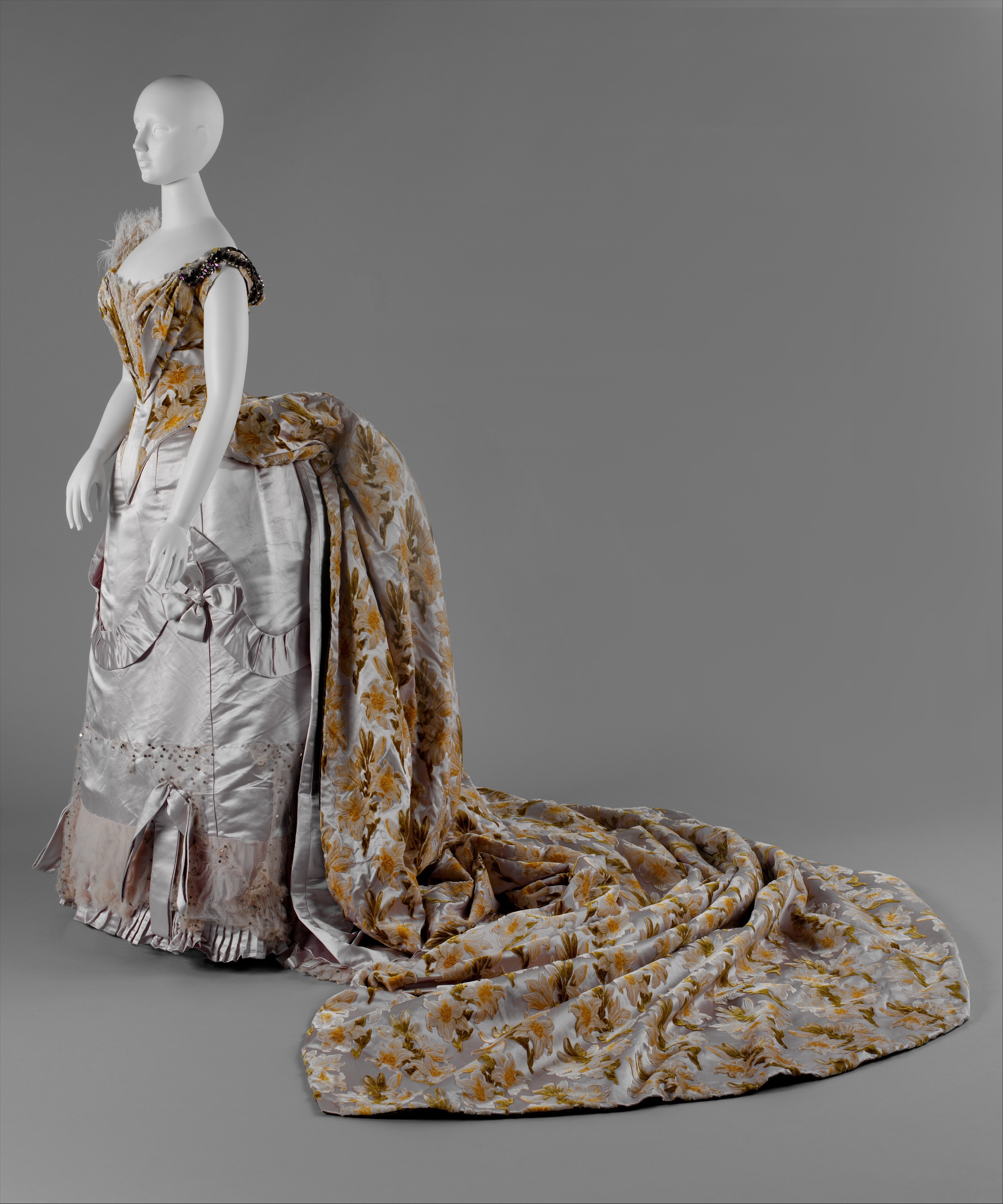
Archaeology of Opulence: Deconstructing the Court Presentation Ensemble
Within the rarefied archive of French sartorial history, the court presentation ensemble stands as a supreme artifact of codified elegance. It is not merely a garment but a complex instrument of social navigation, a three-dimensional manifesto of lineage, power, and aesthetic hierarchy. For Natalie Fashion Atelier, engaging in isolated aesthetic archaeology—divorcing the object from its specific historical narrative to focus purely on its formal and material language—reveals a profound blueprint for 2026 luxury. The prescribed materiality of silk, metal, feathers, and glass provides a technical lexicon through which we can deconstruct classical elegance and project its distilled principles onto the future silhouette.
Structural Sovereignty: The Architecture of Silhouette
The foundational elegance of the court gown lies in its imposed architecture. The rigid bodice, often boned with baleen or early metals, and the expansive skirt supported by panniers or crinolines created an unmistakable, authoritative silhouette. This was elegance defined by space-claiming volume and impeccable posture. For 2026, this translates not into historical replication but into a philosophy of structural sovereignty. We foresee luxury silhouettes built upon internal architectures of technical innovation: lightweight, flexible 3D-printed lattice cages that sculpt the torso, and hip-mounted frameworks of carbon fiber or resin-coated silk that create intentional, geometric volume. The elegance is in the engineered form itself—a modern exoskeleton that dictates a poised, commanding carriage, echoing the unyielding grace of the courtier.
Material Dialectics: Silk, Metal, and the Modern Tension
The ensemble’s material palette establishes a masterful dialectic between softness and rigidity, delicacy and permanence. Silk—the quintessential luxury fiber—represented fluidity, luminosity, and sensual touch. Metal, in threads, embroideries, and structural elements, introduced strength, reflection, and permanence. This tension is the core of a sophisticated material narrative for 2026. We advance this dialogue through hybrid materiality. Silk organza is fused with microscopic metallic meshes, granting it a permanent, sculptural crispness. Liquid silk satin is embroidered with fused glass beads and laser-cut metal foils that create armor-like textures on fluid foundations. The interplay is no longer merely decorative but molecular, creating fabrics that are paradoxically ethereal and structural, capturing light and form with equal authority.
The Semiotics of Embellishment: Feathers and Glass as Narrative Code
Feathers (ostrich, marabou) and glass (beads, sequins) served as the primary codes of magnification and luminosity. Feathers added kinetic volume and a sense of otherworldly lightness, often denoting elevated status. Glass captured and multiplied candlelight, creating a personal halo. In the 2026 context, these elements are reinterpreted through a lens of techno-naturalism and amplified luminosity. Feathers are ethically sourced and treated with nano-coatings for iridescent color shifts, or are replicated through laser-cut silk gazar layers that mimic their pneumatic volume with precision. Glass is superseded by lab-grown crystals with superior refractive indices, and by micro-LED filaments woven directly into silk jacquard, allowing for garments that emit light. Embellishment becomes an active, luminous field, not mere decoration.
Deconstructed Hierarchy: From Monolithic Ensemble to Modular Luxury
The court ensemble was a complete, hierarchical system: from the foundational gown (a) to the separate accessories (b-l). This modularity, though prescribed, informs a contemporary principle of articulated dressing. The 2026 luxury wardrobe will comprise not a single garment, but a curated system of interoperable pieces. A sleek, structural silk-metal column dress (e, f) becomes a canvas for a detachable, feather-and-metal "halo" collar or bustle (g). Lightweight metal-mesh sleeves (b-d) or articulated silk-trains (h-l) can be attached via magnetic closures or technical hooks, allowing the wearer to architect their silhouette for different contexts. This empowers a new personal ceremony, echoing the ritual of court dressing through a lens of modern, customizable luxury.
Conclusion: The 2026 Silhouette—A New Court of Personal Ceremony
The isolated archaeology of the court presentation ensemble yields a potent formula for the future: Sovereign Architecture + Material Dialectic + Luminous Code + Modularity. The 2026 silhouette informed by this heritage is one of assertive calm and intelligent opulence. It is a silhouette that commands space through engineered form, engages the senses through paradoxical textiles, captivates through active light, and adapts through a modular mindset. For Natalie Fashion Atelier, this research posits that the future of haute couture lies not in abandoning its classical roots, but in reverse-engineering their first principles. The new court is not a palace hall but the global stage of individual expression; the new presentation is a continuous performance of personal power, dressed in the re-coded elegance of history's most rigorous craftsmanship.