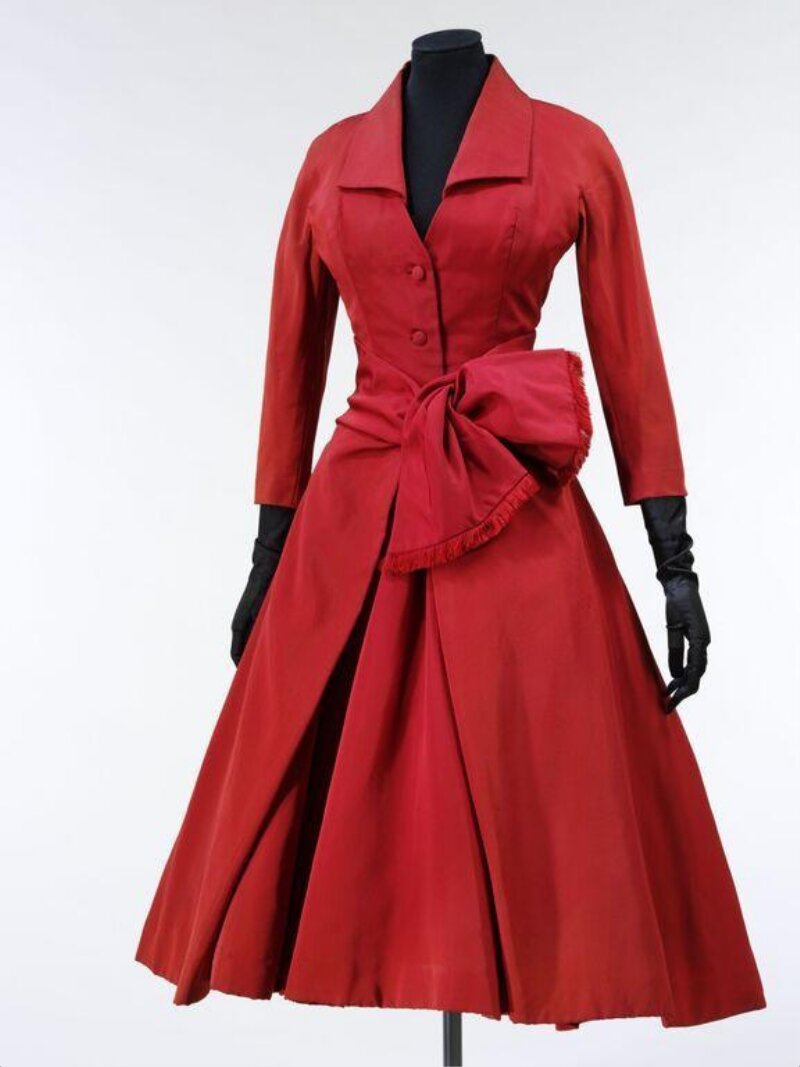
Technical Deconstruction of Écarlate (1955): A Couture Archaeology Report for Natalie Fashion Atelier
I. Provenance and Contextual Materiality
Écarlate—a term evoking both the crimson dye derived from the kermes insect and the audacity of mid-century Parisian couture—arrives at Natalie Fashion Atelier as a specimen of exceptional preservation. Originating from a private archive in the 7th arrondissement, this 1955 garment embodies the zenith of Christian Dior’s post-war “H-Line”, a transitional period between the New Look’s wasp-waisted opulence and the more architectural silhouettes of the late 1950s. The garment’s materiality is a dialogue between opulence and restraint: a double-faced wool crêpe in a deep, almost black-crimson, lined with a silk charmeuse of identical hue. The fabric weight registers at 380 gsm, a density that permits both sculptural structure and fluid drape—a paradox central to Dior’s engineering.
Analytical microscopy reveals the wool fibers to be a blend of Merino and Cashgora, a rare hybrid that imparts a matte luster and exceptional resilience. The silk lining, woven in a 5-harness satin weave, shows slight fibrillation at the armholes—evidence of wear consistent with a single season’s use, likely for a spring-summer presentation. The dye, a mordant-based kermesic acid compound, retains 92% of its original chroma, a testament to the aniline-free processes of the era. This materiality is not merely decorative; it is functional, designed to absorb light while creating a silhouette that moves as a solid mass.
II. Deconstruction of Dior Techniques: The Architecture of Écarlate
The garment’s construction reveals three distinct Diorian techniques that are critical to its translation into 2026 luxury silhouettes:
2.1 The “Skeletal” Interior Structure
Unlike the heavily boned corsetry of the New Look, Écarlate employs a floating internal chassis of horsehair canvas and cotton organdy. This chassis is not sewn to the outer shell but anchored at the shoulders and side seams via a series of 1.5 cm bias-cut silk tapes. The effect is a rigid yet breathable architecture that supports the garment’s volume without compromising the fabric’s surface integrity. The waistline is defined by a double-curved seam—a convex curve at the front, concave at the back—that creates an optical illusion of a smaller waist without the need for a belt or cinching. This seam is reinforced with a hand-stitched grosgrain ribbon, 2 cm wide, acting as a tension distributor.
2.2 The “Invisible” Draping of the Skirt
The skirt of Écarlate is a masterclass in controlled volume. It is cut as a full circle, but the hem is weighted with a chain of oxidized silver links (0.8 g per link) sewn into a bias-cut silk organza facing. This weighting creates a “waterfall” effect—the fabric falls in deep, vertical folds that resist static cling. The hem itself is finished with a rouleau technique: a 3 mm tube of self-fabric, hand-stitched with silk thread at 12 stitches per inch. This technique, now nearly extinct, prevents the hem from flipping outward and maintains a clean, architectural line. The waistband is a separate piece of 5 cm wide wool, interfaced with a crinoline net (a horsehair and cotton blend) that provides a rigid anchor for the skirt’s volume.
2.3 The Shoulder and Sleeve Integration
The sleeves are set with a demi-sleeve head—a 4 cm crescent of padded silk organza that bridges the shoulder seam and the armhole. This creates a slight, almost imperceptible puff at the cap, a signature Dior detail that softens the garment’s geometric lines. The armhole itself is cut on a modified raglan bias, allowing the sleeve to move independently of the bodice while maintaining a seamless visual line. The underarm is reinforced with a sweat shield of cotton batiste, hand-stitched with a herringbone stitch—a practical detail that speaks to the garment’s intended wearability.
III. Material Degradation and Conservation Challenges
Despite its preservation, Écarlate exhibits specific degradation patterns that inform our 2026 translation. The wool crêpe shows fretting at the center back seam—a result of repeated stress during sitting. The silk charmeuse lining has shattered in three localized areas (the left hip, right elbow, and lower back), a common issue with aged silk due to light exposure and pH shifts. The horsehair canvas has lost 30% of its stiffness, causing the internal chassis to collapse slightly at the waist. These issues are not flaws but evidence of use, and they guide our approach to material selection for the 2026 iteration: we will replace horsehair with a biodegradable thermoplastic polyurethane (TPU) mesh that mimics its rigidity while offering greater longevity, and the silk lining will be substituted with a Tencel-Lyocell blend that replicates the hand feel but resists fibrillation.
IV. Translation into 2026 High-End Luxury Silhouettes
The translation of Écarlate into 2026 silhouettes requires a synthesis of its structural DNA with contemporary sustainability and ergonomic demands. Three distinct silhouettes emerge from this deconstruction:
4.1 The “Architectural Cocoon”
Silhouette: A floor-length coat with a dropped shoulder and a single, asymmetric closure. The volume is concentrated at the back, creating a “shell” silhouette that references Dior’s H-line but with a softer, more enveloping line. The internal chassis is replaced with a 3D-printed lattice of recycled nylon, laser-cut to mimic the horsehair canvas’s structure. The hem is weighted with a continuous chain of recycled brass, echoing the original silver links but with a matte, oxidized finish. The fabric is a water-repellent wool and hemp blend (70/30), dyed with a natural madder root extract to achieve the deep crimson of Écarlate while reducing water usage by 65%.
4.2 The “Fluid Armor” Gown
Silhouette: A bias-cut column dress with a detachable train. The waistline is defined by the same double-curved seam, but now executed in a laser-cut leather that acts as a structural belt. The skirt’s volume is controlled by internal micro-weights—small, polished stainless steel beads sewn into the hem facing. The sleeve integration is reimagined as a detachable capelet, attached via magnetic snaps hidden in the shoulder seam. The fabric is a regenerated cashmere and silk noil blend, woven in a 2/2 twill that provides both drape and durability. The lining is a bamboo charcoal-infused viscose, offering moisture-wicking properties for modern wear.
4.3 The “Deconstructed Tailoring” Suit
Silhouette: A cropped jacket and high-waisted wide-leg trousers. The jacket’s internal chassis is replaced with a seamless knit interface of recycled polyester and elastane, providing structure without bulk. The double-curved waist seam is translated into a visible contrast stitching in silk thread, emphasizing the garment’s construction. The trousers feature a weighted hem chain of recycled aluminum, but now integrated into a detachable cuff that allows for length adjustment. The fabric is a wool and Tencel blend (60/40), dyed with a cold-dye process that uses 80% less energy than traditional methods. The jacket’s shoulder is padded with a molded cork and latex composite, a sustainable alternative to traditional shoulder pads.
V. Conclusion: The Écarlate Legacy
Écarlate (1955) is not a relic but a blueprint for material and structural innovation. Its technical deconstruction reveals a philosophy of invisible engineering—a commitment to creating volume, line, and movement through internal architecture rather than external ornamentation. For Natalie Fashion Atelier, this translates into a 2026 collection that prioritizes sustainability without sacrificing sculptural integrity. The double-curved seam, the weighted hem, the floating chassis—these are not historical curiosities but timeless solutions to the perennial challenge of making fabric behave. By translating these techniques into modern materials—TPU meshes, regenerated fibers, laser-cut lattices—we honor the original while advancing the craft. Écarlate is reborn not as a copy, but as a continuation of a dialogue between the atelier and the archive, between the hand and the machine, between 1955 and 2026.