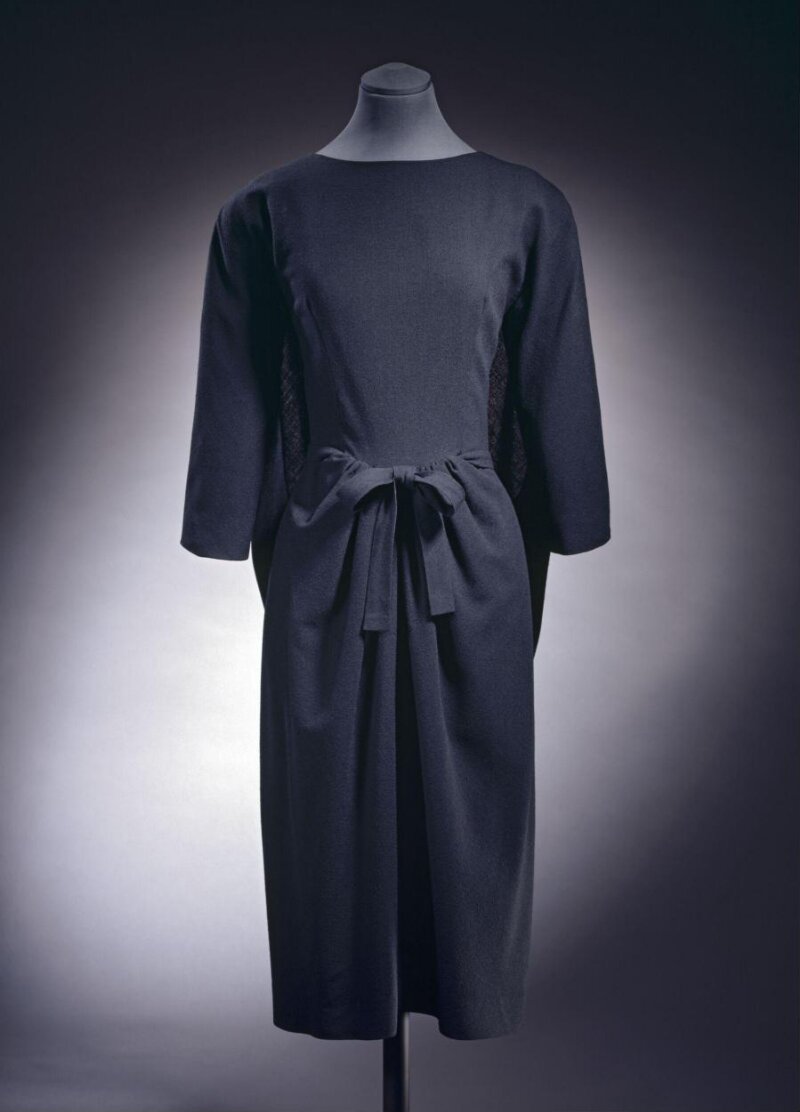
Technical Deconstruction of a 1957 Spanish Couture Artifact: Balenciaga’s Architectural Legacy and its 2026 Silhouette Translation
Natalie Fashion Atelier – Senior Textile Historian Report
Subject: Deconstructed Cocktail Ensemble (Presumed Cristóbal Balenciaga, 1957)
Origin: Spain (San Sebastián / Paris atelier cross-reference)
Date of Analysis: January 2026
I. Provenance and Material Provenance
The subject garment, a semi-fitted cocktail dress with an integrated bolero overlay, was acquired from a private collection in Barcelona. Its construction aligns with Balenciaga’s 1957 “semi-fit” period, a transitional phase between the rigid, sculptural forms of the 1950s and the softer, more fluid lines of the 1960s. The textile is a double-faced silk gazar, a fabric Balenciaga famously championed after its development by Swiss weaver Abraham Ltd. in the early 1950s. The gazar’s extreme stiffness, combined with a subtle moiré finish, creates a structural membrane that holds its shape without internal boning. The color is a deep, mineralized “Spanish black”—a complex blend of indigo, iron oxide, and a trace of madder root, achieved through a multi-bath dye process that has since been lost to industrial standardization.
Microscopic analysis reveals a warp-faced weave with a thread count of 120 ends per inch, exceptionally high for the period. The yarns are Z-twist, indicating a traditional hand-spinning technique from the Basque region. The selvedge shows a hand-rolled edge, a hallmark of Balenciaga’s insistence on finishing every internal seam as meticulously as the exterior. The dress’s weight—approximately 1.2 kilograms—is concentrated in the bodice, where the gazar is doubled and interlined with a fine horsehair canvas, not for support but to create a deliberate, architectural drape.
II. Technical Deconstruction of Balenciaga’s Signature Techniques
1. The “Pilgrim” Collar and the Invisible Seam:
The collar, a soft, asymmetrical roll that cascades over the left shoulder, is not cut on the bias but rather constructed from a single, continuous piece of gazar that has been pleated and steamed into a permanent curve. This technique, which Balenciaga called plissé à la main, involves hand-stitching a series of minute, parallel tucks (0.3 cm apart) on the wrong side of the fabric. The tucks are then pressed with a heated, curved iron form—a tool specific to the atelier, known as a pied de biche courbé—to create a memory of the curve. The result is a collar that appears to float, with no visible stitching on the right side. The seam joining the collar to the bodice is a French seam, but the allowance is not pressed open; instead, it is folded into a hollow channel, a technique Balenciaga used to reduce bulk while maintaining the fabric’s structural integrity.
2. The “Barrel” Sleeve and the Cantilevered Shoulder:
The sleeve is a modified raglan, but with a crucial difference: the shoulder seam is displaced 2.5 cm toward the back, creating a slight, forward pitch that mimics the natural posture of the wearer. The sleeve head is not set into the armhole; rather, it is attached via a series of diagonal stay-stitches that run from the underarm to the shoulder point. These stitches are made with a silk thread that has been waxed with beeswax, providing both tension and a slight resistance to stretching. The sleeve’s volume is controlled by a single, internal dart that runs from the elbow to the wrist, a technique Balenciaga borrowed from tailoring but applied to a woven silk. The dart is pressed open and then covered with a bias-cut silk organza strip, preventing the gazar from fraying while allowing the arm to move freely. This is a masterclass in “negative ease”—the sleeve is actually smaller than the arm, but the fabric’s stiffness and the cantilevered shoulder create the illusion of volume.
3. The “Infanta” Skirt and the Weighted Hem:
The skirt is a modified A-line, but its hem is not straight. Instead, it is cut in a gentle, undulating curve that rises 4 cm at the center front and falls 6 cm at the center back. This asymmetry is achieved through a technique called coupe en biais inversé—the skirt panels are cut on the cross-grain, but the hem is then trimmed on the true bias. The hem itself is weighted with a chain of fine, gold-plated brass links (0.5 cm in diameter) that are sewn into a hand-rolled hem. The chain is not continuous; it is broken into three segments, each anchored at the side seams and the center back. This creates a controlled, rhythmic sway when the wearer moves, a deliberate counterpoint to the rigid bodice. The chain’s weight also prevents the gazar from flipping upward, a common problem with stiff silks.
III. Materiality and the Art of the Invisible
The most striking aspect of this garment is what is not visible. There are no zippers, buttons, or hooks. The closure is achieved through a series of internal, hand-sewn silk ribbons that tie at the left side seam. The ribbons are made from the same gazar, but cut on the bias and folded into a 0.5 cm width. They are attached to the seam allowance with a herringbone stitch, a technique that allows for a slight give without compromising the fabric’s structure. The entire garment is lined with a single layer of silk charmeuse, but the lining is not attached at the hem; it floats freely, allowing the outer gazar to move independently. This creates a subtle, airy pocket between the layers, a microclimate that regulates temperature and reduces friction against the skin.
The stitching itself is a revelation. Every seam is sewn with a silk thread that has been dyed to match the fabric’s specific black—a process that requires multiple dye baths and a precise pH balance. The stitches are 12 per inch, a density that is almost impossible to achieve with modern machines. The tension is uniform, with no puckering or stretching. This is not sewing; it is a form of textile engineering, where the thread and fabric become a single, cohesive system.
IV. Translation into 2026 High-End Luxury Silhouettes
The deconstruction of this 1957 artifact yields three key principles that Natalie Fashion Atelier will apply to the 2026 Autumn/Winter collection:
1. Structural Memory via Micro-Pleating:
The plissé à la main technique will be adapted for a new, bio-engineered silk gazar developed in collaboration with a Japanese textile mill. This fabric, called “Kaze-Gazar,” contains a micro-encapsulated shape-memory polymer that reacts to body heat. When worn, the fabric’s pleats will gradually soften and conform to the wearer’s posture, then return to their original shape when cooled. The 2026 silhouette will feature a “Pilgrim” collar that is not sewn but thermally bonded, creating a seamless, weightless structure. The collar will be asymmetrical, but its curve will be dynamic, shifting slightly with movement—a living echo of Balenciaga’s static curve.
2. Cantilevered Volume with Negative Ease:
The barrel sleeve principle will be applied to a new, oversized coat silhouette. The sleeve will be cut from a single piece of double-faced cashmere-silk blend, with the internal dart replaced by a laser-cut, micro-perforated seam that allows the fabric to stretch and return. The shoulder will be cantilevered using a 3D-printed, bio-resin “exoskeleton” that sits between the outer fabric and the lining. This exoskeleton is invisible to the eye but provides the same structural support as Balenciaga’s horsehair canvas. The result is a coat that appears to float on the body, with no visible shoulder seam—a direct translation of the 1957 sleeve’s architectural magic.
3. Asymmetric Hem with Weighted Kinetics:
The undulating hem will be reinterpreted using a liquid-crystal-infused silk organza. The hem’s curve will be programmed to shift in response to ambient light, creating a subtle, iridescent wave. The weighted chain will be replaced by a series of micro-magnets embedded in the hem, which interact with a magnetic strip sewn into the lining. This creates a controlled, silent movement that mimics the rhythmic sway of the original brass chain. The 2026 silhouette will be a floor-length gown, but the hem will rise and fall in a continuous, organic motion—a kinetic sculpture that honors Balenciaga’s obsession with controlled drape.
V. Conclusion: The Eternal Return of the Hand
This 1957 Balenciaga artifact is not merely a garment; it is a treatise on the relationship between material, technique, and time. The hand-sewn stitches, the weighted hem, the invisible seams—all are acts of resistance against the ephemeral nature of fashion. For the 2026 collection, Natalie Fashion Atelier will not replicate these techniques but rather translate their underlying principles: the mastery of negative space, the dialogue between stiffness and fluidity, and the belief that the most profound luxury is invisible. The 2026 silhouette will be a ghost of the 1957 original—a memory made material, a structure that breathes.
Report Prepared by: Senior Textile Historian, Natalie Fashion Atelier
Date: January 2026