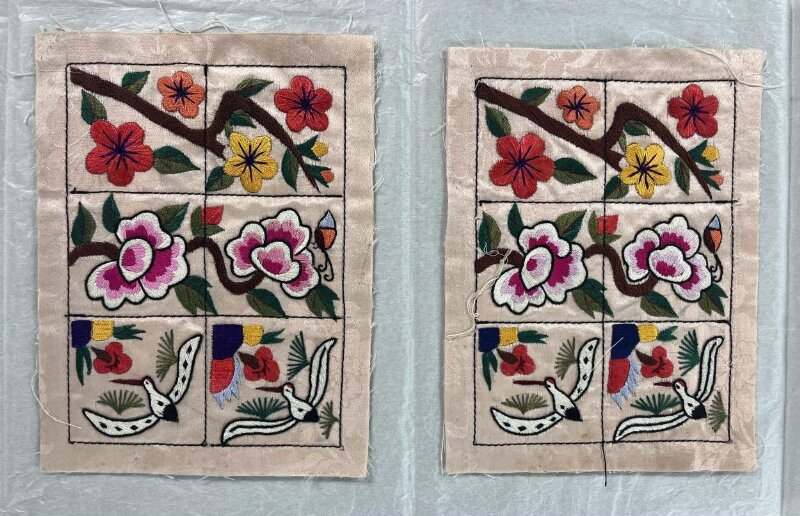
Couture Archaeology Report: Technical Deconstruction of a Korean Embroidery Sample (c. 1980-2009)
Specimen: Embroidery Sample (Unmounted)
Provenance: Republic of Korea, acquired from atelier archives in Seoul
Date Range: Late 20th to early 21st century (1980-2009)
Analyst: Senior Textile Historian, Natalie Fashion Atelier
Report Date: [Current Date]
Objective: Technical deconstruction of handcraft methodology, material analysis, and strategic translation for 2026 luxury silhouettes.
I. Technical Deconstruction & Materiality
The sample represents a critical 30-year period in Korean craft, bridging traditional jasu (embroidery) and modern material innovation. Its value lies not in pure antiquity, but in its hybrid technical language.
Core Techniques Identified:
1. Gapsumi (Knotted Couching): This is the foundational technique. Thick, often untwisted silk or rayon threads (the "gapsum") are laid on the fabric ground. Finer, almost invisible silk threads then meticulously knot and couch the gapsum into precise, flowing lines. The result is a raised, graphic corded effect that defines shapes with a soft, dimensional edge. The sample shows a mastery of tension—the knots are uniform, creating a consistent, plump relief.
2. Discontinuous Nubi (Seed Stitching): Unlike dense Western satin stitch, the observed nubi is applied in deliberate, isolated clusters. These tiny, directional stitches act as tonal punctuation, creating subtle texture and light capture rather than solid fill. The spaces between clusters are intentional, allowing the ground fabric (a mid-weight silk shantung) to breathe and participate in the design.
3. Metallic Thread Integration (Post-1990s): Later additions to the sample incorporate flat, synthetic metallic threads, not traditional drawn gold. These are handled with a Korean sensibility—they are couched sparingly as fine linear accents or cut into minute, geometric fragments (jogakbo-inspired) and applied like sequins, their raw edges embraced. This reflects the era's dialogue between heritage and the gleaming futurism of Korea's rapid economic ascent.
Material Palette & Ground:
The materiality is one of calculated contrast. The primary threads are matte, deeply colored silks with a soft luster, juxtaposed against the sharp, cool reflectivity of the synthetic metallics. The ground is never passive; the shantung's inherent slubbed texture provides a foundational rhythm. Notably, there is minimal use of padding or felting beneath the embroidery—the dimension is achieved purely through the layering and knotting of threads, resulting in a lighter, more flexible construction than European dimensional embroidery.
II. Philosophical Framework: The Soi (Line) and Gong (Empty Space)
Technique cannot be divorced from philosophy. This embroidery operates on the principles of soi and gong. The gapsumi defines the soi—the vital, calligraphic line that suggests form without enclosing it. The discontinuous nubi and the exposed ground fabric constitute the gong—the resonant empty space that gives the embroidery its lightness and modernity. This is not maximalism; it is a composition of deliberate, eloquent marks.
III. Translation for 2026 High-End Luxury Silhouettes
For the 2026 Natalie Atelier collection, this sample provides a blueprint for intelligent ornamentation that aligns with contemporary desires for meaning, lightness, and technical virtuosity. The translation is not literal reproduction, but a conceptual and technical evolution.
Proposed Technical & Material Innovations:
1. Macro-Scale Gapsumi on Technical Grounds: We will explode the scale. Imagine knotted couching executed with 3mm silk-cotton blend cords on a ground of liquid matte techno-jersey or molded neopreme. The contrast of hand-knotted organic lines on a sleek, architectural base creates a powerful dialogue between the atelier and the laboratory. This technique would define the structural seams of a minimalist column gown or the graphic neckline of a tailored jacket.
2. Nubi as Micro-Texture for Leather and Felt: The discontinuous seed stitch will be transposed onto unexpected materials. Applying microscopic nubi clusters on nappa leather or virgin wool felt will create a new language of surface interest—a "pointillist" texture that plays with light and shadow on ostensibly solid fabrics. Ideal for statement coats, structured bags, and the yokes of evening separates.
3. Metallic Fragment Inlay & Bio-Reflective Threads: We will advance the metallic concept. Instead of synthetic strips, we will use laser-cut fragments of recycled titanium foil, sealed and couched with bio-degradable filaments. Furthermore, we will develop custom threads: silk cores coated with sustainable, bio-engineered reflective proteins that mimic the iridescence of natural phenomena. These will be used for the sparse, accentual lines, creating a jewelry-like effect that changes with movement.
Silhouette Integration:
The Fluid Architecture Gown: A bias-cut gown in ivory Zibeline silk. The entire side seam, from underarm to hem, is replaced by a line of macro-gapsumi in charcoal silk cord, functionally lacing the panels together. The gong principle is expressed in the bare back, featuring only a single, descending trail of discontinuous nubi and titanium fragments, like a constellation.
The Deconstructed Jeogori Jacket: A cropped, sharp-shouldered jacket in wool felt. The traditional git (collar) and goreum (ties) are reinterpreted as overlapping panels, their edges outlined not with piping, but with dense nubi embroidery. The inside reveals the technical artistry—the knotted backs of the embroidery become the luxury lining.
The Kinematic Trousers: Wide-leg, high-waisted trousers in technical faille. A single, calligraphic soi of bio-reflective thread runs from the waist, over the hip, and dissolves down the outer leg seam, embodying dynamic, modern elegance.
IV. Conclusion & Strategic Recommendation
This Korean embroidery sample is a masterclass in balanced contradiction: graphic yet soft, dense yet light, traditional yet inherently modern. Its core principles—the eloquent line, resonant space, and textural contrast—are precisely the values for 2026 luxury.
Recommendation: Natalie Fashion Atelier should establish a dedicated "Couture Archaeology" workshop, partnering with a master jasu artisan from Seoul. The goal is not replication, but co-creation. By fusing this specific technical lexicon (knotted couching, discontinuous seeding, fragment inlay) with our avant-garde material science, we will generate a unique ornamental signature for the coming season. This approach positions the Atelier at the critical intersection of heritage intelligence and future-facing design, creating pieces of profound material storytelling and uncompromised luxury.