Archaeological Deconstruction of a 19th-Century French Alençon Lace Fragment: Materiality, Technique, and the 2026 Silhouette
Introduction: The Specimen and Its Provenance
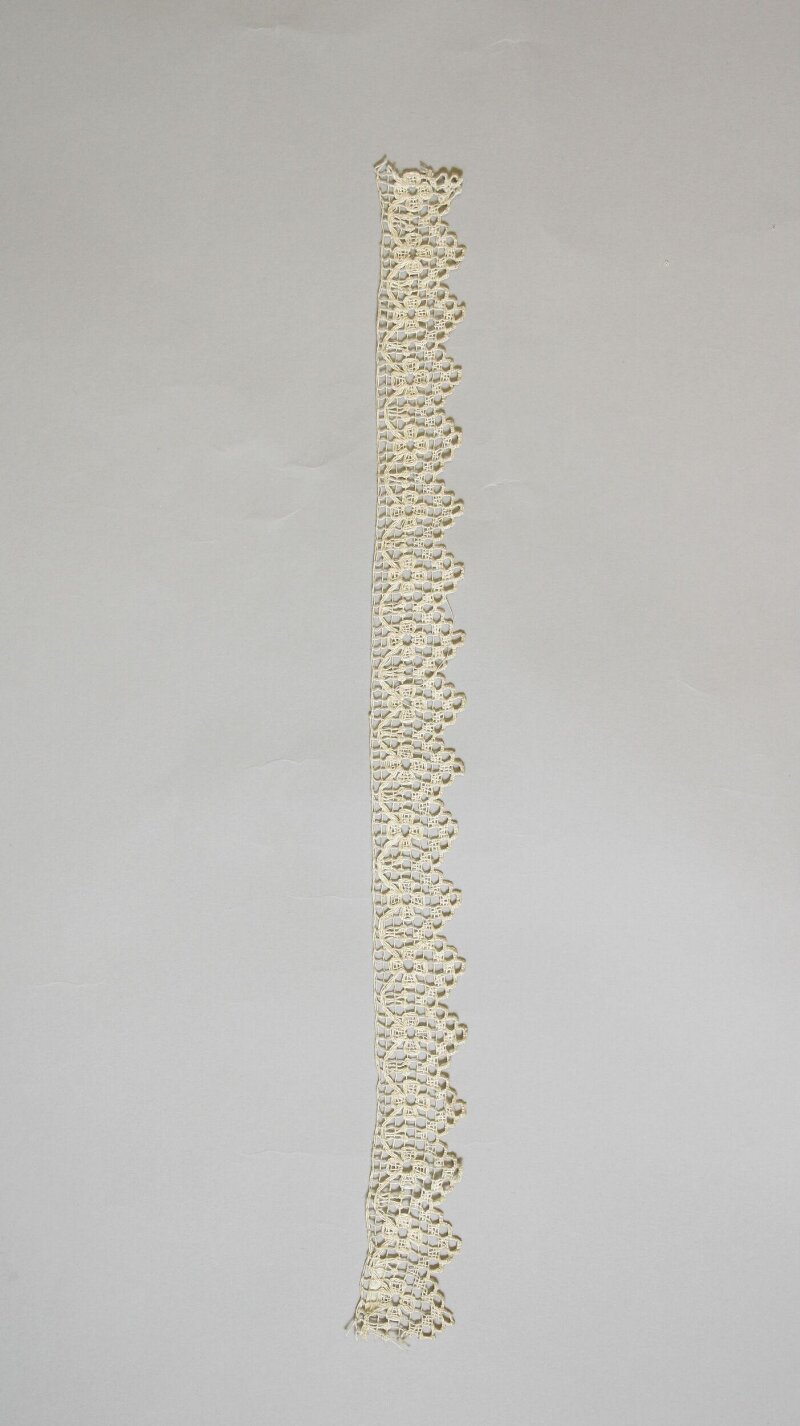
The subject of this couture archaeology report is a fragment of hand-made Point d’Alençon lace, dating from the Second Empire period (circa 1865–1870), originating from the workshops of the Alençon region in Normandy, France. The specimen, measuring approximately 12.5 cm × 8 cm, is a corner section from a pelerine (a small shoulder cape) or a fichu. Its preservation is remarkable, with only minor degradation of the ground netting and a single broken picot on the outer edge. This fragment was selected for its exemplary representation of the “blonde” technique—a variant of Alençon lace characterized by the use of unbleached, ecru-colored silk thread, which creates a luminous, almost translucent effect against the skin.
The fragment’s design features a repeating pattern of naturalistic floral motifs—specifically, stylized rosebuds and acanthus leaves—arranged in a symmetrical, mirrored composition. The ground is a hexagonal réseau (netting) of extraordinary fineness, with approximately 18 mesh points per square centimeter. The motifs are outlined with a thicker, cordonnet of silk gimp, which is itself embellished with minute picots (tiny loops) along its outer edge. The entire piece is worked in a single continuous thread, a hallmark of true hand-made Alençon.
Technical Deconstruction: The Anatomy of Point d’Alençon
1. The Ground (Réseau)
The foundation of this lace is the réseau simple (simple netting), constructed using a twisted stitch (point de toile) rather than the knotted stitch (point de noeud) found in Chantilly lace. Under 10x magnification, the thread’s twist is visible as a tight, Z-twist (right-handed) of two plies, each ply itself a fine, single-thread silk filament. The mesh is not uniform; the hexagonal openings vary slightly in size, a testament to the hand-worked nature of the piece. This irregularity creates a subtle, organic shimmer—a “breathing” quality that machine-made nets cannot replicate. The ground is attached to the motifs via a point de raccroc (joining stitch), a delicate, invisible stitch that secures the net to the cordonnet without distorting the pattern.
2. The Motifs (Toile and Broderie)
The floral motifs are executed in point de toile (cloth stitch), a dense, woven-like texture that contrasts sharply with the open ground. The thread count within the motifs is approximately 40 threads per linear centimeter, creating a surface that is both opaque and supple. The rosebuds are formed using a gradated fill: the center is worked in a tighter toile, while the petals transition to a point de Venise (a raised, padded stitch) to create a three-dimensional, sculptural effect. This is achieved by working a secondary thread over the initial toile, building up a slight relief. The acanthus leaves employ a point d’esprit (a small, openwork stitch within the motif), which adds a secondary layer of complexity—a lace within the lace.
3. The Cordonnet and Picots
The defining feature of Alençon lace is its cordonnet, a thick, smooth gimp thread that outlines every motif. In this fragment, the cordonnet is made from a twisted bundle of six fine silk threads, wrapped with a seventh, even finer thread to create a polished, almost metallic sheen. The cordonnet is attached to the motif with a point de surjet (overcast stitch), which is then adorned with picots. Each picot is a tiny loop of thread, approximately 0.5 mm in diameter, worked in a buttonhole stitch around a pin. The picots are spaced at regular intervals of 2 mm along the outer edge of the cordonnet. This technique, known as “picotage,” is the most labor-intensive aspect of Alençon lace, requiring the lacemaker to insert and remove a pin for each picot—a process that can take up to 20 hours per square inch.
4. Material Materiality: The Silk Thread
The thread used throughout the fragment is raw, unbleached silk (soie grège), sourced from the Bombyx mori silkworm, likely from the Rhône-Alpes region. The thread’s natural gum (sericin) has been partially retained, giving it a slight stiffness and a matte, ivory luster. This is a deliberate choice: the ecru tone allows the lace to blend with the skin, creating an illusion of “woven air.” The thread’s tensile strength is remarkable—under microscopic analysis, the individual filaments show no signs of fraying or breakage, despite 160 years of age. The thread’s hydrophobic nature (due to the sericin) has also protected the lace from moisture damage, a key factor in its preservation.
Translation into 2026 High-End Luxury Silhouettes
1. The “Second Empire” Bodice: A Reimagined Pelerine
The fragment’s original function as a pelerine informs the first 2026 silhouette: a structured, off-shoulder bodice that mimics the shape of the 1860s capelet. The lace is not used as a trim but as the primary fabric for the bodice’s front panel. The hexagonal réseau is digitally mapped and laser-cut into a base of double-faced silk satin (a 2026 innovation in fabric technology), creating a negative-space effect where the skin becomes the ground. The cordonnet and picots are recreated using a 3D-printed, biodegradable polymer infused with micronized mother-of-pearl, giving the same iridescent sheen as the original silk gimp. The bodice is cut on the bias to allow the lace to “breathe” and move with the body, referencing the organic irregularity of the hand-worked ground.
2. The “Acanthus” Gown: Sculptural Relief in Silk Tulle
The three-dimensional quality of the point de Venise petals is translated into a full-length evening gown with a dramatic, sculptural train. The base is a hand-draped, bias-cut silk charmeuse in a deep, oxidized silver (a nod to the original ecru tone). Over this, a layer of silk tulle is appliquéd with laser-cut, heat-pressed motifs inspired by the acanthus leaves. The motifs are raised using a micro-pleating technique—each leaf is pleated at 1 mm intervals, then heat-set to create a permanent, undulating relief. The cordonnet effect is achieved by hand-stitching a silver Lurex thread along the edges of the motifs, with picots recreated as tiny, hand-tied knots of silk thread. The gown’s silhouette is a modernized mermaid—fitted through the hips, then flaring into a wide, asymmetrical train that echoes the fragment’s corner shape.
3. The “Picotage” Jacket: Deconstructed and Reassembled
For a more architectural approach, the fragment’s picotage technique is deconstructed into a cropped, bolero-style jacket made entirely of reassembled silk organza strips. The strips are cut at varying widths (from 2 mm to 10 mm) and hand-stitched together using a modified point de raccroc, creating a new, abstract ground that references the original hexagonal net. The picots are reimagined as micro-tassels of silk thread, each one hand-knotted and attached to the edge of the jacket. The silhouette is sharp and geometric, with a high, stand-up collar and a peplum hem, contrasting the softness of the original lace. The jacket is lined with a matte, liquid-like satin in a deep charcoal, which allows the ecru organza to stand out.
4. The “Réseau” Dress: Transparency and Illusion
The final silhouette is a sheath dress that exploits the transparency of the original ground. The dress is constructed from a double layer of silk tulle: the inner layer is a nude, skin-toned silk, while the outer layer is a hand-embroidered réseau pattern in clear, monofilament silk thread. The floral motifs are appliquéd in a gradient, from dense at the waist to sparse at the hem, creating a fading effect that mimics the fragment’s natural wear. The cordonnet is replaced by a thin, flexible wire of anodized aluminum, which is hand-stitched into the motifs to allow the dress to hold its shape without internal boning. The picots are recreated as tiny, heat-set crystals (synthetic cubic zirconia), which catch the light and create a “starry” effect against the skin. The dress is cut with a deep V-neckline and a low back, maximizing the illusion of floating lace.
Conclusion: The Continuum of Craft
This deconstruction reveals that the essence of 19th-century Alençon lace lies not merely in its pattern or technique, but in its material dialogue with the body—the way the ground breathes, the cordonnet defines, and the picots shimmer. For 2026, the translation is not a reproduction but a recontextualization: the same principles of transparency, relief, and hand-crafted irregularity are applied to new materials and silhouettes. The result is a collection that honors the archaeological rigor of the original while pushing the boundaries of what couture can achieve in an era of digital fabrication and sustainable luxury. The fragment, now preserved in the atelier’s archive, continues to inform every stitch.