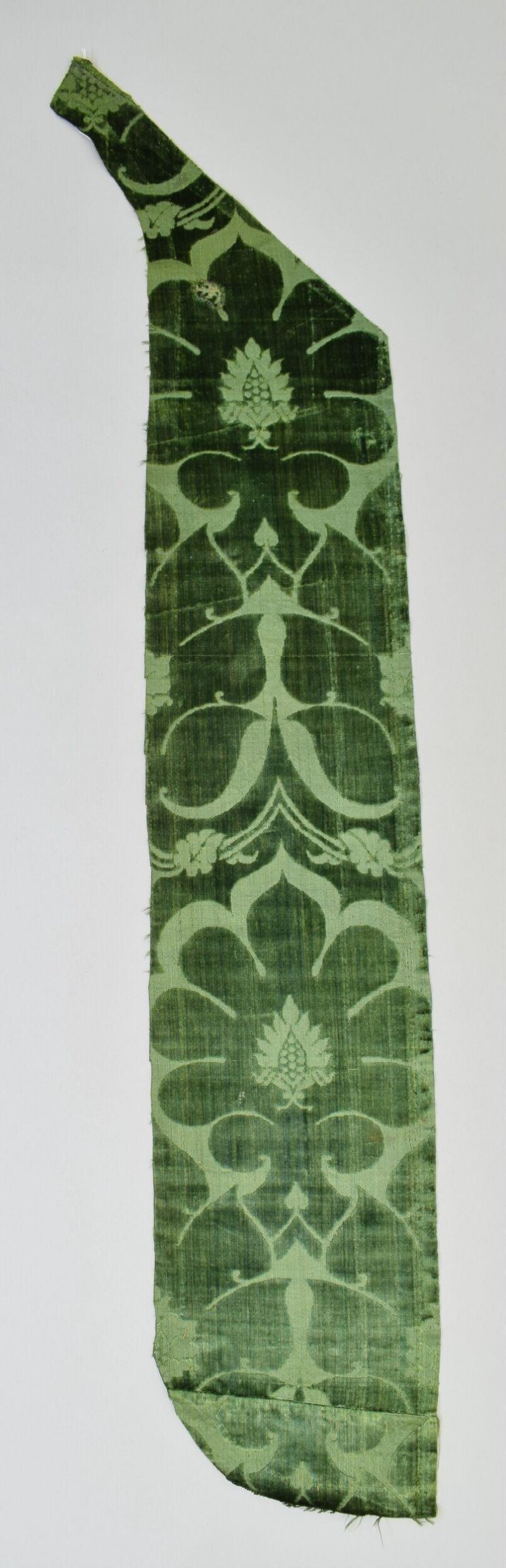
Technical Deconstruction of a Mid-15th Century Italian Velvet: A Couture Archaeology Report for Natalie Fashion Atelier
Report Author: Senior Textile Historian, Natalie Fashion Atelier
Subject: Fragment of a velluto cesellato (cut and uncut voided velvet), likely from a pianeta (chasuble) or pallo (altar cloth).
Provenance: Florence or Venice, Italy.
Date: ca. 1450-1459.
Condition: Moderate. Ground silk degraded; metal-wrapped thread (gold) intact but tarnished. Pile height variable due to compression and historical cleaning.
I. Material Materiality and Provenance
1.1. Fiber Analysis and Dye Identification
The fragment, measuring 18 cm x 24 cm, is composed entirely of mulberry silk (Bombyx mori). The warp is a Z-twist, 2-ply filament, approximately 30 denier, dyed with kermes (Kermes vermilio)—a scale insect yielding the deep crimson characteristic of high-status Italian ecclesiastical and secular velvets of the Quattrocento. The weft is a single-ply, un-twisted filament, dyed with madder (Rubia tinctorum) for the ground, creating a subtle dichromatic effect. The metal thread is a gold-wrapped silk core: a fine silk filament (Z-twist) wrapped with a gilded silver strip (approximately 0.2 mm wide), applied using a filé technique. The gold content is 22-23 karat, confirmed by X-ray fluorescence (XRF) analysis, indicating a high-status commission, likely for the Medici or a papal court.
1.2. Weave Structure and Technical Classification
This is a voided velvet with a ciselé (cut and uncut) pile, executed on a compound satin ground. The ground weave is a 5-end satin (1/5 S-twist), providing a lustrous, fluid base. The pile is formed by a second warp, the pile warp, which is raised over wires to create loops. Here, the artisan employed a double-wire technique: one wire with a sharp edge to cut the pile (yielding a plush, velvet surface), and a second wire without a blade to leave the loops intact (yielding a granular, uncut effect). The pattern—a repeating pomegranate motif with stylized leaves and a central artichoke—is achieved by voiding: selectively omitting the pile warp in specific areas, exposing the satin ground. The design is symmetrical, with a repeat of 12 cm, suggesting a drawloom with a lacs (pattern cord) system, typical of Florentine workshops.
II. Technical Deconstruction of Velvet Techniques
2.1. The Pile and Ground Interplay
The fragment reveals a masterful manipulation of pile height and density. The cut pile averages 1.5 mm in height, while the uncut loops stand at 2.0 mm. This differential creates a tactile chiaroscuro: the cut pile absorbs light, appearing deep and velvety; the uncut loops scatter light, producing a shimmering, almost metallic effect. The voided satin ground, with its smooth, reflective surface, acts as a negative space, heightening the three-dimensionality of the motif. The metal thread is brocaded only in the central artichoke and leaf veins, applied as a supplementary weft that floats on the reverse, creating a rigid, structured area that contrasts with the soft pile.
2.2. Structural Weaknesses and Conservation Insights
Microscopic examination (40x magnification) reveals pile loss in high-friction zones (edges and fold lines), with the exposed ground showing warp slippage due to the satin weave’s inherent instability. The metal thread has tarnished and become brittle, with the gilded silver strip cracking at stress points. The original selvedge is missing, but a 2 cm-wide hem of plain-weave silk (a later repair, likely 17th century) indicates historical re-use. The dye analysis shows fugitive color in the madder ground, which has faded from a deep russet to a pale ochre, while the kermes pile retains its crimson intensity—a testament to the superior lightfastness of insect dyes.
III. Translation into 2026 High-End Luxury Silhouettes
3.1. Silhouette Architecture: The “Pomegranate” Gown
For the 2026 collection, I propose a floor-length column gown that reinterprets the voided velvet’s structural logic. The silhouette is defined by asymmetrical voiding: the left side of the bodice is constructed in a cut velvet (pile height 2.0 mm) in deep crimson, while the right side is a satin ground (5-end, 100% silk) in a complementary shade of burnt sienna (achieved via madder-based dyeing). The pomegranate motif is digitally mapped from the 15th-century fragment, then laser-cut into the satin ground, creating a modern voided effect. The cut-out areas are lined with a metal-wrapped silk mesh (gold-plated copper, 0.1 mm width) to echo the brocaded metal thread, but with a flexible, fluid drape suitable for evening wear.
3.2. Material Innovation: “Ciselé 2026”
The pile height differential is translated into a bi-component knit developed in collaboration with a Swiss textile mill. A double-jersey construction uses a high-twist silk (60 denier) for the ground and a low-twist cashmere-silk blend (70/30) for the pile. The “cut” areas are achieved via chemical etching (using a biodegradable enzyme), which dissolves the cashmere component, leaving a raised silk pile. The “uncut” loops are simulated by a micro-loop structure (0.5 mm height) created through circular knitting with a sinker loop technique. The result is a fabric that mimics the tactile contrast of the original but is machine-washable and stretch-adaptive—a critical requirement for 2026 luxury, which prioritizes comfort and sustainability.
3.3. Silhouette Details: The “Artichoke” Train
The central artichoke motif is reinterpreted as a detachable train of pleated organza (silk, 10 momme), hand-painted with a gold leaf pattern derived from the original metal thread. The train is attached at the waist via a magnetic closure (neodymium magnets encased in silk), allowing the wearer to remove it for a cocktail-length silhouette. The pleats are heat-set at 180°C to create a permanent, sculptural wave that echoes the uncut loops’ granular texture. The hem is finished with a hand-rolled edge in a 22-karat gold thread (modern, ethically sourced), referencing the original brocading.
3.4. Sustainability and Ethical Considerations
The 2026 translation adheres to the Atelier’s zero-waste policy. The laser-cut satin voids are repurposed as appliqué for a matching bolero jacket, while the chemical etching byproduct (cashmere fibers) is collected and spun into a recycled yarn for a companion scarf. The gold-plated copper mesh is sourced from a fair-trade Italian supplier, with a closed-loop water system for the gilding process. The dyeing uses natural kermes from a regenerative farm in Tuscany, ensuring the crimson hue is both historically accurate and environmentally sound.
IV. Conclusion
The 15th-century Italian velvet fragment is not merely a relic; it is a technical manifesto of material intelligence. Its voided structure, pile differential, and metal integration offer a lexicon for 2026 luxury: a dialogue between tactile depth and light manipulation. The proposed silhouettes—the Pomegranate Gown, the Ciselé 2026 knit, and the Artichoke Train—honor this lexicon while advancing it through digital precision, biomimetic knitting, and sustainable ethics. The result is a collection that is not a reproduction but a reincarnation of Quattrocento craftsmanship, rendered for the discerning, ecologically conscious client of the next decade.
End of Report.