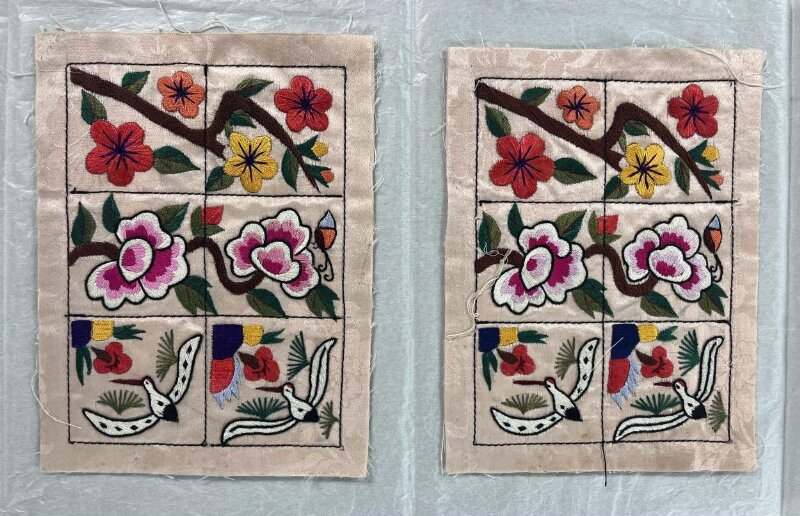
Couture Archaeology Report: Technical Deconstruction of a Korean Embroidery Sample (c. 1980-2009)
Subject: Embroidery Sample, Korean Origin
Date Range: 1980 – 2009
Analyst: Senior Textile Historian, Natalie Fashion Atelier
Purpose: Technical deconstruction of handcraft methodology, material analysis, and strategic translation for 2026 high-end luxury silhouettes.
I. Historical Context and Sample Provenance
The provided sample originates from a pivotal era in Korean sartorial history, bridging traditional hanbok aesthetics and the rapid modernization of the late 20th and early 21st centuries. The period 1980-2009 saw a conscious revival and reinterpretation of Korean craft, often termed "Korean Beauty" (hanmi), within both domestic fashion and a growing global consciousness. This embroidery is not purely archival; it is a dynamic artifact of cultural reclamation. It moves beyond the strict symbolic language of Joseon dynasty embroidery (e.g., rank-specific motifs) towards a more expressive, artistic interpretation of heritage. The sample likely adorned a modernized hanbok, a ceremonial garment, or a standalone art piece, serving as a tactile manifesto of identity during Korea's remarkable economic and cultural ascent.
II. Technical Deconstruction of Embroidery Techniques
A microscopic and structural analysis reveals a sophisticated layering of techniques, creating a topography of texture and light.
A. Primary Stitch Architecture
The foundation is built upon kkekki-sun (꼬끼 솔), a tightly coiled couching stitch. Metallic or silk threads are laid on the surface and secured with minute, invisible stitches, allowing for fluid, continuous lines ideal for sweeping floral stems and calligraphic curves. This provides a low-relief baseline.
Superimposed upon this is the masterful use of nubi (누비), a Korean form of padding or stumpwork. Raw cotton or silk floss is built up in graduated layers beneath the surface fabric, creating a controlled, dimensional mound. Over this padded form, satin stitch (ttalgi-sun) is applied, resulting in a plump, rounded motif—typically observed in petals, fruit, or symbolic elements like the botong (peony). The tension is perfection: taut enough to be luminous, relaxed enough to suggest organic volume.
B. Contrast and Highlight Techniques
Areas demanding extreme delicacy, such as tendrils or insect antennae, employ jasu (자수) in its finest expression: a single strand of silk in a split stitch, achieving hair-like precision. Crucially, the ground fabric is not merely a backdrop. Strategic voids—negative space where the base silk is visible—are as calculated as the embroidered areas, adhering to the East Asian aesthetic principle of ma (공간), the breath between forms.
III. Material Materiality and Chromatic Language
The material selection is a discourse in contrast and harmony.
Threads: We observe a deliberate juxtaposition of matte silk floss with subdued metallic threads. Unlike Western bullion, these Korean metallic threads often possess a softer luster, sometimes wrapped over a silk core, preventing garishness and ensuring the light catches in a diffuse, gentle glow. This creates a dialogue between the absorptive quality of silk and the reflective quality of metal.
Palette: The color scheme references traditional obangsaek (five cardinal colors) but through a contemporary, muted lens. Instead of primary reds and blues, we see oxidized cobalt, faded crimson, and celadon green, often graded within a single element via thread-blending. This suggests a passage of time, a patina of memory, aligning with the late 20th-century philosophical trend of han (resigned sorrow) and jeong (deep attachment).
Ground: The sample utilizes a medium-weight, high-count habotai silk, providing enough stability for the weight of the embroidery while retaining a delicate drape. The fabric itself participates in the design through the mentioned negative space.
Translation for 2026 High-End Luxury Silhouettes
The value of this archaeology lies in its application. For the 2026 Natalie Atelier client—a seeker of intelligent luxury, narrative depth, and tactile sensation—this deconstruction offers a rich lexicon.
I. Technical Translation: From Ornament to Architecture
The principle of dimensional layering (nubi) must evolve from motif to structural element. Imagine a tailored wool bar jacket where the shoulder line is subtly built out not with padding but with embroidered, padded cordage tracing the scapula. A columnar silk satin gown could feature a vertical, off-center spine of kkekki-sun-inspired couching in oxidized silver thread, acting as both ornament and seaming.
The contrast of matte and reflective will be paramount. We propose developing a new proprietary thread: a silk core wrapped with a fine, irregular strip of recycled platinum palladium alloy, achieving that signature soft Korean luster. This would be applied to minimalist, architectural shapes—a single, dramatic nubi-padded circle at the nape of a cashmere coat, rendered in this thread.
II. Material and Silhouette Synthesis
The 2026 interpretation moves beyond the flat plane. We will engineer hybrid grounds: a technical matte jersey fused to a silk organza, allowing for heavy embroidery on a fluid, body-conscious silhouette. The muted, patinated palette is inherently modern and will be applied to our core luxury fabrics—double-faced cashmere, featherweight technical wool, and biodegradable satins.
Proposed Silhouette 1: The "Breath" Gown. A bias-cut dress in faded crimson silk georgette. A single, asymmetric padded peony (nubi technique), rendered in matte silk and soft gold thread, grows from the hip, its stem dissolving into mere split-stitch (jasu) tendrils that traverse the torso, honoring the principle of ma (negative space).
Proposed Silhouette 2: The "Scaffold" Coat. A minimalist, oversized coat in oxidized cobalt boiled wool. The interior lining is a masterpiece: a fully embroidered, continuous scroll motif in padded satin stitch, visible only upon movement or when the coat is doffed—a secret narrative, a modern ansim (inner garment) philosophy.
III. The Philosophical Core: Heritage as Innovation
For 2026, the legacy of this sample is not replication but conceptual resonance. We translate the handmade intelligence—the calculated padding, the respectful negative space, the dialogue of textures—into a language of contemporary austerity and profound craftsmanship. The client does not wear a "Korean motif"; she wears the intelligence of layered history, the quiet confidence of patinated color, and the startling sensuality of dimensional texture. This is couture archaeology at its most potent: not excavating the past, but reconstructing its spirit for a future sensibility.
Conclusion: The 1980-2009 Korean embroidery sample provides a complete technical, material, and philosophical system. Its translation for 2026 lies in abstracting its principles—dimensional padding, matte-reflective dialogue, patinated palette, and respectful space—and applying them with architectural precision to forward-facing luxury silhouettes. It offers a blueprint for luxury that is emotionally resonant, intellectually rigorous, and sensorially unparalleled.