Deconstructing the Classical Elegance: The Table Vallance with Elephant as a Blueprint for 2026 Haute Couture
Introduction: Aesthetic Archaeology and the Archival Fragment
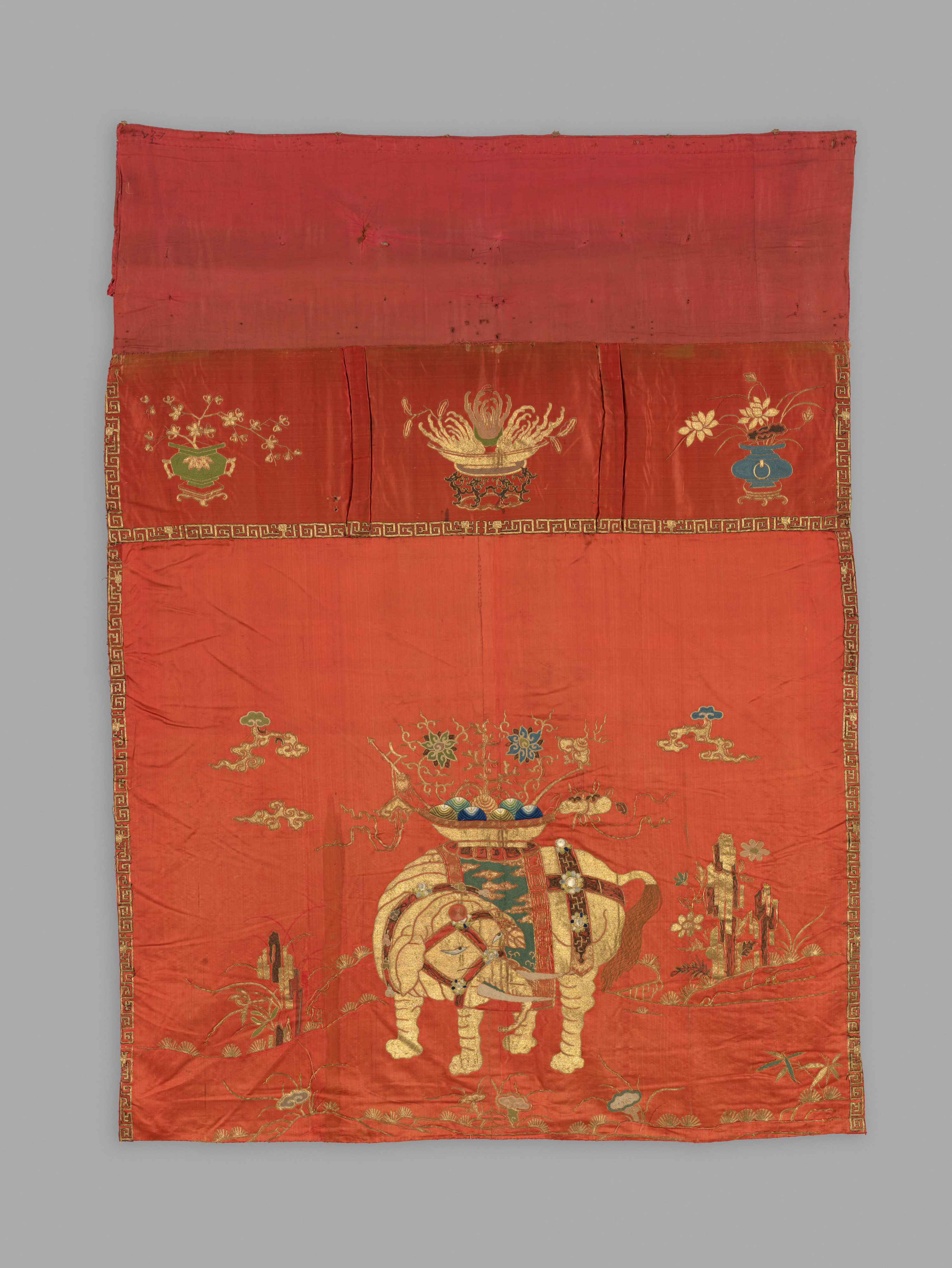
The Table Vallance with Elephant, a fragment of Chinese heritage preserved within the archives of Natalie Fashion Atelier, represents a pivotal artifact for aesthetic archaeology. Crafted from silk satin and embroidered with silk and metal threads, this piece transcends its original domestic function to become a masterclass in structural opulence and narrative materiality. Its isolated presence—devoid of its original context—forces a focused deconstruction of its classical elegance. For the 2026 haute couture season, this artifact informs a new paradigm of luxury silhouettes, where the weight of historical craftsmanship is translated into architectural volume, and the luminosity of metal thread redefines the interplay of light and form on the female body.
Materiality as a Structural Language
The foundation of this artifact is the silk satin, a fabric prized for its liquid sheen and inherent drape. In the context of the table vallance, the satin served as a horizontal plane, a surface for narrative embroidery. For 2026, this materiality is reimagined as a primary structural element. The satin’s natural fluidity is manipulated through engineered tailoring, creating silhouettes that cascade and pool like liquid metal. The metal thread embroidery, originally used to depict the elephant’s regal trappings, becomes a scaffolding of light. By applying dense, couched metal threads along seams and darts, the atelier can create invisible architecture—a structure that holds the silhouette’s shape while catching ambient light, mimicking the original’s interplay between matte silk and reflective metal.
Deconstructing the Elephant Motif: From Narrative to Abstraction
The elephant, a symbol of wisdom, strength, and royalty in Chinese iconography, is not merely depicted but abstracted into geometric and organic forms. The embroidery technique—a combination of satin stitch, couching, and Peking knot—creates a textural topography. For 2026, this abstraction informs a new silhouette language. The elephant’s trunk, a curved line of metal thread, is translated into a sculptural sleeve that sweeps from shoulder to wrist. The animal’s massive, rounded body becomes a voluminous peplum or a bell-shaped skirt, constructed from layered silk satin panels. The metal thread embroidery, originally used to delineate the elephant’s harness and ornaments, is recontextualized as architectural seaming—defining the silhouette’s negative space and creating a visual rhythm that echoes the original’s narrative flow.
Silhouette Translation: Horizontal Grace to Vertical Majesty
The original table vallance was designed to be viewed horizontally, draped over a table’s edge. This horizontal orientation is a key point of departure. In 2026, the horizontal grace is rotated into vertical majesty. The deep, fringed edges of the vallance—often finished with metal-wrapped silk threads—become the hemline of a dramatic train or the cascade of a cape. The central motif of the elephant, once centered on a flat plane, is now asymmetrically placed on the body, creating a dynamic tension that draws the eye diagonally. This rotation requires a re-engineering of the fabric’s weight distribution. The dense embroidery is concentrated on the silhouette’s structural anchors—the shoulder, the hip, the waist—while the satin flows freely, ensuring the garment retains its sculptural integrity without sacrificing movement.
Luminosity and the 2026 Palette
The metal thread—likely gold or silver-gilt wrapped around a silk core—imparts a variable luminosity that shifts with the viewer’s angle. This quality is central to the 2026 collection. The palette is not merely color, but light itself. The silk satin is dyed in deep, charcoal blacks, midnight blues, and oxidized bronzes, mimicking the patina of aged metal. The embroidery, however, retains its original brilliance. This creates a chiaroscuro effect on the silhouette, where the embroidered sections appear to float above the satin. For evening wear, this translates into a gown that is both matte and reflective, with the metal thread embroidery forming a lattice of light that traces the body’s contours. The effect is not decorative but structural—the embroidery defines the silhouette’s volume and directs the viewer’s gaze.
Technical Execution: The Atelier’s 2026 Protocol
Translating this artifact into a 2026 silhouette requires a rigorous technical protocol. First, the silk satin is backed with a fine horsehair canvas to provide the necessary support for the dense embroidery without compromising the fabric’s drape. Second, the metal thread is applied using a modified couching technique, where the thread is laid on the surface and secured with a fine silk filament. This allows for precise control over the thread’s tension and direction, creating the desired architectural lines. Third, the silhouette is constructed in three dimensions directly on the mannequin, with the embroidery serving as the primary pattern piece. The garment is not cut and then embroidered; rather, the embroidery defines the cut. This method ensures that the metal thread’s weight and stiffness are integrated into the silhouette’s structure, creating a garment that is both armor and drapery.
Conclusion: The 2026 Silhouette as a Living Archive
The Table Vallance with Elephant is not a relic to be copied, but a lexicon of techniques and forms to be translated. For Natalie Fashion Atelier, the 2026 haute couture silhouette emerges from this archaeological fragment as a dialogue between weight and flight. The density of metal thread anchors the silhouette, while the fluidity of silk satin allows it to breathe. The elephant’s narrative is abstracted into pure form, becoming a sculptural sleeve, a cascading train, or a lattice of light. This is not a revival of historical dress, but a re-engineering of historical materiality for the contemporary body. The 2026 silhouette is a living archive—a garment that carries the weight of its heritage while soaring into the future, its metal threads catching the light of a new season. The classical elegance is not deconstructed; it is reconstructed as a new language of luxury, where every stitch is a sentence, and every silhouette is a poem written in silk and metal.