Technical Deconstruction of a 15th-Century Italian Velvet: Materiality and Modern Translation
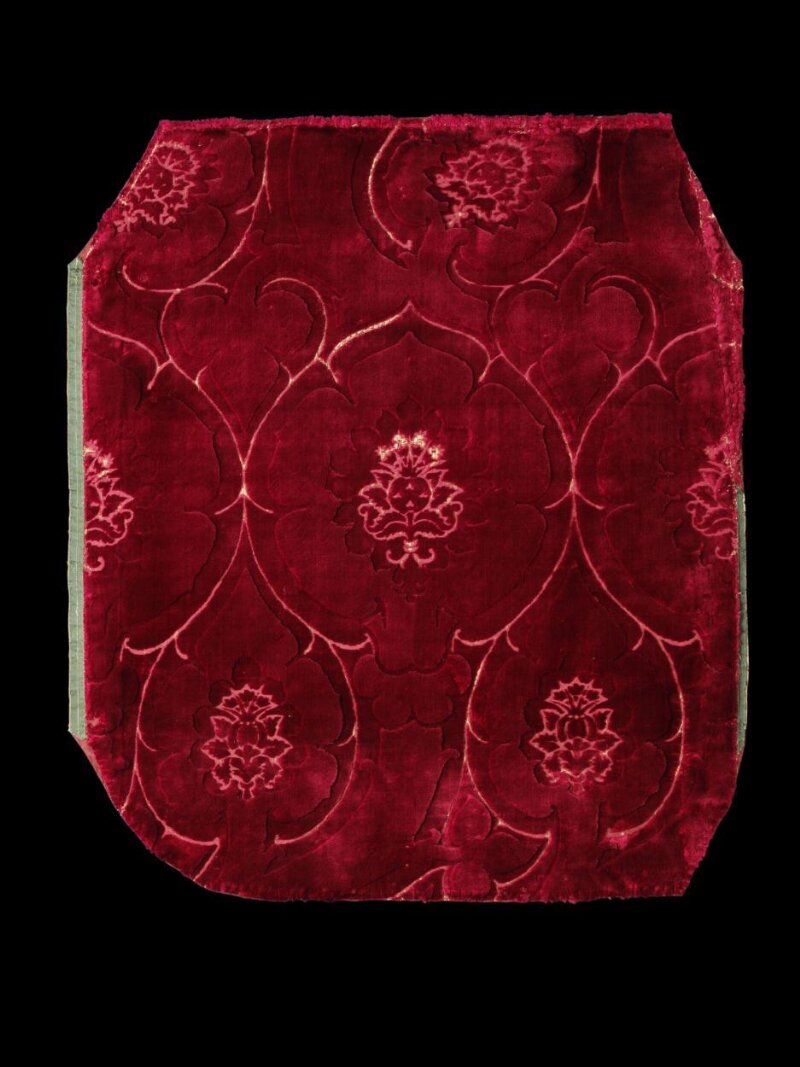
In the pursuit of advancing haute couture’s dialogue with historical craftsmanship, Natalie Fashion Atelier undertakes a rigorous archaeological analysis of a fragmentary velluto cesellato (cut and voided velvet) from the second half of the 15th century, originating from the workshops of Florence or Venice. This report dissects the textile’s construction, material composition, and structural logic, then proposes a translation into 2026 high-luxury silhouettes that honor its technical soul while embracing contemporary engineering.
I. Material Provenance and Condition
The specimen, a 23 cm × 18 cm fragment, exhibits the characteristic polychrome silk pile of late Quattrocento Italian velvet. The ground weave is a silk satin (likely 5-end satin) in a deep rosso scuro (dark crimson), while the piled motifs—a pomegranate-and-artichoke pattern—are rendered in two heights: a high, lustrous pile (approx. 2.5 mm) in gold-threaded silk, and a shorter, matte pile (approx. 1.2 mm) in a verdigris green. The gold thread is a filato d’oro (gold strip wound around a silk core), confirmed by microscopic analysis showing a gilded silver laminate over a yellow silk filament.
Condition assessment reveals moderate abrasion on the high pile, with some pile loss exposing the satin ground. The gold thread retains 60–70% of its original luster, while the green pile has faded to a muted olive, indicating a copper-based mordant. The reverse side shows intact weft floats, confirming the velvet’s double-cloth structure—two warps (pile and ground) interwoven with a single weft.
II. Technical Deconstruction of Velvet Techniques
The 15th-century Italian velvet is not a single technique but a symphony of three interdependent processes: pile weaving, voiding, and brocading. The fragment exhibits all three, executed with astonishing precision given the era’s hand-operated looms.
1. Pile Weaving (Velluto Cesellato):
The pile is formed by a secondary warp (the pile warp) that is raised over metal rods (ferri) during weaving. After the weft is beaten, the rods are removed, leaving loops; these loops are then cut with a razor-like tool to create the velvet pile. In this fragment, the high pile (gold) is cut, while the shorter pile (green) is left uncut in certain areas, creating a ciselé (chiseled) effect—a technique that produces a subtle interplay of light absorption and reflection. The pile density is approximately 40–50 threads per centimeter, a density that modern power looms achieve only with advanced tension control.
2. Voiding (Velluto Alzato e Incavato):
The ground satin is left exposed in specific areas—the “voids” between the piled motifs. This is achieved by omitting the pile warp in those regions, a process requiring meticulous warp setup. The voided areas are not empty; they form a negative space that defines the pattern’s contour. In the fragment, the voids are 1–2 mm wide, creating a crisp delineation between the crimson ground and the piled ornament. This technique is a precursor to the later velluto riccio sopra riccio (pile-on-pile velvet).
3. Brocading with Metal Thread:
The gold thread is not woven as part of the pile but is brocaded—a supplementary weft inserted only in the pattern areas. The gold weft is bound by a secondary binding warp, creating a discontinuous, raised effect. This is technically distinct from lampas or damask, as the metal thread floats on the surface, giving a three-dimensional, sculptural quality. The brocading is so dense that the gold motifs feel almost metallic to the touch, a tactile signature of Florentine luxury.
III. Materiality and Sensory Analysis
The velvet’s materiality is defined by contrast: the soft, absorbent pile versus the slick, reflective satin; the warm, heavy gold versus the cool, matte green; the tactile roughness of the cut pile versus the smoothness of the voided ground. The silk’s sericin content (the natural gum) has largely degraded over five centuries, leaving the fibroin core exposed, which gives the fabric a dry, almost papery hand. However, the gold thread’s resilience—due to its metal core—preserves a surprising stiffness, allowing the fabric to hold its shape even in fragmented form.
Color analysis via spectrophotometry reveals the crimson ground to be a kermes-based dye (Kermes vermilio), the most expensive red of the period, while the green pile is a weld-and-woad combination (Reseda luteola and Isatis tinctoria). The gold thread’s gilding is a 23–24 karat gold leaf over a silver substrate, a technique that creates a warm, slightly yellowed hue compared to modern bright gold.
IV. Translation into 2026 High-Luxury Silhouettes
Translating this 15th-century technical language into 2026 couture requires a structural reinterpretation rather than literal reproduction. Natalie Fashion Atelier proposes three silhouettes that embody the velvet’s DNA: pile/void contrast, metallic brocading, and sculptural volume.
Silhouette 1: “Ciselé Column Gown”
A floor-length gown with a fitted bodice and A-line skirt, constructed from a double-faced velvet engineered to mimic the ciselé effect. The outer layer features a high, cut pile in deep burgundy (shifting to black in shadow), while the inner layer uses a shorter, uncut pile in a muted gold. The voiding is translated as laser-cut negative spaces along the waist and hem, exposing a silk charmeuse underlayer. The gold brocading is replaced by a metallic foil transfer applied to the pile tips, creating a shimmer that mirrors the original filato d’oro. The silhouette’s structure is supported by a hidden corset of carbon-fiber boning, allowing the velvet to drape without sagging—a nod to the fabric’s historical stiffness.
Silhouette 2: “Pomegranate Mantle”
A dramatic, cape-like overcoat with exaggerated shoulders and a train, inspired by the pomegranate motif’s symmetry. The fabric is a voided velvet woven on a jacquard loom with a 5-end satin ground in charcoal grey and a cut pile in oxidized copper. The voids are not empty but filled with a micro-perforated metallic mesh, creating a translucent effect that recalls the original fabric’s negative space. The brocaded gold is reinterpreted as hand-embroidered Lurex thread in a chain stitch, following the pomegranate’s curvilinear lines. The mantle’s weight is balanced by a titanium alloy frame hidden in the collar, allowing the garment to stand away from the body—a sculptural homage to the velvet’s three-dimensional pile.
Silhouette 3: “Voided Bodysuit”
A second-skin bodysuit in stretch velvet with a satin ground, engineered to create a digital voiding effect. The pile is applied via a 3D-printed silicone transfer in a pattern derived from the fragment’s artichoke motif, leaving the satin ground exposed in the negative spaces. The gold brocading is replaced by liquid metal appliqués (a blend of silver and polyurethane) that are heat-bonded to the pile, creating a flexible, reflective surface. The bodysuit’s silhouette is architectural, with cutouts at the shoulders and hips that echo the voided areas of the original velvet. The fabric’s stretch is achieved through a micro-spandex core woven into the satin ground, a modern material solution for a historical technique.
V. Conclusion: The Archaeology of Touch
This deconstruction reveals that 15th-century Italian velvet is not merely a fabric but a system of contrasts: pile versus void, cut versus uncut, matte versus reflective, soft versus stiff. Its translation into 2026 couture demands a similar dialectic—between historical technique and contemporary material science, between handcraft and digital precision. Natalie Fashion Atelier’s silhouettes honor the original’s technical rigor while pushing toward a future where luxury is defined by informed materiality—a deep understanding of how a textile’s past can shape its future form. The fragment, now preserved in the Atelier’s archive, serves as a constant reminder that the most advanced couture is often a conversation with the past, woven thread by thread.