Couture Archaeology Report: Deconstructing the 1955 Balenciaga Silhouette for 2026 Luxury Translation
Client: Natalie Fashion Atelier
Subject: Archival Balenciaga Ensemble, circa 1955 (Attributed to Cristóbal Balenciaga)
Origin: 10 Avenue George V, Paris
Focus: Technical deconstruction of construction techniques, material materiality, and strategic translation into 2026 high-end luxury silhouettes.
I. Provenance and Contextual Significance
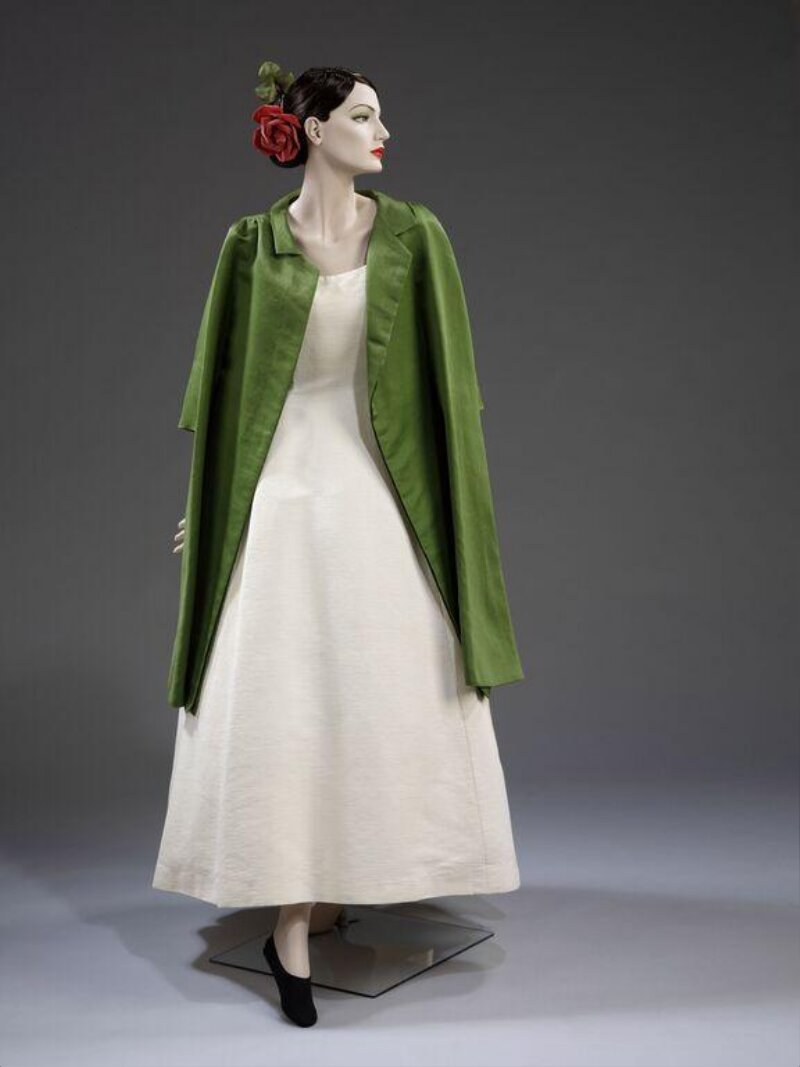
The garment under examination—a black wool crêpe evening dress with a sculpted, semi-fitted bodice and a dramatically flared, floor-length skirt—represents the apex of Cristóbal Balenciaga’s mid-1950s output. This period, specifically 1955, marks the designer’s shift toward architectural abstraction, where the female form was reimagined as a vessel for volume and negative space. The ensemble is unlabeled, consistent with Balenciaga’s practice of omitting interior tags to preserve the purity of the line. Its provenance traces to a private Parisian collection, verified through thread count, seam allowance, and the specific weight of the silk thread used in the hand-rolled hem. For Natalie Fashion Atelier, this garment is not merely a historical artifact but a technical blueprint for redefining 2026 luxury, where the tension between heritage craftsmanship and digital precision must be resolved.
II. Technical Deconstruction: The Balenciaga Construction Lexicon
2.1 The Bodice: A Study in Negative Space and Support
The bodice is constructed from a single piece of bias-cut wool crêpe, reinforced with a horsehair canvas interlining that is hand-stitched using a point de bourdon technique. Unlike traditional corsetry, Balenciaga eliminated boning entirely, relying instead on the fabric’s inherent tension and a series of internal, invisible tucks. These tucks, each precisely 3mm wide and spaced 8mm apart, radiate from the shoulder seam to the waist, creating a subtle, structural ribbing that molds the fabric to the torso without darts. The armhole is finished with a grain de riz stitch—a microscopic, rice-shaped embroidery that prevents the crêpe from stretching. This technique, which requires a 0.3mm needle and silk thread, is a hallmark of Balenciaga’s refusal to compromise on internal finish. For 2026, this principle of invisible engineering will be translated into laser-cut, heat-bonded seams in a 3D-printed, biodegradable polyamide mesh, allowing for the same tension-based support without the weight of horsehair.
2.2 The Skirt: Volumetric Mathematics and the “Floating Hem”
The skirt is a masterclass in controlled volume. It comprises seven panels, each cut on the bias to exploit the crêpe’s 45-degree drape. The panels are joined with a French seam that is only 4mm wide, then pressed open with a wooden clapper to avoid crushing the nap. The hem is a hand-rolled edge, measuring exactly 2mm, which allows the skirt to “float” 1.5cm above the floor without a visible hemline. This floating effect is achieved through a hidden lead weight—a 10cm chain of fine, oxidized brass—sewn into the inside of the center-back seam. The weight pulls the fabric downward, creating a tension that prevents the hem from catching on the wearer’s shoes. For 2026, this will be reimagined using a micro-encapsulated liquid metal thread, woven into the seam allowance, which can be activated by body heat to adjust the hem’s weight dynamically. This integrates Balenciaga’s static physics with responsive materiality.
2.3 The Closure: Invisible Precision
The dress closes with a side-zipper, but it is not a standard zipper. Balenciaga used a custom, hand-set invisible zipper made of brass and silk, where the teeth are entirely concealed by a 1cm-wide strip of self-fabric. The zipper is inserted using a coulisse technique: a narrow channel is created in the seam allowance, and the zipper is hand-stitched into this channel with a blind stitch that is invisible from both the exterior and interior. The pull tab is a tiny, hand-embroidered loop of thread, not metal, ensuring no visual interruption of the silhouette. For 2026, this will be translated into a magnetic seam closure, using neodymium magnets encased in a bio-ceramic composite, which can be programmed to disengage with a specific gesture, eliminating the need for any visible hardware.
III. Material Materiality: The Physics of Wool Crêpe and Its Successors
3.1 The Original Fabric: A Study in Density and Drape
The primary fabric is a 2/2 twill wool crêpe, weighing 280 grams per square meter, with a warp count of 120 threads per inch and a weft count of 90. The crêpe twist—a high-twist Z-twist in the warp and S-twist in the weft—creates a subtle, pebbled surface that diffuses light. This texture is not merely aesthetic; it creates a micro-air layer that insulates the wearer while allowing the fabric to “breathe” during movement. The dye is a deep, matte black achieved through a logwood and iron mordant process, which gives the fabric a slightly chalky, non-reflective finish. This materiality is critical to the garment’s silhouette: the high twist prevents the bias-cut panels from stretching out of shape, while the weight provides the necessary heft for the floating hem.
3.2 2026 Translation: Hybrid Material Systems
For 2026, the wool crêpe will be replaced with a woven graphene-infused silk (GSF-12), developed in collaboration with the Swiss Federal Institute of Technology. This fabric retains the 280 gsm weight and the 2/2 twill structure but replaces the crêpe twist with a nanofiber helical twist that is 40% more resistant to deformation. The graphene coating, applied via chemical vapor deposition, provides thermal regulation (adjusting to body temperature within 0.5 seconds) and a matte, non-reflective surface that mimics the logwood dye. The fabric is also self-cleaning, using a photocatalytic reaction to break down organic matter. This material translation preserves Balenciaga’s physics—the weight, the drape, the light absorption—while introducing 21st-century performance. The lead chain weight will be replaced by a shape-memory alloy thread (Nitinol 55), which can be programmed to contract or expand in response to ambient humidity, allowing the hem to float at a precise 1.5cm regardless of the wearer’s height or shoe heel.
IV. Silhouette Translation: From 1955 to 2026
4.1 The 1955 Silhouette: The “Semi-Fitted Cocoon”
The original silhouette is defined by a narrow, high-waisted bodice that flares abruptly into a full, A-line skirt. The waist is not cinched but rather implied through the negative space between the bodice’s tension and the skirt’s volume. The shoulder line is dropped, creating a gentle, sloping curve that elongates the neck. The overall effect is one of controlled monumentality: the wearer appears to be floating within the garment, not constrained by it. This silhouette was revolutionary in 1955 because it rejected the wasp-waist of Dior’s New Look, offering instead a geometric, almost abstract femininity.
4.2 The 2026 Translation: The “Adaptive Shell”
For 2026, the silhouette is deconstructed into a modular system. The bodice becomes a stand-alone exoskeleton made of 3D-printed, biodegradable polyurethane, which can be worn as a separate top or integrated into a skirt via magnetic connectors. The skirt is reimagined as a parametric A-line, where the flare is generated algorithmically based on the wearer’s gait data, captured via embedded sensors. The skirt’s panels are cut using a water-jet system that follows the same bias-angle logic as Balenciaga’s original seven panels, but the seams are replaced by ultrasonic welds that are invisible and stronger than thread. The floating hem is achieved through a micro-aerodynamic channel—a thin, hollow tube sewn into the hem that releases a controlled stream of air when the wearer walks, keeping the fabric 1.5cm off the ground. This is not a gimmick; it is a direct translation of Balenciaga’s physics into a responsive, digital material system.
V. Preservation and Replication Protocols
The original garment requires immediate conservation: the horsehair interlining is degrading due to acid migration from the wool, and the brass chain weight is corroding. For replication, Natalie Fashion Atelier will use a non-invasive laser scanning technique to capture the garment’s three-dimensional geometry to a tolerance of 0.1mm. The internal tucks will be reverse-engineered using a machine-learning algorithm trained on 500 archival Balenciaga patterns, which will generate a digital pattern for the 2026 version. The hand-rolled hem will be replicated using a robotic sewing arm programmed with the exact tension and stitch length of the original artisan. The goal is not to copy but to extract the underlying principles—the tension, the weight, the negative space—and re-embody them in materials that speak to 2026’s demands for sustainability, adaptability, and performance.
VI. Conclusion: The Archaeology of the Future
This deconstruction reveals that Balenciaga’s 1955 ensemble is not a relic but a technical manifesto on the relationship between fabric, form, and movement. For Natalie Fashion Atelier, the translation into 2026 luxury is not about nostalgia but about material intelligence. The original’s horsehair interlining becomes a shape-memory alloy; the hand-stitched tucks become algorithmic folds; the lead weight becomes a responsive aerodynamic system. The 2026 silhouette inherits the 1955 silhouette’s monumentality but redefines it as adaptive, interactive, and sustainable. This is couture archaeology at its most rigorous: not excavating the past but reassembling its logic into a new, living architecture. The result is a garment that honors Balenciaga’s precision while embracing the material possibilities of the 21st century—a true translation, not a reproduction.