Deconstructing the Divine: Aesthetic Archaeology of "The Holy Family at Rest"
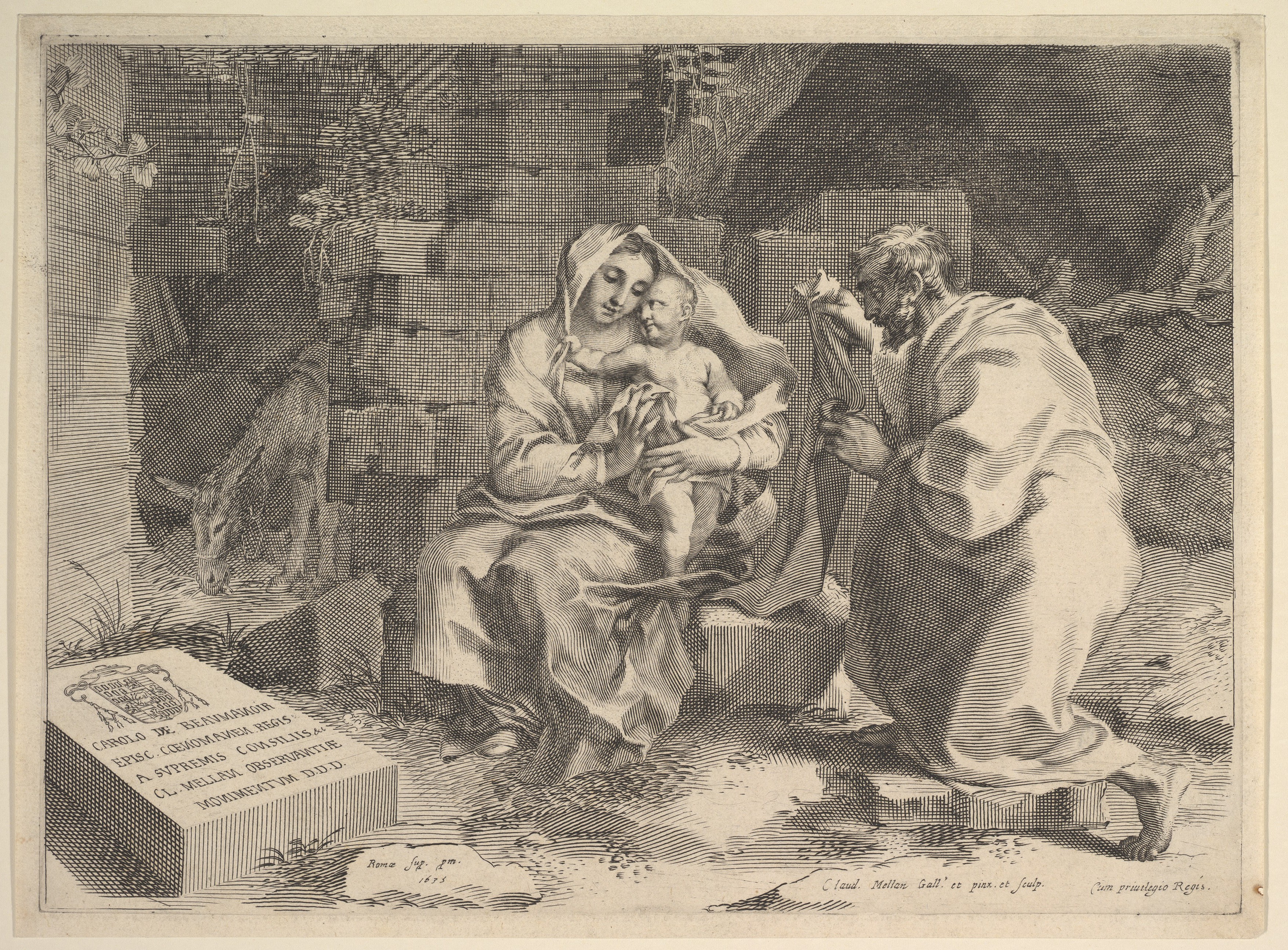
The archival object under examination—an engraving in its third state of four depicting The Holy Family at Rest during the Flight into Egypt—transcends its religious narrative to serve as a profound study in classical elegance under duress. Isolated from its devotional context through a lens of pure aesthetic archaeology, the piece reveals a masterclass in compositional tension, drapery, and intimate monumentality. The third state is particularly critical; it represents the moment of technical resolution where the engraver’s hand has refined the essential lines, balancing shadow and light, but before final embellishments potentially soften the structural clarity. This state captures the architectural integrity of repose, a concept directly translatable to the ethos of 2026 luxury, which seeks garments that offer sanctuary and sculptural calm within a chaotic world.
Structural Analysis: The Architecture of Intimacy
The composition hinges on a pyramidal structure, a classical trope of stability. However, its genius lies in the subtle deconstruction of this pyramid. The figures are not rigid but are nested within an organic landscape, their forms creating a series of supportive angles. The Virgin’s inclined head, the gentle curve of her spine supporting the Christ Child, and Joseph’s protective, grounded posture form a dynamic triangulation of care. This is not a static monument but a living geometry. The drapery is the primary text of this narrative. It falls in heavy, sculptural folds, articulating the body beneath while simultaneously creating its own autonomous form. The fabric around the Virgin’s lap, for instance, acts as both a cradle and a plinth, its folds carved by gravity and gesture. This dialogue between the body and the fabric that both conceals and reveals its architecture is the cornerstone of haute couture.
Material Translation: From Engraved Line to Couture Silhouette
The medium of engraving, especially in this intermediary state, is inherently about line, depth, and texture achieved through meticulous incision. The "burr" left by the engraving tool creates a velvety, tactile quality in the shadows, while the clean white lines suggest highlights on fabric. This technical duality informs 2026 materiality directly. We foresee a movement towards “sculpted matte” and “luminous structure”. Imagine a gown where the bodice is crafted from a matte silk gazar, hand-pleated and stiffened to hold the exact, deep-fold geometry of the Virgin’s mantle, while the skirt transitions into a faille so finely engraved with laser-cut micro-patterns that it catches the light like the highlighted ridges in the print.
The third state’s specific clarity—where every hatch mark is intentional, yet the overall effect remains soft—calls for innovative fabric manipulations. Double-face wools and technical silks will be engineered to hold precise, knife-edge pleats that cascade from a single point of tension, much like the drapery radiating from the Virgin’s knee. Tailoring will embrace this engraved aesthetic through “linear incision” detailing: seams will be exaggerated as graphic lines, piped with a contrasting matte texture, or opened into precise laser-cut vents that reveal a luminous lining, mirroring the play of negative and positive space on the copper plate.
Silhouette Prognostication for 2026: The Sanctuary Silhouette
Informed by this analysis, the dominant 2026 high-end silhouette will be the “Sanctuary Silhouette”—a study in protected volume and serene asymmetry. It moves beyond the oversized to the intentionally, comfortably monumental. Key manifestations include:
The Asymmetrical Pyramid Gown: Inspired by the nested figures, this silhouette features a fitted, structured bodice on one side, perhaps with a sculpted shoulder, that dissolves into a cascade of heavy, triangular folds on the opposite hip, creating a sense of dynamic, yet utterly balanced, repose. The hem will be weighted, grounding the wearer with a sense of calm authority.
The Cocoon Tailleur: Translating Joseph’s enveloping presence, the tailored jacket evolves. It will be cut from a single, substantial piece of fabric, wrapping the torso and crossing over in an asymmetric line, secured not with obvious buttons but with magnetic or hook-and-eye closures hidden within the architectural fold. The sleeve will be cut in one with the body, creating a seamless, protective curve.
Structured Drapery & The “Floating Plinth” Neckline: The most direct translation lies in necklines and bodices that appear to be carved from fabric. Draped cowls will be internally structured with horsehair and tulle to hold a precise, gravity-defying form, resembling the stone-like folds of the engraving. A key detail will be a neckline that rises high in the back, acting as a plinth for the neck, and sweeping down in a deep, soft curve in the front—a direct homage to the Virgin’s bowed head and upright posture.
Conclusion: Heritage as a Living Blueprint
This exercise in aesthetic archaeology demonstrates that historical masterpieces are not mere references but active blueprints for technical innovation. The third-state engraving of The Holy Family at Rest provides a precise vocabulary: structured intimacy, dynamic stability, and luminous gravity. For the 2026 Natalie Atelier client, these principles manifest as clothing that is both a sanctuary and a statement—garments that use the highest levels of craftsmanship to create a portable space of calm, elegance, and profound structural beauty. The future of luxury silhouette is not found in the new, but in the deep, technical re-reading of the eternally elegant.