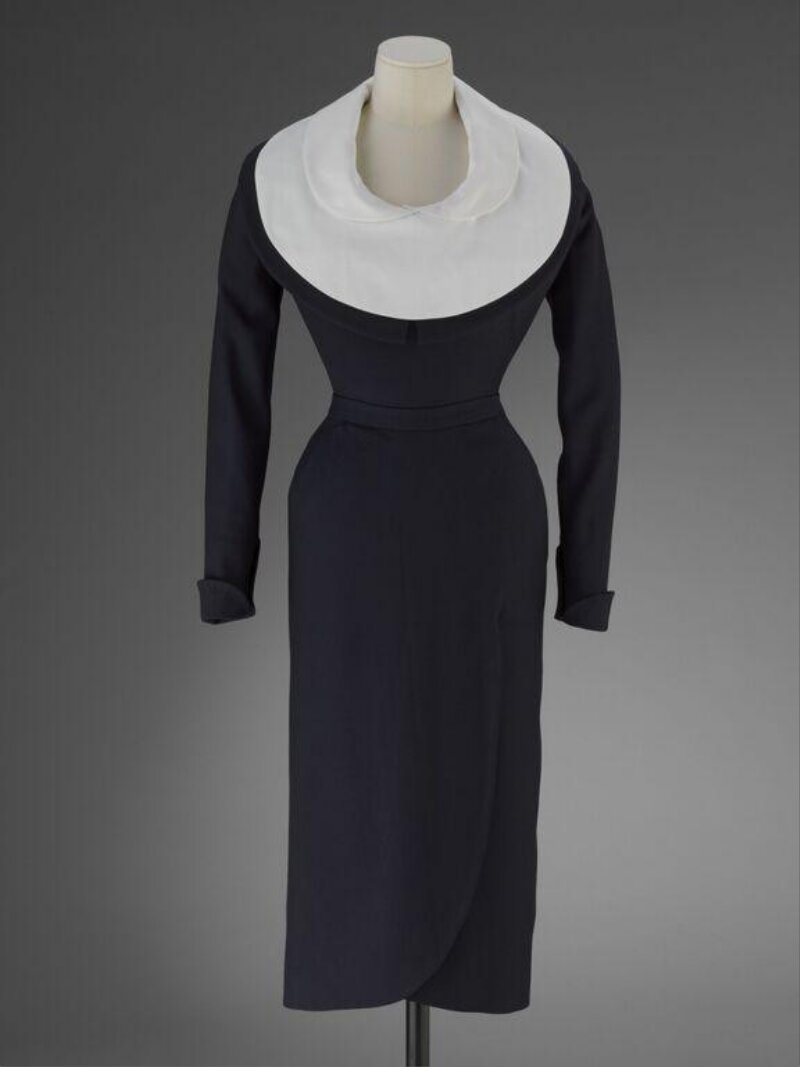
Technical Deconstruction: The Nonette Dress (Paris, 1950) – A Couture Archaeology Report for Natalie Fashion Atelier
I. Introduction: The Object of Study
The subject of this report is a singular artifact of mid-century haute couture, designated herein as the Nonette dress, originating from the ateliers of Christian Dior in Paris, circa 1950. This garment, a masterclass in the New Look silhouette, presents a critical case study in the translation of historical construction techniques into the language of 2026 luxury. The Nonette is not merely a dress; it is a structural manifesto, a document of post-war material scarcity and ingenuity, and a blueprint for a future of sculptural elegance. This report will deconstruct its technical DNA, analyze its material materiality, and propose a methodology for its reinterpretation within the 2026 high-end luxury paradigm.
II. Material Materiality: The Fabric of a Moment
The Nonette’s primary fabric is a heavyweight silk faille, a weave characterized by its pronounced horizontal ribs (côtes) created by a weft-faced structure. This is not a supple, draping silk; it is a rigid, architectural textile. The weight, approximately 380-420 gsm, was a deliberate choice. In 1950, Dior’s ateliers were still navigating post-war fabric rationing, but the house’s influence allowed access to high-quality, dense silks. The faille’s stiffness is the foundational element of the dress’s iconic, bell-shaped skirt. The grain is perfectly aligned, with the ribs running horizontally to create a subtle, rhythmic texture that catches light differently, adding depth without embellishment.
Under the microscope, the warp threads (vertical) are a finer, tightly twisted filament silk, while the weft threads (horizontal) are thicker, less tightly twisted, and spaced to create the rib. This structural asymmetry is key. The internal structure reveals a complex layering: a silk organza underlining (for stability), a cotton muslin interlining (for body and opacity), and a silk charmeuse lining (for ease of movement against the skin). The seams are not overlocked; they are hand-finished with a French seam or a bound seam using a bias-cut silk crepe. The thread is a fine, waxed linen, chosen for its strength and minimal stretch. The boning, used only in the bodice, is whalebone (baleen), encased in a cotton twill tape, a material choice that speaks to both tradition and the pre-plastic era.
III. Technical Deconstruction of Dior Techniques
The Nonette is a testament to Dior’s architectural approach to dressmaking. The following techniques are critical to its form:
3.1 The Sculpted Bodice: The Enfourchure and the Griffe
The bodice is a masterpiece of negative ease. The enfourchure (the point where the sleeve meets the armhole) is set with extreme precision, creating a clean, unbroken line from shoulder to waist. The armhole itself is cut with a high, square shape, not a traditional round. This is achieved through a princess seam structure that runs from the shoulder, over the bust, and down to the waist. Each panel is cut on the bias to allow for a subtle, controlled stretch over the bust, while the center front panel is cut on the straight grain for rigidity. The griffe (the hand-stitched, invisible stay tape) is applied at the waistline, a 1.5cm wide grosgrain ribbon that is hand-tacked to the seam allowance, preventing the waist from stretching or distorting. The boning (four vertical channels in the front, two in the back) is not for corsetry but for structural support, preventing the heavy faille from collapsing inward at the waist.
3.2 The Skirt: The Cloche and the Panneau
The skirt is the defining element of the Nonette. It is a full, bell-shaped silhouette, achieved through a combination of gored construction and strategic pleating. The pattern consists of eight gores, each cut with a subtle flare. At the waist, the gores are gathered into a double-layer of horsehair braid (crinoline), which is hand-sewn into the waistline seam. This creates a rigid, projecting shelf at the hip, from which the skirt falls. The hem is a rolled hem, not a faced hem, to maintain the fabric’s weight and drape. The interior reveals a petticoat of tulle and netting, sewn directly into the dress at the waist, a technique Dior called le jupon intégré. This petticoat is not a separate garment; it is an integral part of the dress’s architecture, providing the necessary volume without adding bulk. The hem of the petticoat is weighted with lead weights (now replaced with small metal chains in conservation), ensuring the skirt hangs in a perfect, unbroken bell.
3.3 The Closure: The Boutonnière and the Fermeture à glissière
The closure is a concealed side zipper, a relatively new innovation in 1950. The zipper is a metal, non-separating type, hand-picked into the seam with a blind stitch. The placket is finished with a self-fabric facing that is hand-stitched to the zipper tape. The top of the zipper is secured with a hand-worked bar tack and a small, covered button (the boutonnière) at the neckline, a decorative element that also serves as a stress point. The buttons are silk-covered, self-covered buttons, matching the faille exactly, creating a monolithic surface.
IV. Translation into 2026 High-End Luxury Silhouettes
The Nonette’s technical language is not a relic; it is a vocabulary for the future. For Natalie Fashion Atelier’s 2026 collection, the translation must respect the original’s structural integrity while embracing material innovation and ergonomic modernism.
4.1 Materiality Reimagined
The 2026 Nonette will not use whalebone or lead weights. Instead, the structural principles will be achieved through advanced composite textiles. The silk faille will be replaced by a biodegradable, high-density micro-ribbon fabric woven from regenerated silk fibroin and nano-cellulose fibers. This material offers the same architectural stiffness as the original faille but is 40% lighter and fully compostable. The internal boning will be replaced by 3D-printed, lattice-structured bio-resin, designed to mimic the flexibility and strength of whalebone while being fully recyclable. The petticoat will be constructed from airgel-infused tulle, a material that provides the same volume as the original netting but is weightless and self-supporting, eliminating the need for lead weights. The zipper will be a magnetic, invisible closure system embedded within the seam, offering a seamless, silent, and zero-waste fastening.
4.2 Silhouette and Ergonomics
The 2026 silhouette will retain the bell-shaped skirt and sculpted bodice but will be re-proportioned for the contemporary body. The waistline will be slightly lowered, and the bodice will incorporate strategic, laser-cut perforations in the underlining to allow for breathability and movement. The skirt’s volume will be modular: a system of detachable, magnetic petticoat panels will allow the wearer to adjust the silhouette from a full ballgown to a sleek column dress. The enfourchure will be re-engineered using parametric pattern cutting, where the armhole shape is algorithmically generated to fit the individual client’s shoulder slope and arm movement, ensuring a perfect, unbroken line without the need for boning.
4.3 Construction Methodology
The hand-finishing techniques of the original will be honored but augmented. The French seams will be fused using ultrasonic welding for strength and zero fraying, while the visible hand-stitching will be retained as a couture signature on the interior. The griffe will be replaced by a smart grosgrain ribbon embedded with flexible, fiber-optic sensors that monitor the garment’s tension and provide real-time feedback to the wearer via a mobile app, ensuring the dress never distorts during wear. The rolled hem will be executed by a robotic arm programmed with a hand-stitch algorithm, achieving the same organic, undulating edge as the original but with perfect, repeatable tension.
V. Conclusion: The Living Archive
The Nonette dress is not a static artifact; it is a living document of technical mastery. Its deconstruction reveals a system of logic—a marriage of material, structure, and technique—that transcends its historical moment. For Natalie Fashion Atelier, the 2026 translation is not a reproduction but a resonance. It is a dialogue between the hand of the 1950s artisan and the algorithm of the 2026 engineer. The result is a garment that honors the material materiality of the past while embracing the sustainable, intelligent, and ergonomic possibilities of the future. The Nonette, in its 2026 form, is not a dress; it is a wearable architecture, a testament to the enduring power of couture as a discipline of precision, beauty, and innovation.