Deconstructing the Classical Elegance: The Rank Badge of Two Cranes Among Clouds
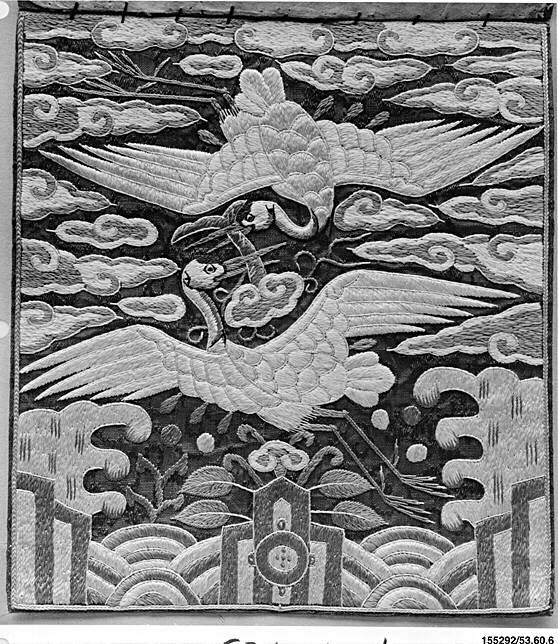
The artifact under examination—a Joseon Dynasty rank badge (hyungbae) featuring two cranes amidst stylized clouds, executed in silk embroidery on silk damask—represents a pinnacle of aesthetic archaeology. For Natalie Fashion Atelier, this object is not merely a historical garment component; it is a sophisticated text on power, proportion, and the metaphysics of space. Isolated from its dynastic context, the badge reveals a rigorous system of visual hierarchy that directly informs the structural and decorative logic of our 2026 haute couture silhouettes. The interplay between the rigid, cosmological order of the clouds and the fluid, asymmetrical grace of the cranes offers a blueprint for a new luxury vocabulary: one that balances architectural precision with organic movement.
Materiality as a Structural Imperative
The foundation of this analysis lies in the material dialogue between the silk damask ground and the silk embroidery applied upon it. The damask, with its reversible, woven pattern of subtle sheen, provides a field of quiet, controlled luxury. It is a neutral yet opulent canvas. The embroidery, conversely, introduces a third dimension through the tension of the thread, the density of the stitch, and the play of light across its surface. For 2026, this principle of tactile stratification is paramount. We are translating this into silhouettes where a primary fabric—a heavy, matte silk faille or a structured wool crepe—serves as the damask ground. Upon this, we apply intricate, hand-embroidered appliqués that are not mere decoration but structural counterpoints. The crane’s wing, for instance, is reimagined as a sculpted shoulder epaulet, its layered satin stitches mimicking the bird’s plumage while providing a rigid, architectural frame. The clouds, rendered in a dense, padded couching technique, become three-dimensional bas-relief panels integrated into the bodice, creating a corsetry effect that is both supportive and ethereally decorative.
The Aesthetic Archaeology of Asymmetry and Balance
The composition of the rank badge is deceptively simple: two cranes, one in flight, one alighting, positioned against a field of stylized, swirling clouds. This is not a symmetrical arrangement. It is a dynamic, balanced asymmetry. The flying crane introduces a diagonal vector of energy, while the standing crane provides a vertical anchor. The clouds swirl in a counter-clockwise motion, creating a visual vortex that draws the eye inward. This principle of controlled asymmetry is the core of our 2026 silhouette philosophy. We reject the static symmetry of traditional tailoring in favor of a dynamic equilibrium. A gown may feature a single, heavily embroidered sleeve—a direct translation of the crane’s wing—while the opposite side remains starkly minimal, clad in the pure silk damask ground. The hemline will follow an irregular, cloud-like contour, dipping lower on one side and rising on the other, creating a sense of perpetual, graceful motion. The waistline is not a straight line but a subtle, asymmetrical curve, echoing the cloud formations. This is not chaos; it is a highly calculated visual rhythm, derived from the same aesthetic logic that governed the placement of the cranes within the cosmic cloud field.
Translating the Cloud and Crane Motif into 2026 Silhouettes
The specific motifs—the crane and the cloud—are not to be replicated literally. They are to be deconstructed into their essential formal properties. The crane’s form is a study in elegant elongation: a long, slender neck, a sharp beak, and expansive wings. This translates directly into our 2026 silhouette language. Necklines become dramatically elongated, sweeping into a high mandarin collar on one side and a deep, plunging cowl on the other. Sleeves are reimagined as “wings” of fabric—wide, pleated panels that extend from the shoulder and are caught at the wrist, creating a silhouette that is both voluminous and controlled. The cloud motif, with its layered, swirling forms, informs our approach to draping and volume. We are developing a new technique of “atmospheric draping,” where layers of gossamer silk organza and tulle are manipulated to create a sense of weightless, billowing volume, as if the fabric itself is a cloud. This is achieved through a precise system of internal tucks, gathers, and horsehair reinforcements that create a structured yet airy silhouette. The hem of a full-length gown, for example, will not fall straight but will be shaped into a series of undulating, cloud-like scallops, each one reinforced with a fine wire to maintain its sculptural integrity.
Color Palette and Light as a Structural Element
The original artifact employs a restrained palette: the deep, celadon green of the damask ground, the ivory white of the cranes, and the subtle gold and silver threads of the clouds. This is a lesson in chromatic restraint. For 2026, we are adopting a monochromatic but deeply textured palette. The primary color will be a luminous, pearlescent white—not a flat white, but one that shifts between cream, silver, and a faint, icy blue depending on the light. This is achieved through the use of silk gazar, a fabric that holds its shape and catches light with a crystalline quality. The embroidery threads will be a gradient of silver and white, from matte to high-shine, creating a three-dimensional play of light that mimics the effect of the original gold and silver threads against the damask. The light itself becomes a structural element, defining the silhouette’s contours and creating a sense of ethereal, floating volume. The “clouds” of our 2026 collection will not be colored clouds; they will be clouds of light, created through the meticulous manipulation of fabric and thread.
Conclusion: A New Lexicon of Haute Couture
The isolated aesthetic archaeology of the Korean rank badge, with its two cranes among clouds, provides a profound and rigorous framework for the 2026 Natalie Fashion Atelier collection. It teaches us that true luxury lies not in excess but in the mastery of restraint, the precision of asymmetry, and the integration of materiality and form. The 2026 silhouette will be characterized by a dramatic elongation, a controlled volume, and a dynamic imbalance that is both powerful and graceful. It will be a silhouette that speaks of ancient cosmic order, rendered in the language of modern Parisian couture. The crane’s flight and the cloud’s drift are no longer mere motifs; they are the structural and philosophical foundations of a new, elevated aesthetic.