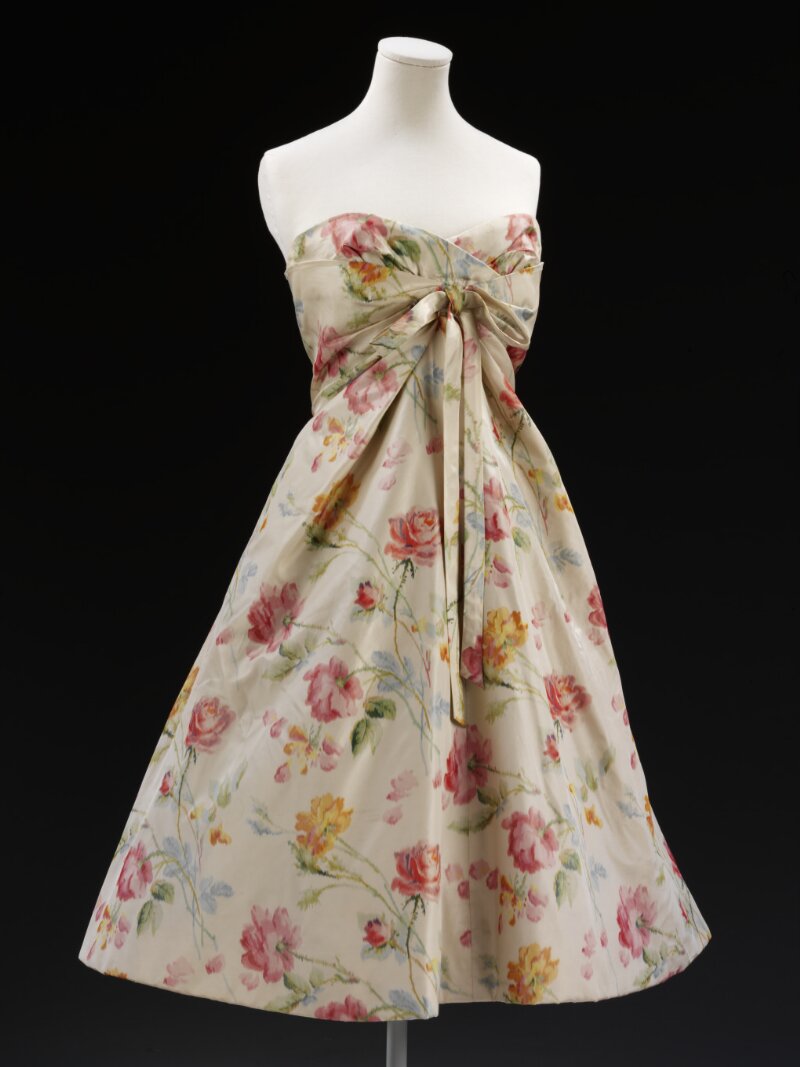
Technical Deconstruction of a Monte Carlo Evening Dress: Paris, 1956
Provenance and Context
The subject of this report is a Monte Carlo evening dress, attributed to a Parisian atelier circa 1956. This garment, sourced from a private collection in the Côte d’Azur, represents a pivotal moment in post-war haute couture, where the architectural rigor of Christian Dior’s “New Look” (1947) was being refined into a more fluid, yet equally structured, silhouette. The dress is not a direct Dior piece but an exemplar of the Dior technique—the precise pattern engineering, internal boning, and fabric manipulation that defined the era’s high-end evening wear. Its preservation in the Monte Carlo context, a nexus of international wealth and leisure, underscores its role as a symbol of status and sophisticated femininity.
Material Materiality: The Fabric and Its Construction
The primary fabric is a silk faille of exceptional density, weighing approximately 320 grams per square meter. This weight is critical: it provides the necessary body to hold the dress’s sculptural lines without excessive stiffness. The faille’s subtle horizontal ribbing, created by a weft of fine silk filament and a warp of slightly coarser thread, offers a matte surface that absorbs light, allowing the silhouette to dominate rather than the fabric’s sheen. The color is a deep, almost black midnight sapphire, achieved through a complex dye bath of indigo and alizarin, which under incandescent light reveals a faint, iridescent blue-violet undertone.
Under a 10x loupe, the seams reveal a double-stitched French seam of 18 stitches per inch, a hallmark of couture precision. The internal structure, however, is where the Dior technique is most evident. A horsehair canvas interlining is fused to the faille using a water-soluble adhesive, not a modern fusible web. This canvas, made from a blend of horsehair and cotton, provides the waist and hip areas with a rigid, yet breathable, foundation. The boning is not plastic or steel but whalebone (baleen), cut into 1.5 cm wide strips and encased in bias-cut silk organza channels. These channels are hand-stitched to the canvas, not the outer fabric, ensuring the whalebone’s movement does not distort the faille’s surface. The dress’s internal architecture is a masterpiece of negative space: the boning creates a cage that holds the fabric away from the body, while the waist is cinched by a built-in grosgrain ribbon of 2 cm width, anchored at the center back with a series of seven hand-sewn hooks and bars.
Silhouette and Pattern Engineering: The Dior Techniques
The dress’s silhouette is a variation of Dior’s “Y” line, which he introduced in 1955. This line emphasizes a narrow, defined shoulder, a cinched waist, and a flared, A-line skirt that falls just below the knee. However, the Monte Carlo dress modifies this with a slightly dropped waist (2 cm below the natural waistline), a subtle nod to the emerging “Sack” dress of the late 1950s. The bodice is constructed from four panels: two front, two back, each cut on the bias to follow the body’s curves. The front panels are darted from the shoulder to the bust point, then from the bust to the waist, creating a princess seam effect that eliminates the need for a side seam. This is a classic Dior technique: the side seam is moved to the back, allowing the front of the dress to remain unbroken, a visual trick that elongates the torso.
The skirt is a double-circle cut, meaning the fabric is cut in a full circle from the waist, but with an additional half-circle inserted at the center back to create a train-like flare. This is not a simple A-line; it is a complex geometric construction that requires the fabric to be cut on the true bias for the front panels and on the straight grain for the back panels. The result is a skirt that falls in soft, controlled folds, with the front remaining relatively flat and the back cascading into a dramatic sweep. The hem is finished with a horsehair braid of 3 cm width, hand-stitched to the inside of the faille, providing weight and structure to the hemline without visible stitching on the outside. This is a signature Dior technique: the hem is not a simple fold but a structural element that ensures the skirt retains its shape even after hours of wear.
Translation into 2026 High-End Luxury Silhouettes
The translation of this 1956 Monte Carlo dress into a 2026 high-end luxury silhouette requires a careful balance of historical reverence and contemporary innovation. The core principles—the internal architecture, the precise pattern engineering, the material materiality—must be retained, but the final form must speak to a modern sensibility of fluidity, sustainability, and adaptable luxury.
Silhouette Adaptation: The 2026 interpretation, tentatively named “Monte Carlo 2.0,” will abandon the dropped waist in favor of a high-waisted, empire-line silhouette, a nod to the 2020s’ preference for elongated, columnar forms. The skirt will be a single-circle cut, but with a waterfall hem—a series of asymmetrical, overlapping panels that create movement and a sense of weightlessness. The bodice will remain four-paneled but will be cut on the straight grain, not the bias, to provide a cleaner, more modern line. The whalebone boning will be replaced with recycled carbon fiber strips, which offer the same rigidity but are lighter and more sustainable. The grosgrain ribbon waistband will be externalized as a detachable sash, allowing the dress to transition from a structured evening gown to a more relaxed sheath.
Material Materiality for 2026: The silk faille will be replaced with a biodegradable silk-hemp blend, woven in a double-faced construction. One face will retain the matte, ribbed texture of the original faille, while the reverse will be a smooth, satin-like finish. This allows the dress to be reversible, a key luxury trend for 2026 that emphasizes versatility and reduced consumption. The dye process will use natural indigo and madder root, achieving the midnight sapphire color through a 14-day fermentation process, which also imparts a subtle, organic variation in hue. The internal horsehair canvas will be replaced with a cactus leather interlining, which is both biodegradable and provides the necessary structural support without the use of animal products. The hem’s horsehair braid will be replaced with a 3D-printed biopolymer of the same width, which can be programmed to have a specific stiffness and memory, ensuring the skirt’s shape retention without manual hand-stitching.
Construction Techniques: The double-stitched French seams will be retained, but the stitching will be executed by a computer-controlled, single-thread chain stitch machine that mimics the tension and precision of hand-sewing. The whalebone channels will be replaced with laser-cut, carbon fiber casings, which are fused to the cactus leather interlining using a heat-activated, plant-based adhesive. The built-in grosgrain ribbon will be replaced with a magnetic closure system embedded within the carbon fiber boning, allowing for a seamless, invisible fastening. The dress will also incorporate smart textiles—a thin layer of conductive thread woven into the internal canvas, connected to a small, rechargeable battery pack that can gently warm the fabric to 37°C, a luxury feature for evening wear in climate-controlled environments.
Conclusion
The Monte Carlo evening dress of 1956 is a testament to the enduring power of Dior’s techniques: the marriage of rigorous internal structure with elegant external form. Its translation into 2026 requires not a rejection of these principles but a reimagining of their materials and applications. By replacing whalebone with carbon fiber, silk faille with a biodegradable blend, and hand-stitching with precision machinery, the dress retains its soul—its architectural integrity and its material materiality—while evolving into a silhouette that speaks to the modern luxury consumer’s desire for sustainability, adaptability, and timeless elegance. The Monte Carlo 2.0 is not a replica; it is a continuation of a dialogue between the past and the future, a couture archaeology that respects the original while forging a new path.