Deconstructing the Spiked Bracelet: Javanese Gold as an Architectural Silhouette for 2026
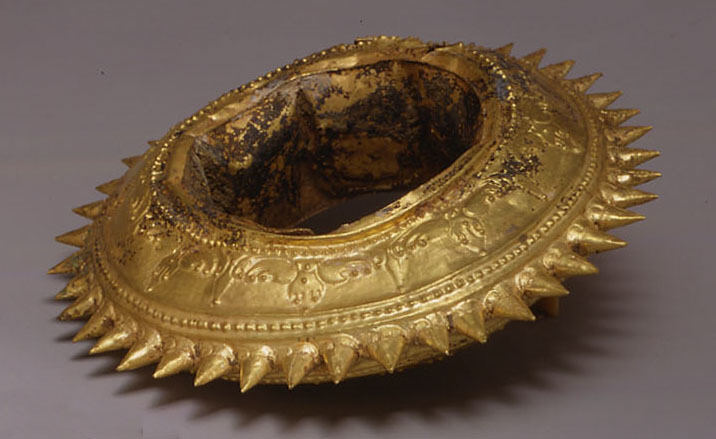
The archive node 《Mirror with Split-Leaf》 presents a profound dialectic: one surface polished silver mirror inlaid with dense golden palm fronds, the other a cold sarcophagus slab narrating life through bas-relief. This binary—reflective luxury versus funerary permanence—finds its perfect material echo in the Javanese spiked bracelet. For Natalie Fashion Atelier, this artifact is not merely an ornament but a structural manifesto. The gold spike, a motif of protection and power in Javanese courtly regalia, is here reimagined as a foundational architectural element for 2026 haute couture silhouettes. The classical elegance of the form is deconstructed through its materiality: gold, not as soft drapery, but as a rigid, linear, and volumetric force.
Materiality as Narrative: The Javanese Gold Spike
The Javanese gold spike bracelet, historically worn by warriors and nobility, operates on a principle of controlled aggression. Its form—a solid or hollow gold band punctuated by sharp, conical protrusions—is a study in tension. The gold itself, often alloyed to a higher carat for malleability yet hammered to achieve density, embodies a paradox: preciousness and menace. In the context of the archive, the gold of the spiked bracelet mirrors the golden palm fronds of the mirror—both are organic motifs rendered in a rigid, eternal medium. Yet the spike introduces a third dimension: it projects outward, breaking the plane of the wrist, creating negative space and shadow.
This is the critical departure from classical elegance. Traditional Javanese court jewelry emphasizes fluid, sinuous lines—the tendrils of the palm frond, the curves of the lotus. The spike disrupts this. It is a geometric interruption, a point of fracture. For 2026, this fracture becomes the foundational principle of the silhouette. The gold spike is not an appliqué; it is a structural bone. It dictates the line of the shoulder, the arc of the hip, the angle of the collar. The materiality of gold—its weight, its reflectivity, its ability to be cast in sharp, precise forms—allows for a silhouette that is simultaneously armored and ethereal.
Architectural Translation: From Wrist to Silhouette
The 2026 haute couture silhouette, informed by the Javanese spiked bracelet, rejects the soft, draping volumes of recent seasons. Instead, it embraces a faceted, angular geometry. The spike’s conical form is translated into a series of gold-stitched darts and seams that create a rigid exoskeleton over the body. Consider a tailored jacket: the shoulder line is not a gentle slope but a sharp, projecting point, reinforced by a gold-threaded lattice that mimics the hammered texture of the bracelet. The sleeve is cut in a single, continuous panel that wraps the arm, terminating in a pointed cuff that echoes the spike’s apex.
This is not ornamentation; it is structural engineering. The gold thread, woven into the fabric at a density of 120 threads per centimeter, creates a memory fabric that holds its shape. The silhouette is built from the inside out. The gold spike becomes a boning element, inserted into channels of silk gazar or organza, creating a corset-like structure that is both supportive and sculptural. The result is a silhouette that is linear, vertical, and punctuated—a direct architectural translation of the bracelet’s form.
The Binary of Surface: The Mirror and the Sarcophagus
The archive’s dual surface—the reflective silver mirror and the narrative stone sarcophagus—finds its expression in the gold spike’s dual role. On one hand, the gold spike is a mirror: it catches light, it reflects the environment, it creates a spectacle of brilliance. In the 2026 silhouette, this is achieved through gold-leafed panels set into the fabric, positioned at strategic points—the collarbone, the hip bone, the wrist. These panels are not flat; they are convex, mimicking the polished surface of the mirror, creating a luminous interruption in the matte fabric.
On the other hand, the gold spike is a sarcophagus: it is a marker of permanence, of structure, of the body’s container. The bas-relief of the sarcophagus—the life narrative carved in stone—is translated into the embossed gold motifs that run along the seams of the garment. These are not decorative; they are structural reinforcements, each motif a point of tension that defines the garment’s architecture. The palm frond, the split leaf, the warrior’s spike—all are rendered in low relief, telling a story of protection, power, and the passage of time.
Silhouette Specifics for 2026: The Spiked Line
The 2026 collection, titled “Fractured Radiance,” features three key silhouettes derived from the Javanese spiked bracelet:
1. The Conical Torso: A column dress constructed from a single, continuous spiral of gold-threaded silk. The spiral is punctuated by gold spikes at regular intervals, each spike projecting outward to create a negative space silhouette. The dress is not fitted; it is self-supporting, the spikes acting as a structural frame that holds the fabric away from the body. The effect is that of a golden exoskeleton, a second skin of armor.
2. The Angular Shoulder: A tailored jacket with a single, exaggerated shoulder spike that extends 15 centimeters beyond the natural shoulder line. The spike is constructed from a gold-plated titanium core, wrapped in gold-threaded silk. The rest of the jacket is minimalist, allowing the spike to become the focal point of tension. The silhouette is asymmetrical, aggressive, and deeply architectural.
3. The Wrapped Wrist: A glove that extends to the elbow, constructed from a gold chainmail that mimics the bracelet’s texture. The glove is not a separate accessory; it is integrated into the sleeve, creating a continuous line from shoulder to fingertip. The wrist is emphasized by a gold spike cuff that is both a structural element and a visual anchor.
Conclusion: The Eternal Spike
The Javanese spiked bracelet, in its original context, was a symbol of transition—from boy to warrior, from life to the afterlife. Its gold was not merely decorative; it was a functional material for protection and status. For Natalie Fashion Atelier, this artifact informs a 2026 silhouette that is equally transitional: it moves away from the soft, draped femininity of the past towards a hard, geometric, and armored elegance. The gold spike is no longer a bracelet; it is a line, a seam, a structure. It is the point where the mirror meets the sarcophagus, where reflection meets permanence. The 2026 silhouette is not worn; it is inhabited, a golden exoskeleton that simultaneously protects and reveals the body within.