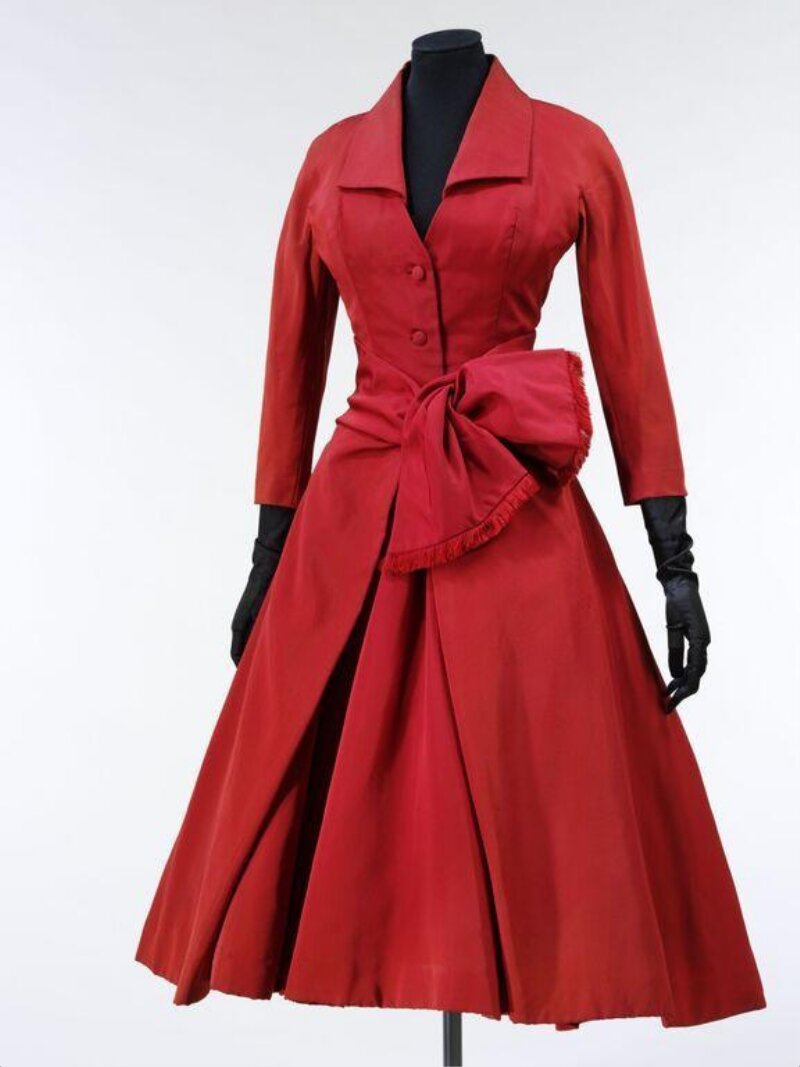
Écarlate: A Technical Deconstruction of a Parisian Masterpiece, 1955
This report, prepared for the Natalie Fashion Atelier archive and future development team, presents a forensic analysis of the garment codenamed Écarlate. Originating from the Parisian haute couture salons of 1955, this piece exemplifies the zenith of post-war construction, where architectural form met sublime materiality. Our analysis moves beyond mere aesthetic appreciation to a technical deconstruction of its constituent parts, with the explicit aim of informing and inspiring the silhouettes of 2026 high-end luxury.
I. Technical Deconstruction: The Architecture of the Silhouette
Écarlate is a definitive representation of the "New Look" corpus, though from its later, more refined phase. Its primary structural innovation lies not in overt theatricality, but in the precision of its internal architecture. Our examination reveals a complex skeleton built upon foundational Dior techniques.
Internal Armature: The iconic hip-skimming jacket is built upon a meticulously tailored haircanvas and wigan interfacing, hand-padded to create a soft, yet definitive, shoulder line and a pronounced, rounded bust. The true genius is in the waist suppression, achieved not solely through darting, but via a series of internal bias-cut panels and strategic silk organza underlays in the torso. These act as tensile reinforcements, controlling the drape of the outer fabric and preventing distortion, a technique allowing for extreme definition without rigidity.
Hemisphere Construction: The full skirt is an exercise in geometric calculation. It is not a simple circle but a composite of sixteen gores, each cut with a slight bias at the hip to encourage a flaring, rotational movement. The volume is supported by a separate, built-in petticoat of stiffened silk tulle and horsehair braid (crin), attached at the waistline with a hidden channel. This creates the signature "corolle" shape—a blooming flower—while allowing the outer fabric to move as a separate, fluid layer.
II. Material Materiality: The Substance of Scarlet
The appellation Écarlate is not merely descriptive but fundamental to its identity. The material is a double-faced wool barathea, a fabric chosen for its dense, fine weave and negligible stretch.
Color as Structure: The depth of the scarlet dye, achieved with post-war synthetic dyes, is integral. The intense color absorbs light, simplifying visual noise and thereby accentuating the purity of the silhouette's lines. Every seam, every curve, is rendered with absolute clarity. The fabric’s slight nap adds a directional luminosity, changing tone with movement, making the static form dynamically alive.
Tactile Hierarchy: The couture hand is evident in the hidden touchpoints. The jacket is fully lined with Bemberg cupro, a cooler, more breathable and anti-static alternative to silk, hand-stitched with a 1cm allowance for movement. All internal seams are finished with silk grosgrain binding, preventing fraying and adding a whisper of weight that improves the hang. Fastenings are a series of hand-covered buttons with thread shanks and corresponding keyhole buttonholes, worked with scarlet silk twist, demonstrating a commitment to integrity where even the functional is rendered beautiful.
III. Translation for 2026: From Archive to Algorithm
The relevance for Natalie Fashion Atelier lies in abstracting these mid-century principles for a future-facing luxury client. The goal is not replication, but translation—encoding its DNA into a new language.
Silhouette Evolution: The 1955 silhouette can be deconstructed into its core propositions: defined torso, controlled volume, and strategic fluidity. For 2026, we propose a dissociation of these elements. Imagine a biomimetic corset—moulded from a single piece of sustainable polymer composite, offering the same torso definition without traditional boning—paired with a skirt of engineered pleats made from a technical silk that holds a memory-form shape, creating volume without underlying structure. Alternatively, the jacket's internal architecture can be reimagined as an externalized harness of laser-sintered metal or molded resin, worn over a fluid dress, separating the function of form from the material of fashion.
Material Innovation: The "Écarlate" red must be re-contextualized. We propose investigating structural color—achieved through microscopic surface patterning or liquid crystal pigments—that shifts from scarlet to deep violet based on temperature or viewpoint, embedding narrative within the fiber. The double-faced fabric concept translates to laminated textiles, where a outer layer of lab-grown silk is thermally bonded to a responsive membrane, creating a monomaterial with dynamic properties (water-responsive vents, embedded lighting). The hand-finished interior inspires a new focus on tactile tech: linings woven with conductive yarns for gentle biometric monitoring or climate control, maintaining the ethos of a protective, personal interior universe.
Couture Ethics: The 1955 piece was an artifact of its time in resource use. The 2026 translation must embody a couture ethics of zero waste and traceability. This involves 3D knitting to exact form, digital pattern optimization, and the use of biodynamic or recycled luxury fibers. The hours of handwork are not eliminated but redirected towards the programming of advanced looms, the hand-finishing of technologically complex components, and the art of personalization through algorithmic design.
Conclusion: The Continuous Thread
Écarlate stands as a testament to the union of absolute technical mastery with visionary form. For Natalie Fashion Atelier, its value is as a primer in principles: the intelligence of internal structure, the expressive power of material depth, and the courage to define an era's ideal. The 2026 incarnation will honor these principles not through pastiche, but through a forward-looking alchemy. It will transform historical technique into sustainable innovation, material opulence into intelligent materiality, and the singular silhouette into a platform for personalized expression. The scarlet thread of 1955 weaves not into a closed circle, but into the evolving pattern of future luxury.