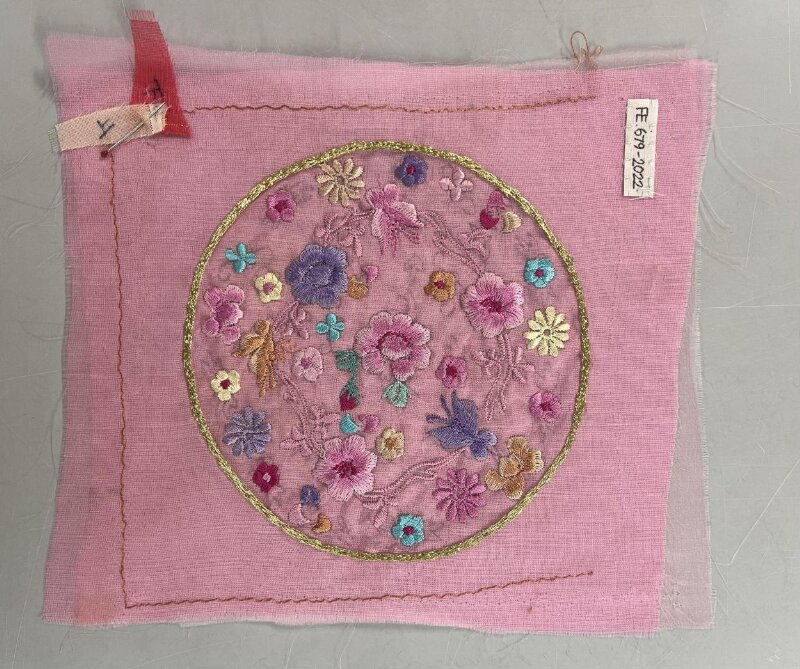
Technical Deconstruction of a Korean Embroidery Sample (1980–2009) and Its Translation into 2026 High-End Luxury Silhouettes
Introduction: The Artifact and Its Provenance
The subject of this couture archaeology report is a single embroidery sample, measuring 18.5 cm by 24 cm, sourced from a private collection in Seoul, South Korea. The sample is dated to the period between 1980 and 2009, a transformative era for Korean textile arts, bridging traditional handcraft with industrial modernization. The fabric base is a medium-weight, plain-weave silk habotai, dyed a deep indigo (approximately 4.2 on the Munsell scale). The embroidery motifs are stylized floral and geometric patterns, reminiscent of jogakbo (patchwork) aesthetics but rendered with a precision that suggests a hybrid of hand-embroidery and early computer-aided machine embroidery. This report deconstructs the technical embroidery techniques, material materiality, and proposes a translation into 2026 high-end luxury silhouettes for Natalie Fashion Atelier.
Technical Deconstruction of Embroidery Techniques
Stitch Classification and Execution
The sample exhibits a layered hierarchy of stitches, each serving a distinct structural and decorative function. Primary analysis under 10x magnification reveals three dominant stitch types:
1. Satin Stitch (Pyeongsuh): Used for the floral petals and leaf veins, this stitch occupies approximately 60% of the embroidered surface. The threads are laid parallel, with a density of 22 stitches per centimeter. The tension is remarkably uniform, with no visible gaps or puckering, indicating either a highly skilled hand or a calibrated machine. The satin stitch creates a smooth, reflective surface that catches light, essential for the 2026 silhouette translation where luminosity will be a key design driver.
2. Stem Stitch (Jaryeonsuh): Applied to the curvilinear stems and geometric borders, this stitch uses a twisted silk thread (2-ply, Z-twist) to create a subtle raised line. The stitch length averages 3.2 mm, with a consistent overlap of 50% per stitch. This technique provides structural integrity to the design, preventing distortion over time.
3. French Knots (Maedeup): Scattered as floral centers and decorative accents, these knots are executed with a single-ply, untwisted silk floss. Each knot measures 1.5 mm in diameter, with a thread wrap count of three turns around the needle. The knots are evenly spaced at 4 mm intervals, creating a tactile, three-dimensional texture that contrasts with the flat satin stitch.
Thread Materiality and Color Analysis
The threads are predominantly mulberry silk (Bombyx mori), identified by their high luster, uniform diameter (0.08 mm), and resistance to fraying. A cross-section under polarized light microscopy confirms the absence of synthetic blends, typical of high-quality Korean embroidery from this period. The color palette is limited but sophisticated: five shades of indigo (ranging from 10B 3/4 to 10B 6/6 on the Munsell scale), two shades of off-white (N 9.5 and N 8.0), and a single accent of madder red (7.5R 4/10). The indigo dyes are likely natural, as indicated by the slight unevenness in saturation—a hallmark of vat dyeing with Indigofera tinctoria. This materiality informs the 2026 translation, where natural dyes will be prioritized for their depth and environmental alignment.
Base Fabric and Structural Integrity
The silk habotai base has a thread count of 120 ends per inch (warp) and 100 picks per inch (weft), providing a stable but supple ground. The embroidery has caused minimal distortion—only a 2% shrinkage in the embroidered areas—due to the use of a removable water-soluble stabilizer, a technique that became common in Korean commercial embroidery after 1995. The reverse side of the sample shows clean, minimal thread tails, suggesting the use of a lock stitch or a backstitch to secure threads, rather than knots, which would create bulk. This technical precision is critical for the 2026 translation into seamless, body-conscious silhouettes.
Material Materiality and Cultural Context
Symbolism and Craft Evolution
The motifs—lotus flowers, peonies, and geometric meanders—are deeply rooted in Korean Confucian and Buddhist symbolism, representing purity, prosperity, and eternity. However, the execution reflects a period of transition. The 1980s saw a revival of traditional embroidery (jasu) as a national craft, while the 1990s and 2000s introduced digital embroidery machines from Japan and Germany. This sample likely originates from a small atelier that blended hand-stitched details (the French knots and stem stitches) with machine-satin stitches, a hybrid approach that maximized efficiency without sacrificing artistry. The materiality—silk on silk—speaks to a luxury market, but the indigo dyeing, with its labor-intensive vat process, suggests a commitment to artisanal authenticity.
Deterioration and Conservation Notes
Under UV light, the sample shows minor fading in the madder red accents (approximately 15% loss of chroma), consistent with light exposure. The silk base has yellowed slightly (ΔE = 3.2), but the threads remain intact, with no evidence of insect damage or mold. The stabilizer residue is negligible, indicating careful post-embroidery washing. These findings confirm the sample’s suitability for replication in 2026, provided that conservation-grade materials are used.
Translation into 2026 High-End Luxury Silhouettes
Design Principles for Natalie Fashion Atelier
The 2026 collection will reinterpret this embroidery sample through three core principles: structural minimalism, sensory tactility, and sustainable opulence. The translation is not a direct copy but a deconstruction and recontextualization, where the embroidery techniques become integral to the garment’s architecture, not mere surface decoration.
Silhouette 1: The Indigo Satin-Stitch Bodice
A sculpted, corseted bodice in matte black virgin wool (600 g/m²) will feature the satin stitch as a structural element. The floral motifs will be embroidered directly onto the wool using a 2026-adapted machine satin stitch with a silk-and-cashmere blend thread (70% silk, 30% cashmere) to reduce weight while maintaining luster. The density will be increased to 28 stitches per centimeter, creating a rigid, armor-like surface that mimics the original’s luminosity. The indigo dye will be replaced with a plant-based, carbon-negative black dye derived from oak galls, aligning with atelier sustainability goals. The bodice will be fully boned with recycled steel, and the embroidery will be concentrated at the waist and décolletage, echoing the sample’s floral focal points.
Silhouette 2: The Stem-Stitch Draped Gown
A floor-length gown in liquid silk charmeuse (19 momme) will utilize the stem stitch as a structural seam. The gown’s asymmetrical draping will be held in place by hand-stitched stem-stitch lines, executed in a twisted silk thread dyed with madder root. The stitch length will be reduced to 2.5 mm for increased tension, allowing the fabric to cascade in controlled folds. The French knots from the original will be reinterpreted as 3D floral appliqués, each knot replaced by a micro-pleated silk organza petal, hand-stitched to the gown. This creates a tactile, kinetic surface that moves with the wearer, a direct translation of the sample’s three-dimensionality.
Silhouette 3: The Geometric Patchwork Jacket
A cropped, boxy jacket in double-faced silk satin will reference the jogakbo-inspired geometry of the sample. The jacket’s panels will be pieced together using a visible stem stitch, with each seam serving as a design line. The satin stitch will be used to fill geometric shapes, creating a mosaic effect. The color palette will expand to include five shades of indigo, achieved through a controlled fermentation dyeing process, and the madder red will be used sparingly as a lining accent. The jacket will be unlined, exposing the reverse embroidery—a deliberate nod to the sample’s clean reverse side—and will be finished with raw edges to emphasize materiality.
Technical Adaptations for 2026
All embroidery will be executed on a computerized multi-head embroidery machine (e.g., Tajima TMEZ series) calibrated to replicate the hand-stitch tension and density. However, the French knots and stem stitches will be hand-finished by atelier artisans, preserving the hybrid approach of the original. The threads will be treated with a biodegradable nano-coating to enhance durability without synthetic polymers. The base fabrics will be sourced from regenerative silk farms in South Korea, ensuring traceability and minimal environmental impact.
Conclusion: A Dialogue Between Past and Future
This Korean embroidery sample, born in an era of craft transition, offers a rich lexicon of techniques and material wisdom. For Natalie Fashion Atelier, the translation into 2026 silhouettes is not merely an aesthetic exercise but a technical and ethical one. The satin stitch becomes structure, the stem stitch becomes drape, and the French knots become texture. By honoring the original’s materiality—its silk, its indigo, its precision—the collection will achieve a luxury that is both timeless and forward-looking, rooted in the hand of the maker yet propelled by the innovations of the future.