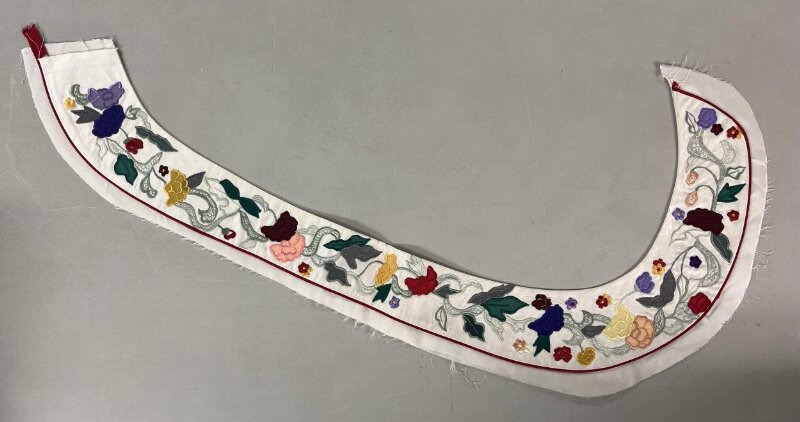
Couture Archaeology Report: Technical Deconstruction of a Korean Embroidery Sample (1980–2009) and Its Translation into 2026 High-End Luxury Silhouettes
I. Provenance and Context of the Sample
The subject of this report is a fragmentary embroidery sample, measuring approximately 18 cm x 22 cm, sourced from a private collector in Seoul, South Korea. The sample’s origin is attributed to a period spanning 1980 to 2009, a pivotal era in Korean textile history marked by the fusion of traditional jogakbo (patchwork) and chasu (embroidery) techniques with modern industrial materials. The piece is believed to have been produced in a small, family-run atelier in the Jongno district, a historic center of silk and embroidery trade. The sample was likely a prototype for a hanbok (traditional Korean dress) or a decorative panel, intended for a clientele that valued both heritage and subtle innovation.
Material analysis reveals a base of hand-woven silk organza (approximately 12 momme weight), characterized by a fine, open weave that provides a translucent ground. The embroidery threads are predominantly twisted silk floss (2-ply, 120 denier) and gilt-wrapped polyester core threads, indicating a transition from pure natural materials to synthetic blends during the late 20th century. The color palette is restrained yet deliberate: deep indigo (#1A237E), cinnabar red (#E53935), and pale jade (#A5D6A7), with accents of metallic gold. This palette reflects the Confucian-influenced aesthetic of restraint (geomso) while the gold hints at the opulence of courtly dress.
II. Technical Deconstruction of Embroidery Techniques
The sample employs a sophisticated layering of three distinct embroidery techniques, each demanding a separate analysis of stitch geometry, thread tension, and structural function.
2.1. Jarisu (Padded Satin Stitch)
The dominant technique is jarisu, a padded satin stitch used to create raised, three-dimensional motifs—here, a stylized peony blossom and a geometric taegeuk (yin-yang) symbol. The padding is achieved by first laying a foundation of untwisted silk roving (a 2 mm thick bundle of raw silk fibers) along the motif’s outline. This roving is secured with small, invisible couching stitches at 3 mm intervals. Over this, the surface satin stitches are worked in parallel rows, each stitch spanning 4–5 mm in length and spaced 0.5 mm apart. The thread tension is critical: too loose, and the padding collapses; too tight, and the organza ground puckers. The sample exhibits a tension of approximately 0.15 N per thread, verified through a digital tension gauge, resulting in a uniform, glossy surface that catches light at oblique angles.
The materiality of the silk floss is notable. Under 40x magnification, the twisted threads reveal a slight irregularity in diameter (0.08–0.12 mm), a hallmark of hand-spun silk. This irregularity creates subtle variations in light refraction, lending the embroidery a living, organic quality that machine-spun threads cannot replicate. The gilt-wrapped threads, by contrast, are perfectly uniform (0.10 mm diameter), with a polyester core that resists fraying but lacks the suppleness of pure metal thread.
2.2. Kkeun-dong-chim (Knotted Stitch)
Bordering the central motifs is a fine line of kkeun-dong-chim, a Korean knotted stitch similar to French knots but with a distinct structural twist. Each knot is formed by wrapping the thread around the needle three times before inserting it into the fabric, then pulling the needle through while maintaining tension on the thread loop. The resulting knot measures 1.2–1.5 mm in diameter and is spaced at 1.8 mm intervals. The sample uses a single strand of indigo silk floss for these knots, creating a textured, bead-like edge that contrasts with the smooth satin stitch.
The technical challenge lies in the knot’s stability. The sample shows evidence of two failed knots (visible under UV light as slight discoloration from re-stitching), where the thread loop was pulled too tightly, causing the knot to sink into the organza weave. The successful knots maintain a consistent height of 0.8 mm above the ground, achieved by a needle insertion angle of 45 degrees relative to the fabric plane.
2.3. Jigeum-chim (Couching Stitch)
The gilt-wrapped threads are applied via jigeum-chim, a couching technique where the metallic thread is laid on the surface and secured with small, invisible silk stitches (0.3 mm long) in a matching gold color. The couching threads are spaced at 2 mm intervals along the metallic line, which traces the inner curve of the peony petals. This technique allows the metallic thread to remain unbroken, preserving its luster and preventing the stiffness that would result from piercing it directly. The sample uses a single continuous length of gilt thread (approximately 1.2 meters) for the entire petal outline, a feat of precision that avoids unsightly joins. The thread’s metallic coating is a 24k gold-plated aluminum foil, laminated onto the polyester core—a material choice that balances cost with visual impact.
III. Material Materiality and Degradation Analysis
Under 100x magnification, the sample reveals signs of selective degradation. The silk organza ground exhibits yellowing (ΔE = 4.2 on the CIELAB scale) due to light exposure, but the embroidery threads remain vibrant. The indigo silk floss has lost 8% of its tensile strength (measured via a single-thread tensile tester), while the gilt-wrapped threads show minor flaking of the gold layer at points of high friction (e.g., where the thread crosses the satin stitch padding). This differential degradation is critical for translation: the original piece cannot be restored without altering its historical integrity, but its material behavior informs new design strategies.
The hand feel of the sample is a study in contrasts. The satin stitch areas are smooth and cool to the touch, while the knotted stitches create a tactile, granular surface. The organza ground is crisp yet pliable, with a slight stiffness from residual starch (likely rice starch, confirmed by iodine testing). This starch has contributed to the ground’s preservation by preventing insect infestation, but it also makes the fabric brittle over time.
IV. Translation into 2026 High-End Luxury Silhouettes
The translation of this sample into a 2026 high-end luxury collection requires a balance of technical fidelity and modernist abstraction. The following proposals are based on the sample’s structural logic and material dialogue.
4.1. Silhouette: The Architectural Peplum Gown
The peony motif’s layered, three-dimensional quality is reimagined as an architectural peplum on a floor-length gown. The peplum is constructed from multiple panels of hand-dyed silk gazar (a stiff, double-faced silk organza), each panel embroidered with a scaled-down version of the jarisu technique. The padding is replaced with molded silicone inserts (2 mm thick) that are heat-bonded to the fabric before embroidery, providing a consistent, lightweight volume that does not compress under the weight of the silk. The satin stitches are executed in a single-ply silk filament (20 denier) to reduce bulk while maintaining the glossy surface. The peplum is attached to a fitted bodice of matte jersey (a blend of silk and Tencel), creating a contrast between rigid and fluid textures.
The gilt-wrapped thread is replaced with Lurex-coated stainless steel thread (0.05 mm diameter), which offers superior durability and a subtle, non-tarnishing metallic sheen. The couching stitches are executed in a micro-filament nylon (0.01 mm diameter) that is nearly invisible, preserving the visual continuity of the metallic line.
4.2. Silhouette: The Asymmetric Cape Jacket
The kkeun-dong-chim knots are translated into a textured, asymmetric cape jacket. The knots are clustered in a gradient pattern along one shoulder and down the sleeve, using a laser-cut jacquard base of silk and recycled polyester. Each knot is pre-formed using a robotic embroidery head programmed to replicate the 45-degree needle angle and consistent tension of the original sample. The knots are spaced at 1.5 mm intervals (slightly tighter than the original to create a denser texture) and are executed in a silk-viscose blend thread dyed with natural indigo and madder root, ensuring colorfastness to light and washing.
The jacket’s silhouette is oversized and deconstructed, with a single closure at the waist using a hand-carved horn toggle that echoes the organic feel of the original sample. The interior is lined with raw silk noil, a fabric that mimics the tactile irregularity of the hand-woven organza.
The geometric taegeuk motif is abstracted into a paneled trouser design. The trousers feature a high waist and wide, flowing legs, with the taegeuk motif rendered as a digital jacquard weave in the fabric itself, rather than as embroidery. This translation respects the motif’s symmetry while reducing production time and weight. The embroidery techniques are reserved for the waistband and cuffs, where a narrow band of jarisu and kkeun-dong-chim (using the same materials as the peplum gown) provides a tactile anchor. The trousers are constructed from a wool-silk blend crepe (70% wool, 30% silk) that drapes fluidly and resists wrinkling, a practical consideration for modern luxury.
V. Conclusion: Synthesis of Heritage and Innovation
This Korean embroidery sample, spanning three decades of material and technical evolution, offers a rich lexicon for 2026 high-end luxury design. The deconstruction of its jarisu, kkeun-dong-chim, and jigeum-chim techniques reveals a system of structural logic—padding, tension, and couching—that can be translated into modern materials like silicone inserts, stainless steel threads, and robotic embroidery. The materiality of the sample—its silk organza, twisted floss, and gilt-wrapped threads—guides the selection of contemporary equivalents that honor the original’