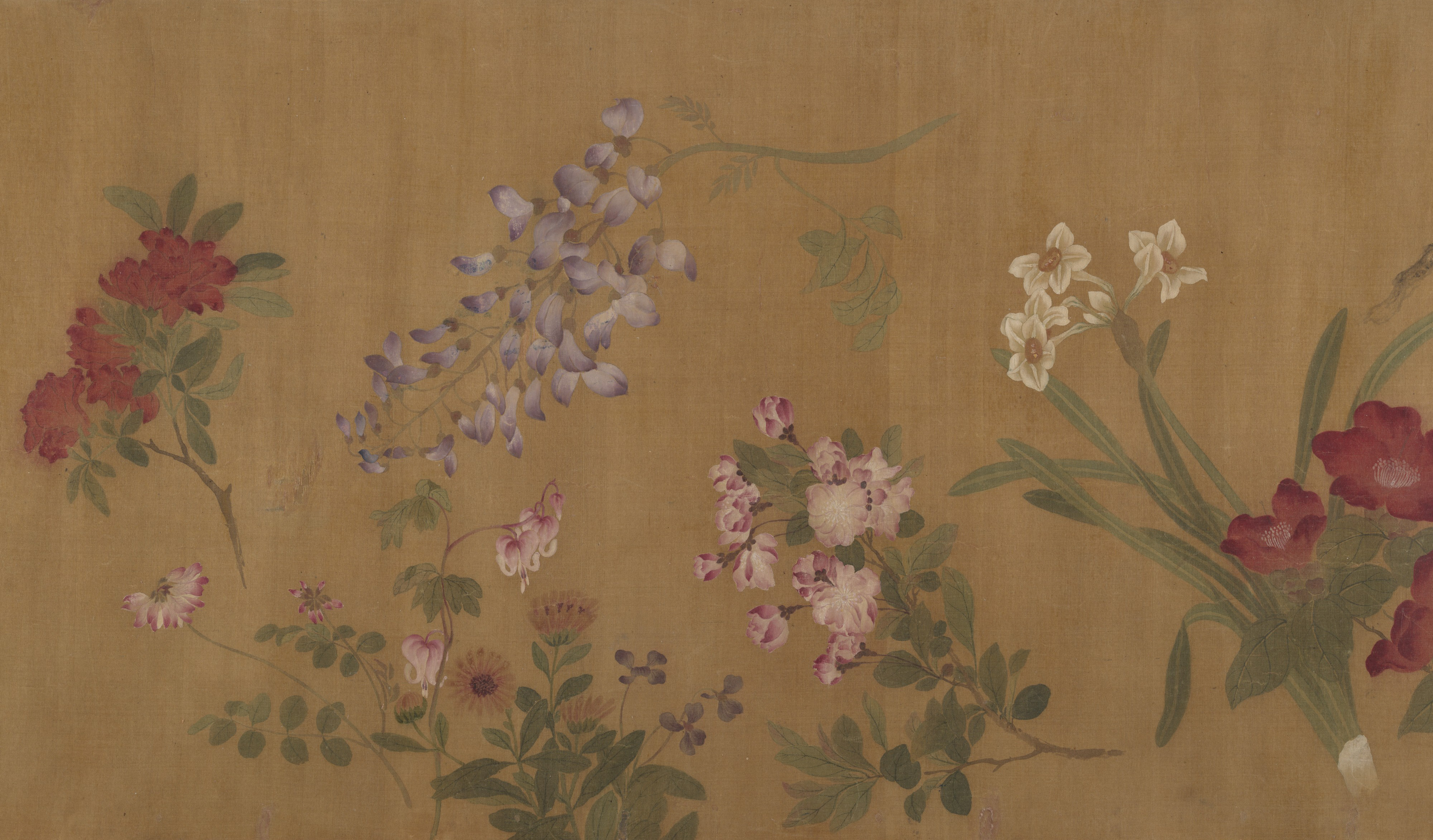
The Hundred Flowers: An Aesthetic Archaeology of Ink, Silk, and the 2026 Silhouette
The Natalie Fashion Atelier archive, in its ongoing pursuit of aesthetic archaeology, presents a singular artifact: a Chinese handscroll executed in ink and color on silk, titled The Hundred Flowers. This work, a masterful rendering of botanical abundance, is not merely a decorative object but a complex text of materiality, composition, and temporal rhythm. For the 2026 luxury silhouette, it offers a profound departure from the digital and the synthetic, grounding haute couture in the logic of the brushstroke and the warp of the silk thread. This research paper deconstructs the classical elegance of the handscroll and explicates how its principles of negative space, chromatic restraint, and sequential unfolding inform our forthcoming collection.
Materiality as a Foundational Lexicon
The handscroll’s substrate—silk—is its primary structural argument. Unlike the rigid, opaque canvas of Western painting, silk is a translucent, fluid membrane. The ink and color do not sit upon it; they inhabit it, bleeding into the weave. This creates a unique luminosity, a depth that is internal rather than applied. For the 2026 silhouette, this dictates a new approach to fabric engineering. We are developing a series of double-faced silks and gauze overlays where the color is not printed but infused, allowing the garment’s inner structure to ghost through its surface. The result is a silhouette that is not a solid volume but a luminous aura, a shape defined by its own internal glow. The handscroll’s materiality teaches us that luxury is not opacity, but the masterful control of translucence.
Compositional Logic: The Architecture of Negative Space
The classical elegance of The Hundred Flowers lies not in the density of its blossoms, but in the breath between them. The artist’s hand has orchestrated a rhythm of presence and absence. The branches do not crowd the field; they arc and retreat, creating pockets of raw silk that are as significant as the painted petals. This is a lesson in negative space as a structural element. For the 2026 silhouette, this translates into a radical rethinking of the garment’s architecture. We are not constructing a dress; we are framing the body with strategic voids. A column gown will feature a single, asymmetrical floral appliqué that originates at the shoulder and dissolves into the silk at the hip, leaving the rest of the form unadorned. The silhouette is defined by the absence of fabric as much as its presence. This is not minimalism; it is compositional precision, where every square centimeter of silk is a deliberate choice.
Chromatic Restraint: The Palette of a Single Season
The handscroll’s palette is deceptively simple: ink black, mineral white, and a spectrum of vegetal hues—vermillion, indigo, ochre, malachite green. There is no chromatic chaos. Each flower is rendered with a single, dominant tone, its petals modeled through washes of that same color, diluted to transparency. This is a monochromatic logic applied to a polyphonic subject. For the 2026 collection, this dictates a chromatic hierarchy. A single silhouette will not be a riot of color. Instead, it will be a study in a single hue—a gradient of peony pink from deep magenta at the hem to a whisper of blush at the shoulder, or a monochrome of ink where the black is layered with charcoal, slate, and silver threads. The luxury is in the nuance, the subtle shift from one value to the next. The handscroll teaches us that color is not a statement; it is a modulation.
The Sequential Silhouette: Unfolding the Body
The handscroll is a temporal object. It is not viewed in a single glance but unfurled from right to left, revealing its narrative in a sequence of visual events. This principle of sequential revelation is the most potent architectural concept for 2026. The static garment is obsolete. We are designing transformable silhouettes that mimic the handscroll’s unfolding. A cocktail dress will feature a detachable train that can be pinned in multiple positions, creating a new silhouette with each adjustment. A jacket will have a reversible lapel that, when turned, reveals an entirely different floral motif, altering the garment’s volume and line. The wearer becomes the curator of her own silhouette, activating the garment’s narrative through movement. This is not fashion as a static object, but as a ritual of discovery.
Structural Borrowing: The Brushstroke as Seam
The handscroll’s ink lines are not outlines; they are boundaries of energy. A single brushstroke defines the curve of a petal, the bend of a stem, the vein of a leaf. This calligraphic line is a structural element. For the 2026 silhouette, we are translating this into sculptural seams. A gown’s bodice will be constructed not with darts but with a single, curving seam that mimics the arc of a chrysanthemum stem. This seam is not hidden; it is celebrated, perhaps embroidered with a fine silver thread to echo the ink’s sheen. The garment’s structure is its calligraphy. The silhouette is not draped or cut; it is drawn onto the body.
Conclusion: The Archive as a Living Dialogue
The Natalie Fashion Atelier does not replicate the past; it extracts its principles. The Hundred Flowers handscroll, with its material intelligence, its compositional mastery, and its temporal logic, provides a rigorous framework for the 2026 silhouette. The result is a collection that is not nostalgic but profoundly contemporary, a dialogue between a 12th-century brush and a 21st-century form. The luxury is in the depth of the research, the precision of the translation, and the quiet authority of a silhouette that knows its own history. This is aesthetic archaeology as a creative act—a method for forging the future from the wisdom of the past.