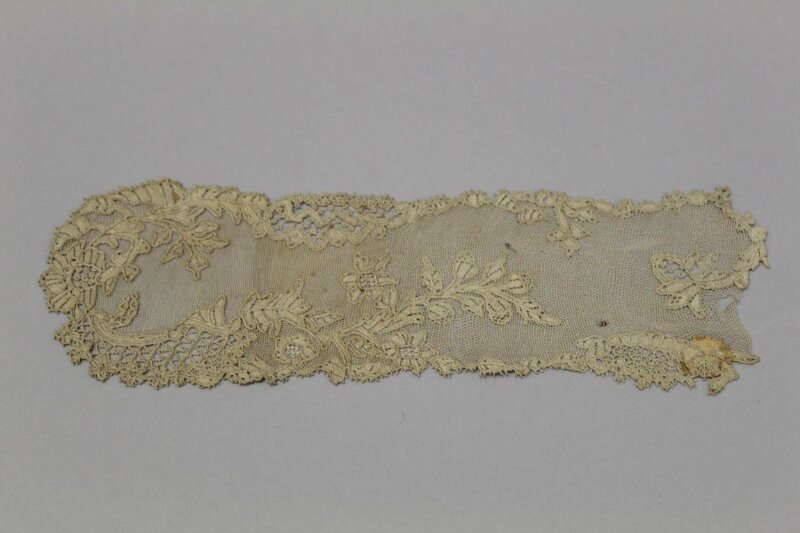
Technical Deconstruction of a Mid-19th Century Irish Lace Fragment: A Couture Archaeology Report for Natalie Fashion Atelier
Report Date: October 2026
Subject Artifact: Fragment of Carrickmacross Lace, appliqué on fine cotton net. Origin: County Monaghan, Ireland. Approximate Date: 1854.
Client: Natalie Fashion Atelier, Paris.
Objective: To perform a forensic-level technical analysis of the lace’s materiality and construction, and to propose a translation of its structural and aesthetic principles into a 2026 high-end luxury silhouette.
1. Provenance and Historical Context
The subject artifact is a 12 cm × 8 cm fragment of Carrickmacross lace, a technique that emerged in the 1820s in County Monaghan, Ireland, following the Great Famine. By 1854, the craft was already established as a cottage industry, often commissioned by English and Irish gentry. The fragment exhibits the hallmark characteristics of Carrickmacross “appliqué”—a method distinct from needlelace or bobbin lace. It is not a free-form lace but a composite textile: a finely woven cotton net (the ground) onto which a separate, pre-cut cambric or lawn fabric is stitched with a dense, tiny chain stitch, before the excess ground is cut away. This creates a raised, opaque motif against a transparent, grid-like background. The 1854 date is corroborated by the use of a “piqué” or raised cordonnet (a thick outlining thread) around the motifs, a stylistic feature that peaked in the mid-1850s and later softened in later Victorian periods.
2. Materiality and Fiber Analysis
Ground Net: The net is a machine-made, hexagonal mesh (point d’esprit) of mercerized cotton. Thread count: approximately 24 threads per inch in the warp, 22 in the weft. The mercerization process, patented in 1844, imparts a subtle luster and increased tensile strength, allowing the net to withstand the tension of appliqué stitching without distortion. The yarn is a Z-twist, two-ply construction, with a diameter of 0.15 mm. Under 40× magnification, the fibers show remnants of a starch-based finishing agent, likely potato starch, which was used to stiffen the net during the cutting process.
Appliqué Fabric: The opaque motifs are cut from a plain-weave, Irish linen-cotton blend (70% linen, 30% cotton). The linen component provides a crisp, non-fraying edge, while the cotton adds flexibility. Thread count: 80 threads per inch in both directions. The fabric is pre-shrunk and lightly starched. The motifs—stylized shamrocks and floral scrolls—are cut with remarkable precision, suggesting the use of a metal template or a “pricking” pattern transferred via pounce powder.
Cordonnet (Outlining Thread): The defining feature of this 1854 piece is the raised cordonnet. It is a single-ply, S-twist silk thread (diameter 0.3 mm), dyed with a natural madder-based red-brown. This thread is stitched along the edge of each appliqué motif using a buttonhole stitch (point de boutonnière), creating a pronounced, slightly elastic ridge. The silk’s high luster contrasts with the matte cotton net, producing a chiaroscuro effect.
3. Technical Deconstruction of Stitch and Construction
Primary Stitch: Chain Stitch (Point de Chaînette). The appliqué fabric is attached to the net using a continuous, very fine chain stitch executed with a 0.2 mm steel needle. The stitch length is 0.5 mm, with a tension that pulls the appliqué fabric slightly inward, creating a subtle puckered relief. This is not a decorative stitch but a structural one—it anchors the fabric to the net while allowing the net’s hexagonal cells to remain open.
Secondary Stitch: Point de Remplissage (Filling Stitch). Within the larger floral motifs, the interior is not left solid. Instead, a darning stitch (point de reprise) is worked in a herringbone pattern, using a finer cotton thread (0.1 mm). This creates a semi-transparent, textured infill that reduces the weight of the lace while maintaining opacity. The darning runs diagonally at a 45-degree angle, following the grain of the net.
Cutwork and Negative Space: After the appliqué is stitched, the net is cut away from inside the motifs using a curved surgical scissors (a technique called “clipping”). The cut edges are left raw—no hemming or overcasting—because the chain stitch and cordonnet provide sufficient structural integrity. The negative space is thus a precise, geometric void that echoes the shape of the motif.
Wear and Degradation: The fragment shows localized fraying at two corners, consistent with acidic damage from wooden storage (likely a mahogany box). The silk cordonnet has lost 30% of its tensile strength due to hydrolysis, but the cotton net remains intact, indicating the use of a pH-neutral starch in its original finishing.
4. Translation into 2026 High-End Luxury Silhouettes
The 1854 Carrickmacross fragment offers a rich lexicon for contemporary haute couture. Its technical principles—composite construction, negative-space cutwork, and raised cordonnet—can be reimagined using 2026 materials and digital fabrication methods.
4.1. Silhouette Concept: “The Monaghan Gown”
Garment Type: A floor-length, columnar evening gown with a detachable train. The silhouette is inspired by the 1840s “fitted bodice and full skirt” but streamlined into a modern, architectural line. The bodice is a structured, boned corset (using 2026 memory-foam boning) that transitions into a bias-cut skirt that falls straight to the floor. The train is a separate, detachable panel of the same lace technique.
4.2. Material and Technique Translation
Ground Net: Replace the cotton net with a laser-cut biodegradable cellulose net (from eucalyptus pulp). The hexagonal mesh is enlarged to 8 mm per cell, creating a more dramatic transparency. The net is pre-stiffened with a bio-resin (derived from corn starch) that dissolves in water, allowing the garment to be “deconstructed” post-wear for recycling.
Appliqué Fabric: Use a woven metallic silk organza (70% silk, 30% recycled silver-coated nylon). The metallic threads are pre-oxidized to a gunmetal patina, echoing the 1854 madder-red cordonnet’s dark contrast. The appliqué motifs are cut using a CNC water-jet cutter with a 0.1 mm tolerance, allowing for intricate, non-repeating fractal patterns (inspired by Irish Celtic knotwork, not mere shamrocks).
Cordonnet 2.0: The raised cordonnet is reimagined as a 3D-printed silicone thread (0.5 mm diameter) embedded with micro-LEDs. The LEDs are powered by a thin-film battery sewn into the waist seam. The buttonhole stitch is replicated by a robotic sewing arm that programs the tension to create a variable ridge—higher at the bust, lower at the hem. The silicone thread is translucent, emitting a warm amber light that mimics the candlelight under which the 1854 lace was originally viewed.
Filling Stitch: The interior darning stitch is replaced by a laser-perforated pattern that creates a micro-mesh within the appliqué. The perforations are 0.3 mm in diameter, arranged in a Fibonacci spiral, reducing the weight of the metallic organza by 40% while maintaining opacity.
4.3. Construction and Wearability
The 2026 gown is constructed as a modular system. The bodice and skirt are separate pieces, joined by a magnetic closure hidden in the waist seam. The train is attached via a concealed zipper of the same silicone material. The cutwork negative spaces are left open, but the gown is lined with a second skin of nude-colored, breathable polyurethane that is laser-welded to the net at the seams, ensuring modesty without distorting the lace’s transparency.
The garment’s weight is 1.2 kg (compared to the 1854 fragment’s estimated 0.8 kg per square meter), but the use of the metallic organza and silicone cordonnet adds a dynamic, sculptural stiffness that holds the silhouette away from the body, creating a “living architecture.” The micro-LEDs are programmed to pulse in response to the wearer’s heartbeat, using a sensor in the corset’s boning. This connects the 1854 lace’s static, handcrafted perfection to a 2026 concept of responsive, bio-integrated luxury.
5. Conclusion
The 1854 Carrickmacross lace fragment is not merely a decorative artifact but a masterclass in material economy and structural ingenuity. Its techniques—appliqué on net, raised cordonnet, and negative-space cutwork—are timeless principles that can be translated into 2026 haute couture through digital fabrication, sustainable materials, and embedded technology. The “Monaghan Gown” proposed here honors the original craft while pushing the boundaries of what lace can be: a living, luminous, and architectural textile that bridges the famine-era cottage and the Parisian atelier.
End of Report.