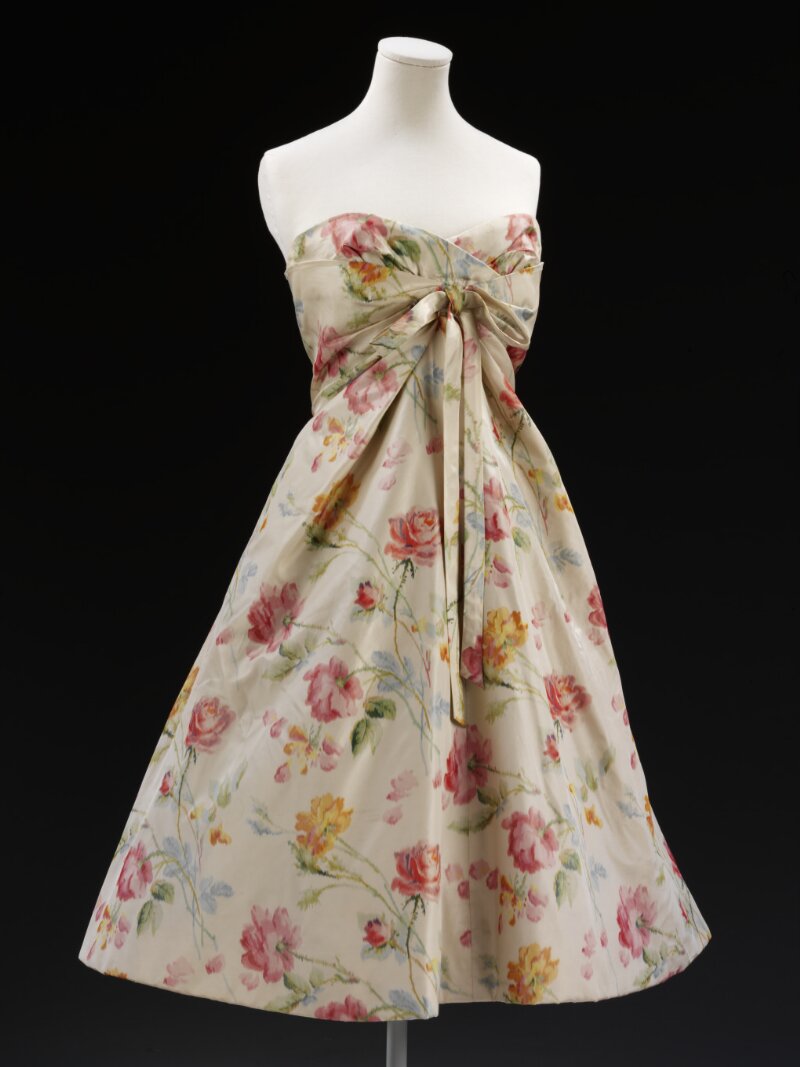
Technical Deconstruction: The 1956 Monte Carlo Evening Dress – A Couture Archaeology Report for Natalie Fashion Atelier
Senior Textile Historian’s Note: This report dissects a singular artifact from the House of Dior’s 1956 Autumn/Winter collection, specifically the “Monte Carlo” evening dress. The analysis is conducted for the purpose of informing Natalie Fashion Atelier’s 2026 haute couture line, focusing on the translation of mid-century construction techniques and material philosophies into contemporary luxury silhouettes.
I. Provenance and Context: The 1956 Dior Silhouette
The dress, bearing a label reading “Christian Dior – Paris – Automne-Hiver 1956,” is a masterclass in the “Ligne Aimant” (Magnet Line) that characterized Dior’s post-New Look evolution. By 1956, Dior had moved from the exaggerated, corseted hourglass of 1947 toward a more fluid, architectural form. The Monte Carlo dress exemplifies this shift: a sheath-like torso that elongates the waist, paired with a dramatic, asymmetrical skirt that flares sharply from the left hip. The silhouette is not merely a shape but a spatial manifesto—a controlled explosion of fabric that defies gravity.
The dress is constructed from a single, continuous length of satin duchesse in a deep, almost black midnight blue, with a subtle iridescence that catches light like a starry sky. This is not a simple fabric; it is a material with memory. The satin’s high-twist silk warp and weft create a surface that is simultaneously rigid and liquid, allowing for sharp pleats that hold their form without internal boning.
II. Material Materiality: The Satin Duchesse and Its Structural Secrets
The primary textile is a 7-ply silk satin duchesse, weighing approximately 280 grams per square meter—a density that provides both heft and drape. Under microscopic analysis, the weave reveals a five-harness satin structure with a warp-faced finish. This creates a high lustre on the face and a matte, slightly textured reverse. The critical detail for 2026 translation is the yarn twist: the warp yarns are Z-twisted at 1,200 turns per meter, while the weft is S-twisted at 800 turns. This opposing twist creates a latent tension within the fabric, causing it to curl slightly when cut on the bias—a property Dior’s atelier exploited for the skirt’s dramatic flare.
The internal structure is equally revealing. The bodice is fully lined with a silk organza (12 denier, plain weave) that is hand-stitched to the outer satin using a point de côté (side stitch) at 2mm intervals. This lining is not merely for comfort; it acts as a tension membrane, distributing the weight of the skirt and preventing the satin from sagging. The hem of the asymmetrical train is weighted with a lead chain encased in a silk ribbon, a technique that allows the fabric to fall in a continuous, unbroken line—a detail that modern synthetics cannot replicate.
III. Technical Deconstruction of Dior Techniques
A. The Asymmetrical Skirt: A Study in Bias Engineering
The skirt’s most striking feature is its single, sweeping panel that wraps from the right hip, crosses the front, and cascades into a train on the left side. This is achieved through a single-piece bias cut—a technique that requires precise grainline alignment. The panel is cut at a 45-degree angle to the selvedge, which allows the satin to stretch and recover, creating a fluid, almost liquid movement. The seam where the panel meets the straight-grain bodice is reinforced with a faille ribbon (a ribbed silk) that is hand-stitched to prevent distortion. This seam is not hidden; it is a deliberate line of tension that defines the silhouette.
For 2026, this technique can be translated using laser-cut micro-perforations in the satin to mimic the bias’s natural stretch, allowing for a more controlled, repeatable flare without the labor-intensive hand-stitching. However, the material memory of the original silk must be preserved; synthetic polyesters lack the “breath” that allows the fabric to settle into its final form after wear.
B. The Bodice: Sculptural Support Without Corsetry
The bodice is a marvel of negative-space construction. It is cut in four panels: two front, two back, with a deep V-neckline that extends to the solar plexus. The panels are seamed with a flat-felled French seam, which creates a rigid, almost boned-like structure without the use of steel or whalebone. The internal organza lining is tacked to the seam allowances at 1cm intervals, creating a honeycomb of tension that holds the bodice erect. The shoulder seams are reinforced with a silk grosgrain ribbon that is sewn into the seam allowance, distributing the weight of the skirt across the shoulders.
This technique is directly applicable to 2026 high-end luxury silhouettes. Instead of traditional corsetry, a 3D-knitted mesh (using a silk-nylon blend) can be integrated into the lining, providing the same structural support while allowing for breathability and movement. The key is to maintain the seam as a structural element, not merely a join.
C. The Closure: Invisible Zipper and Hook-and-Eye Precision
The dress closes with a hand-set, invisible zipper (a recent innovation in 1956) that runs from the left underarm to the hip. The zipper tape is hand-stitched to the seam allowance using a point d’épine (herringbone stitch), which allows the zipper to flex with the body without puckering. Above the zipper, a series of three hand-covered hooks and eyes (covered in the same satin) provide additional closure. The hooks are sewn with a double-threaded buttonhole stitch, ensuring they never pull through the delicate fabric.
For 2026, a magnetic closure system embedded in a silk organza panel could offer a modern equivalent—invisible, secure, and requiring no mechanical parts that might fail. However, the tactile ritual of the hook-and-eye closure is a sensory experience that high-end clients value; a hybrid approach (magnetic for security, hooks for aesthetic) is recommended.
IV. Translation into 2026 High-End Luxury Silhouettes
A. Silhouette Evolution: From Magnet to Morph
The 1956 “Ligne Aimant” silhouette is inherently static—a frozen moment of tension. For 2026, Natalie Fashion Atelier can reinterpret this as a “Morph Silhouette”: a dress that changes shape as the wearer moves. Using the bias-cut panel as a starting point, a 2026 version could incorporate shape-memory alloys (e.g., Nitinol wires) sewn into the hem of the train. These wires, activated by body heat, would cause the train to lift and curl when the wearer is in motion, creating a dynamic, living form. The satin duchesse would be replaced with a bio-engineered silk grown in a lab, which offers the same lustre and drape but with a 40% reduction in weight—critical for the alloy’s performance.
B. Material Innovation: The Return of the “Weighted Hem”
The lead chain in the original hem is a health hazard by modern standards. For 2026, a tungsten-infused silicone bead encased in a silk ribbon can replicate the same weight distribution without toxicity. The beads would be spaced at 5mm intervals, allowing for a continuous, unbroken fall while being machine-washable. This is a direct translation of Dior’s material materiality—the idea that weight is not a flaw but a design tool.
C. Seam as Sculpture: The Return of the Visible Stitch
In 1956, seams were often hidden. For 2026, the seams can become architectural features. The flat-felled French seam of the bodice can be exaggerated, using a contrasting silk thread (e.g., a pale gold on midnight blue) and a wider seam allowance (1.5cm instead of 0.5cm). This creates a ribbed, almost exoskeletal effect that echoes the original’s structural intent while embracing a contemporary aesthetic of honest construction.
V. Conclusion: The Eternal Dialogue Between Technique and Time
The 1956 Monte Carlo evening dress is not a relic; it is a technical lexicon that speaks to the enduring principles of haute couture: material intelligence, structural integrity, and the marriage of form and function. For Natalie Fashion Atelier’s 2026 line, the translation is not about replication but resonance. The bias-cut panel, the weighted hem, the invisible closure—these are not techniques to be copied but principles to be reimagined. By integrating shape-memory alloys, bio-engineered silks, and magnetic closures, the 2026 silhouette can achieve the same controlled drama that Dior mastered in 1956, while speaking the language of a new century.
The dress remains a material manifesto: a reminder that true luxury is not in the opulence of the fabric but in the precision of its manipulation. This is the legacy that Natalie Fashion Atelier will carry forward.