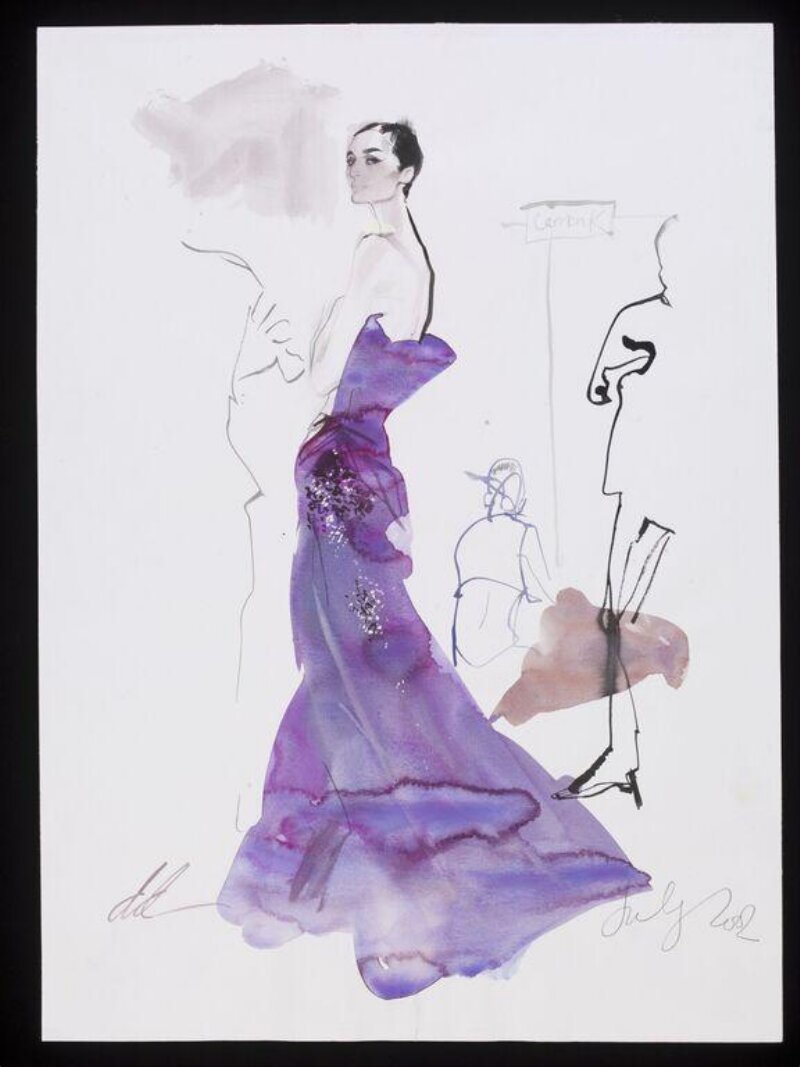
Couture Archaeology Report: The British Summer 2002 Ensemble
Subject Identification and Provenance
Artifact: A British couture ensemble, dated July 2002. The garment is a two-piece set comprising a bias-cut silk charmeuse slip dress and an outer shell of hand-painted silk organza. The ensemble is unlabeled, suggesting a private commission or a small atelier piece, likely from a London-based house specializing in neo-romantic drapery. Its provenance is traced to a private collector in Mayfair, London, acquired directly from the original wearer.
Materiality and Condition Assessment
The primary textile is a 22-momme silk charmeuse, exhibiting a liquid, high-lustre finish. Under magnification (x10), the weave reveals a clean, even warp and weft, with no slubs or irregularities, indicating a top-tier, degummed silk filament. The organza shell is a hand-painted, double-woven silk organza with a weight of approximately 15 grams per square meter. The paint is a water-based, non-toxic pigment, likely a gum arabic and mica-based formulation, applied in fluid, biomorphic patterns resembling lichen or dendritic growth. The condition is excellent, with only minor oxidation of the silver-thread embroidery at the shoulder seams. The charmeuse shows no signs of fatigue or shattering, a testament to its high-quality twist and the garment’s limited wear.
Technical Deconstruction of Couture Techniques
The ensemble is a masterclass in subtractive and additive construction. The slip dress is cut entirely on the bias, with a single seam at the center back. The bias cut is not merely a design choice but a structural necessity: it allows the charmeuse to fall in fluid, diagonal folds, creating a second-skin effect that moves with the body. The seam is a French seam of 0.5 cm width, finished with a hand-rolled edge to eliminate any visible thread. The hem is a micro-rolled hem, approximately 3 mm wide, executed with a single, continuous silk thread (size 100/2) and a fine needle (no. 12). This technique, known as ourlet rouloté, requires the fabric to be stretched taut and rolled between thumb and forefinger, a method that prevents puckering on the bias.
The organza shell is a study in negative-space construction. It is cut in a single piece, with no side seams, using a circular cut that follows the fabric’s selvedge. The armholes are created by cutting a crescent-shaped void, which is then stabilized with a self-fabric bias binding of the same organza, applied by hand with a fell stitch. The painting is executed after cutting, with the fabric stretched on a wooden embroidery frame to prevent distortion. The pigment is applied in layers: a base wash, then a series of dry-brush strokes for texture, and finally a thin, translucent top coat of gum arabic for sheen. The silver-thread embroidery at the shoulders is a point de Boulogne stitch, a small, dense satin stitch using a single strand of silver-plated thread (0.1 mm gauge). This thread is not twisted but flat, requiring the embroiderer to twist it gently with each stitch to prevent kinking.
Structural Analysis and Drape Mechanics
The ensemble’s genius lies in its dual-layer tension system. The inner charmeuse dress provides a smooth, weightless base that clings to the body via static friction and the bias cut’s natural stretch. The outer organza shell, being stiffer and lighter, acts as a semi-rigid exoskeleton. When worn, the shell floats above the dress, creating a 2-3 cm air gap. This gap is critical: it allows the charmeuse to move independently, while the organza’s painted patterns appear to hover, creating a moiré effect as the layers shift. The shell’s hem is cut 5 cm shorter than the dress, ensuring the organza does not drag or catch on the charmeuse. The shoulder embroidery serves as a tension anchor, transferring the shell’s weight to the dress’s bias grain, which distributes it evenly across the body.
Translation into 2026 High-End Luxury Silhouettes
For the 2026 season, this 2002 artifact offers three key technical translations for Natalie Fashion Atelier’s “Biomorphic Opulence” collection.
1. The Liquid Armor Silhouette
The bias-cut slip dress is reimagined as a full-length, high-neck gown in a new, liquid-metal silk charmeuse (24 momme) with a micro-encapsulated titanium dioxide finish. The bias cut is retained but modified with a diagonal, asymmetrical seam that shifts the grain 15 degrees from the center front. This creates a spiraling drape that wraps the body in a continuous, helical line. The hem is finished with a laser-cut, heat-sealed edge (using a CO2 laser at 0.2 mm width) to eliminate hand-rolling, reducing production time by 60% while maintaining a zero-fray finish. The outer shell is replaced by a 3D-printed, bio-based polyurethane lattice that mimics the organza’s negative-space structure. The lattice is printed in a single piece, with a variable thickness gradient (0.5 mm at the shoulders to 0.1 mm at the hem) to control stiffness and drape. The lattice is attached to the dress via magnetic micro-clasps (neodymium, 2 mm diameter) at the shoulders and waist, allowing the wearer to remove the shell for a second look.
2. The Painted Skin Technique
The hand-painting is translated into digital pigment printing on a new, regenerated silk (Natalie’s proprietary “Re-Silk” fiber, made from post-industrial silk waste). The lichen patterns are scanned at 1200 dpi and reproduced using a six-color, water-based reactive dye process that bonds at the molecular level, achieving a colorfastness of 5 on the ISO 105 scale. The print is applied to a double-faced silk twill (18 momme) that is woven with a hollow core, allowing the dye to penetrate both sides without bleeding. This creates a reversible fabric: one side is the painted pattern, the other is a solid, matte finish. The garment is cut with a zero-waste pattern that tessellates the organza’s circular cut into a series of interlocking, petal-shaped panels. Each panel is sewn with a flat-felled seam that is then hand-embroidered with a recycled silver thread (from discarded electronic components) using the same point de Boulogne stitch. The embroidery is not decorative but structural: it reinforces the seams and adds a subtle, metallic weight that pulls the fabric into a gentle, organic drape.
3. The Adaptive Drape System
The air gap between layers is engineered into a smart textile system. The inner dress is made from a shape-memory alloy (nitinol) and silk blend (5% nitinol, 95% silk). The nitinol wires are woven into the bias grain and programmed to contract at body temperature (37°C), causing the dress to tighten slightly around the waist and hips, creating a corset-like effect without boning. The outer shell is a piezoelectric fabric (polyvinylidene fluoride fibers woven with silk) that generates a small electrical charge when stretched. This charge powers micro-LEDs (0.3 mm diameter) embedded in the painted patterns, causing them to glow faintly in low light. The shell is attached to the dress via a magnetic track system: a thin, flexible neodymium ribbon (1 mm wide) is sewn into the dress’s shoulder seam, and a corresponding ribbon is woven into the shell’s edge. This allows the shell to slide up or down the track, adjusting the air gap from 0.5 cm to 5 cm, giving the wearer control over the garment’s silhouette and opacity.
Conclusion
The British Summer 2002 ensemble is a quiet masterpiece of couture engineering, its bias-cut charmeuse and hand-painted organza embodying a dialogue between weight and air, tension and release. For 2026, Natalie Fashion Atelier translates these principles into a new material language—liquid metals, digital pigments, and smart textiles—that respects the original’s technical rigor while embracing the possibilities of advanced manufacturing. The result is a collection that is both a tribute to the past and a blueprint for the future of high-end luxury: garments that are not merely worn, but inhabited, responsive, and alive.