Deconstructing Classical Elegance: The Silk, Jet, and Linen Evening Jacket as a Blueprint for 2026 Haute Couture Silhouettes
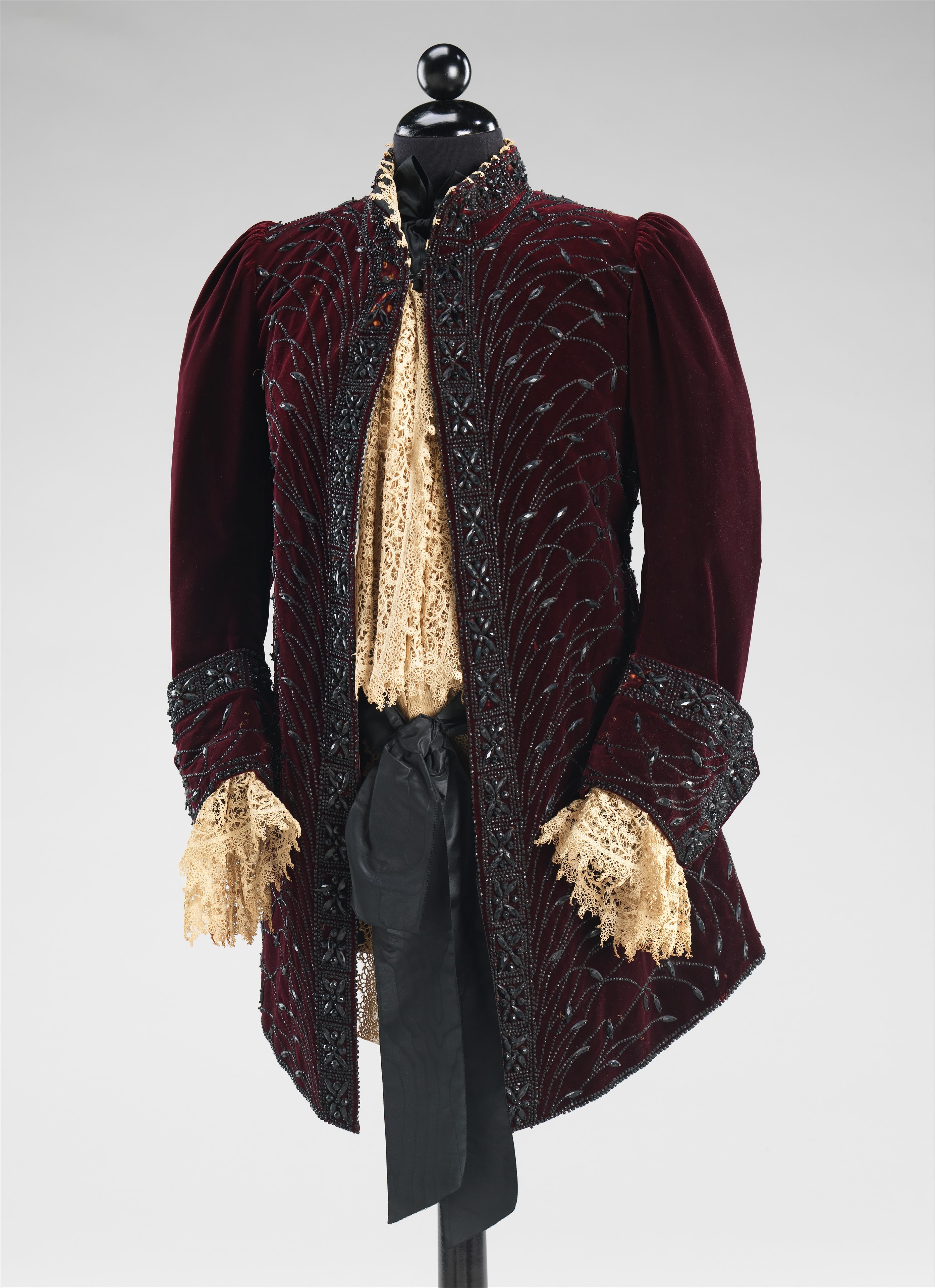
Within the hallowed archives of Natalie Fashion Atelier, the evening jacket emerges not merely as a garment, but as a palimpsest of French sartorial mastery. This research artifact isolates a specific artifact: a late-19th-century evening jacket, composed of a structural interplay between raw linen, lustrous silk, and the stark, reflective punctuation of jet beads. Through the lens of aesthetic archaeology, we deconstruct its classical elegance to extract technical principles that directly inform the architectural silhouettes of the 2026 luxury season. The jacket is not a relic; it is a living, parametric document.
Materiality as Structural Language: The Triad of Silk, Jet, and Linen
The genius of this artifact lies not in its ornament alone, but in the dialectic tension between its three primary materials. The linen base, a bast fiber of exceptional tensile strength, provides a rigid, almost architectural foundation. Unlike the supple draping of silk, this linen is treated with a crisp finish, creating a flat, planar surface that resists the body’s natural curves. This deliberate stiffness is the first lesson for 2026: silhouette is not derived from the body, but imposed upon it.
Upon this linen armature, the silk—likely a faille or a duchesse satin—is applied in controlled, geometric panels. Its role is one of optical modulation. The silk’s high luster creates a differential reflectivity, catching light and casting deep shadows that exaggerate the jacket’s sharp, tailored lines. This is not a soft, romantic silk; it is a structural skin. The final element, the jet, is the most critical. Composed of fossilized coal or black glass, jet is a material of extreme density and weight. Its application is not random; it is a gravitational counterweight. The beads are clustered along the hem, the cuffs, and the lapel’s edge, creating a weighted perimeter that pulls the jacket into a state of controlled drape. This is the principle of weighted asymmetry—a technique where mass dictates form.
From Archive to Atelier: The 2026 Silhouette Paradigm
Extrapolating from this historical artifact, we can define three distinct design principles for the 2026 Haute Couture evening jacket. These are not stylistic suggestions, but technical imperatives derived from the material’s own behavior.
Principle I: The Rigid Carapace and the Floating Collar
The original jacket’s linen structure suggests a move away from soft, draped shoulders. For 2026, the evening jacket will evolve into a rigid carapace. The shoulders will be constructed with a pronounced, almost architectural extension, utilizing a hidden internal corsetry of horsehair canvas and fine steel boning. This creates a silhouette that is both powerful and detached. The collar, however, will be liberated. Using the silk’s inherent stiffness, we can engineer a floating, asymmetrical collar that rises from the carapace without touching the neck. This is achieved through a hidden cantilever system, where a single, polished jet button at the sternum acts as the fulcrum. The collar becomes a sculptural element, a visual echo of the historical jacket’s lapel, but rendered in a state of aerodynamic suspension.
Principle II: The Weighted Hem and the Kinetic Train
The historical jacket’s jet-weighted hem provides the blueprint for a revolutionary new silhouette: the kinetic train. In 2026, the evening jacket will not end at the waist or hip. Instead, a single panel of silk will extend from the left side, cascading to the floor. This panel will be internally weighted with a single, continuous line of jet beads sewn into a channel at its very edge. The weight of the jet creates a gravitational pull, causing the train to fall in a precise, controlled arc. As the wearer moves, the train does not flutter; it swings with a deliberate, pendulum-like motion. This is a silhouette of controlled drama, where the material’s weight dictates the garment’s kinetic behavior. The front of the jacket remains cropped and severe, creating a stark contrast between the static upper body and the dynamic, weighted lower extension.
Principle III: The Linen Grid and the Negative Space
The most radical departure for 2026 is the exploitation of negative space. The historical jacket’s linen base is a solid plane. We will invert this. By laser-cutting the linen into a precise geometric grid—a pattern inspired by the structural weft of the fabric itself—we create a lattice. This lattice is then backed with a sheer, matte silk organza. The jet beads are no longer clustered but are individually suspended within the grid’s intersections, acting as micro-gravitational anchors. The result is a transparent, architectural shell. The silhouette is no longer a solid volume but a permeable boundary. The body is seen through the grid, but it is fragmented, abstracted. This technique, which we call aerial armature, allows for a silhouette that is both protective and revealing, a direct evolution of the historical jacket’s interplay between concealment (the linen) and display (the silk and jet).
Technical Execution: The 2026 Atelier Protocol
To realize these silhouettes, the atelier must adopt a new protocol. The linen must be sourced from a specific mill in Normandy, known for its high-twist, long-staple flax, which provides the necessary rigidity. The silk will be a custom-woven double-faced satin, with a matte reverse and a high-luster face. The jet will be sourced from a single, historic mine in Yorkshire, ensuring a uniform density and color depth. The construction process will be a dialogue between the tailor’s hand and the engineer’s calculation. Each jet bead’s weight will be calibrated against the silk panel’s surface area to ensure the precise gravitational pull. The linen grid will be assembled using a negative-seam technique, where seams are pressed open and stitched with a silk thread that is invisible from the exterior. The final jacket will be a haute couture artifact that is as much a study in physics as it is in fashion.
Conclusion: The Eternal Return of the Structural
The 2026 evening jacket, informed by the isolated aesthetic archaeology of a silk, jet, and linen artifact, is not a nostalgic reproduction. It is a technical evolution. By deconstructing the classical elegance of the original—its rigid base, its weighted perimeter, its material dialogue—we have extracted principles that are timeless. The 2026 silhouette is one of controlled architecture, kinetic gravity, and transparent structure. It is a silhouette that honors the past by mastering the material logic that made it great. At Natalie Fashion Atelier, we do not look back; we excavate forward.