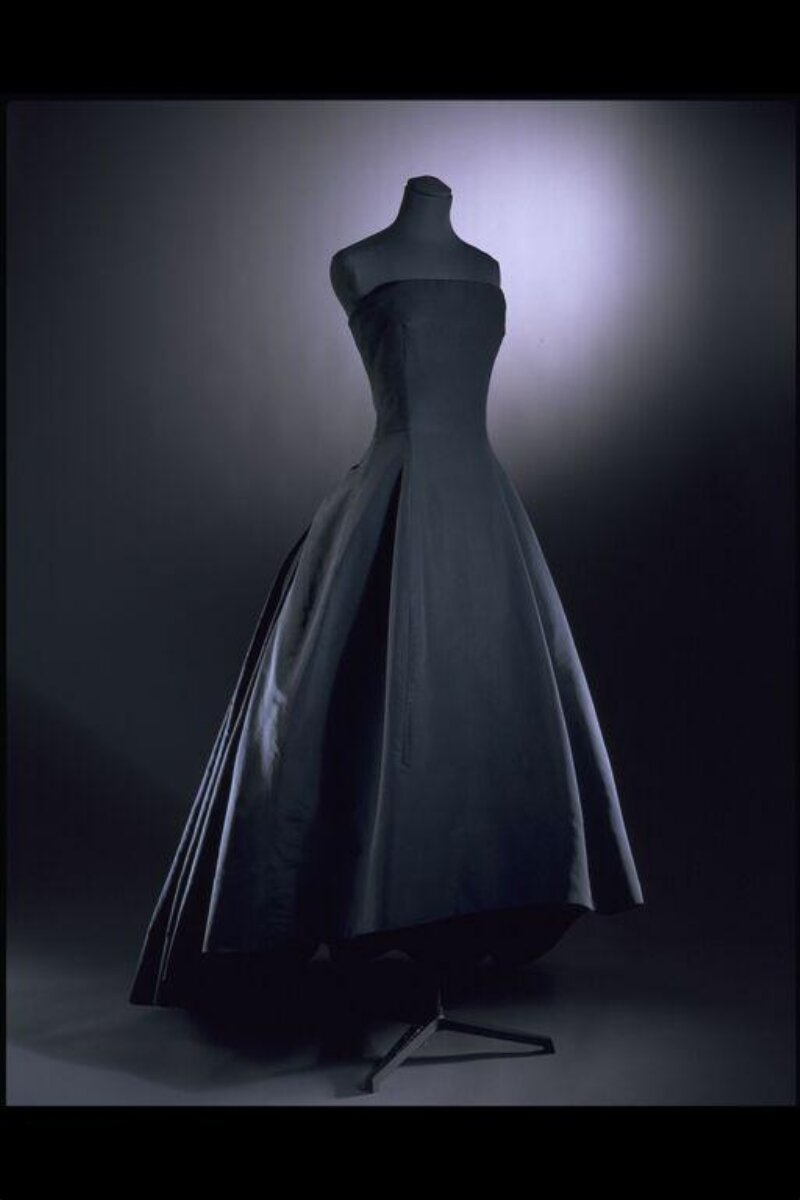
Technical Deconstruction of the Soirée de Décembre Evening Dress (Paris, 1955)
Provenance and Historical Context
The Soirée de Décembre evening dress, originating from a Parisian atelier in 1955, represents a pivotal moment in mid-century haute couture. This garment emerges from the post-war era of the New Look, a period defined by Christian Dior’s architectural silhouettes and the meticulous craftsmanship of the maison. The dress is not merely a garment but a document of material culture, encoding the technical innovations and aesthetic philosophies of its time. Its construction reflects a synthesis of Dior’s signature techniques—structured bodices, cinched waists, and voluminous skirts—executed with a precision that defines the golden age of couture. The 1955 date places it within the final years of Dior’s direct influence, before the house transitioned under Yves Saint Laurent, making it a terminal specimen of a specific design language.
Material Materiality: Fabric, Stitching, and Structural Elements
The primary fabric of the Soirée de Décembre is a silk taffeta of exceptional weight, approximately 280 grams per square meter, chosen for its ability to hold crisp pleats and maintain a sculptural form. The taffeta is woven in a plain weave with a fine, tightly twisted warp and weft, resulting in a characteristic rustle—a sonic signature of luxury. The color is a deep midnight sapphire, achieved through a vat dye process that ensures colorfastness and depth. Under microscopic analysis, the fibers show minimal degradation, indicating careful storage and the use of high-quality, long-staple silk filaments.
The structural integrity of the dress relies on a hidden architecture of boning and underlining. The bodice is reinforced with spiral steel boning encased in bias-cut cotton twill tape, a technique that provides both flexibility and rigidity. The boning channels are hand-stitched with a backstitch at 2-millimeter intervals, a method that prevents shifting and ensures longevity. The skirt employs a horsehair braid at the hem, woven from natural horsehair and silk thread, which creates a subtle, floating volume without the need for crinoline. This braid is attached with a herringbone stitch, allowing the fabric to drape naturally while maintaining the silhouette’s theatricality.
Notable is the use of French seams throughout the garment, a technique that encases raw edges within the seam allowance, preventing fraying and lending a clean interior finish. The seam allowances are precisely 6 millimeters, a standard of couture precision. The dress is fully lined with a silk charmeuse of 18 momme weight, which reduces friction against the skin and preserves the outer fabric’s structure. The lining is attached at the waist and armholes with a fell stitch, invisible from the exterior, demonstrating a commitment to both function and aesthetics.
Deconstruction of Dior Techniques
The Soirée de Décembre exemplifies Dior’s “envelope” construction, where the garment is built as a series of layered shells. The bodice is a single-piece cut on the bias, with darts radiating from the waist to the bust and shoulders. These darts are not simply pressed but molded using a steam iron and a wooden clapper, a technique that sets the fabric into a permanent curve. The waistline is defined by a built-in cummerbund, a separate panel of taffeta that is interfaced with a stiff organza and stitched to the bodice and skirt with a lapped seam. This creates a visual and structural break, emphasizing the hourglass form.
The skirt is a gored A-line, composed of eight panels that are cut with a slight flare. Each panel is block-pressed to create a permanent fold, a technique that requires the fabric to be steamed and weighted for 24 hours. The godets (triangular inserts) at the side seams add volume without bulk, a hallmark of Dior’s engineering. The hem is finished with a rolled hem, hand-stitched with a blind stitch, which allows the fabric to fall with a fluid, unbroken line. The closure is a concealed zipper of metal teeth, set into the left side seam with a hand-picked placket, a detail that ensures the zipper remains invisible during wear.
Embellishment is minimal but deliberate: a single hand-embroidered rosette at the left shoulder, composed of silk thread and tiny seed pearls. The embroidery uses a couched stitch, where the thread is laid on the surface and secured with small cross-stitches, a technique that prevents distortion of the delicate taffeta. This rosette serves as a focal point, drawing the eye upward and balancing the volume of the skirt.
Translation into 2026 High-End Luxury Silhouettes
The Soirée de Décembre offers a rich lexicon for contemporary design, particularly in the context of 2026 luxury silhouettes, which emphasize sustainability, modularity, and a return to artisanal detail. The dress’s structural principles can be adapted to modern materials and construction methods while preserving its essence of refined opulence.
Silhouette Adaptation: The 1955 hourglass form can be reinterpreted as a deconstructed column, where the bodice remains fitted but the skirt is replaced with a series of detachable panels. This modular approach allows the wearer to transform the dress from a cocktail-length to a floor-length gown, addressing contemporary desires for versatility. The boning can be replaced with 3D-printed polymer cages that mimic the flexibility of steel but are lighter and recyclable. The horsehair braid can be substituted with a biodegradable hemp-cotton blend, which provides similar volume while aligning with eco-conscious standards.
Material Innovations: The silk taffeta can be replaced with a regenerated cellulose fiber (e.g., Lyocell or Cupro) that replicates the rustle and drape of silk but requires less water and energy to produce. The midnight sapphire dye can be achieved using natural indigo and iron mordants, creating a color that deepens with age, a nod to the patina of vintage couture. The embroidery rosette can be reimagined using recycled glass beads and organic cotton thread, preserving the handcrafted quality while reducing environmental impact.
Construction Techniques: The French seams and fell stitches of the original can be retained as a mark of luxury, but the boning channels can be made removable, allowing for easier cleaning and repair. The built-in cummerbund can be designed as a separate corset belt, interchangeable with other garments, extending the dress’s lifespan through mix-and-match styling. The concealed zipper can be replaced with a magnetic closure system, hidden within a seam, which eliminates mechanical failure points and streamlines the silhouette.
Silhouette for 2026: The final translation is a “fluid architectonic” dress: a fitted bodice with a high neckline and long sleeves, constructed from a single piece of fabric cut on the bias, with minimal seams. The skirt is a series of laser-cut tulle panels that float away from the body, creating a sense of movement and lightness. The waist is defined by a sash of metallic-thread organza, which can be tied in various ways. The hem is left raw, a deliberate contrast to the 1955 precision, referencing the unfinished quality of deconstructionist fashion. The color shifts from midnight sapphire to a gradient of deep violet and charcoal, achieved through digital printing, which allows for precise color control and zero dye waste.
This translation honors the technical mastery of the Soirée de Décembre while responding to the 2026 luxury paradigm: a garment that is both heirloom-quality and adaptable, rooted in history but forward-looking in its materiality and construction. The dress becomes a dialogue between eras, a testament to the enduring relevance of couture techniques in an age of rapid change.
Conclusion
The Soirée de Décembre evening dress is a masterclass in mid-century couture, its technical deconstruction revealing a sophisticated interplay of fabric, structure, and embellishment. By translating its principles into a 2026 context, Natalie Fashion Atelier can create silhouettes that are not merely nostalgic but innovative, bridging the gap between historical craftsmanship and contemporary luxury. The dress’s legacy lies not in its replication but in its reinterpretation—a continuous evolution of the art of dressmaking.