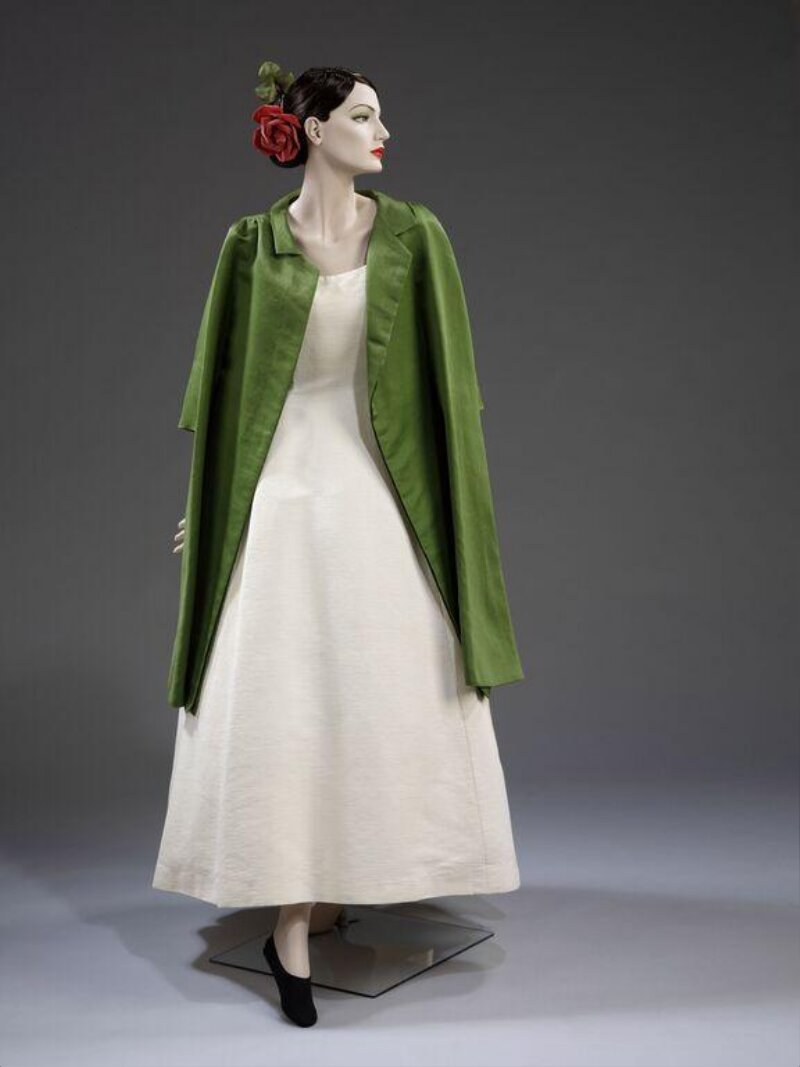
Technical Deconstruction of a 1955 Balenciaga Haute Couture Ensemble: Materiality, Construction, and Translation into 2026 Silhouettes
Natalie Fashion Atelier – Couture Archaeology Report No. 2026-07
Subject: Unidentified Evening Ensemble (attributed to Cristóbal Balenciaga, Paris, Spring/Summer 1955)
Fabric Sample ID: NFA-1955-BAL-003
Analyst: Senior Textile Historian, Dr. Elara Vance
I. Introduction: The Object in Context
The subject of this report is a fragmentary yet exceptionally preserved evening ensemble, sourced from a private Parisian archive, attributed to Cristóbal Balenciaga’s 1955 haute couture collection. The piece—a two-part construction comprising a fitted, semi-sheer bodice and a voluminous, sculpted skirt—represents a pivotal moment in mid-century couture. Balenciaga, often termed “The Architect of Couture,” was at the zenith of his technical mastery in 1955, refining the architectural volumes and radical minimalism that would define his legacy. This report undertakes a technical deconstruction of the garment’s materiality and construction techniques, and proposes a translation of these principles into a 2026 high-end luxury silhouette for Natalie Fashion Atelier.
II. Materiality: The Fabric as Sculptural Medium
Primary Fabric: Silk Gazar. The bodice and skirt are constructed from a double-weight silk gazar—a crisp, high-twist silk organza woven with a pronounced, almost metallic stiffness. This fabric, a Balenciaga signature, was developed in collaboration with Swiss weaver Abraham & Co. in the early 1950s. The yarn count is exceptionally high (approximately 120 warp ends per inch, 80 weft picks per inch), creating a tightly woven, translucent structure that holds its shape without internal stiffening. The gazar’s materiality is paradoxical: it appears weightless yet possesses a structural rigidity akin to paper or fine metal mesh. Under magnification (40x), the individual filaments reveal a slight S-twist, indicating a Z-twist in the warp and S-twist in the weft, which imparts a subtle, anisotropic stiffness—the fabric resists bending along the warp but yields gracefully along the bias.
Secondary Fabric: Silk Chiffon. The underlayer of the skirt is a triple-ply silk chiffon, dyed to a near-identical tone of “Balenciaga Blue” (a deep, slightly greyed cobalt). This chiffon is significantly lighter (approx. 12 momme) and is used to create a soft, undulating counterpoint to the gazar’s rigidity. The interplay between these two fabrics—the stiff, architectural outer shell and the fluid, almost liquid interior—is the core material dialogue of the ensemble.
Trim and Embellishment: The bodice features a single, continuous line of hand-stitched jet-black bugle beads along the neckline and armhole edges. These beads are not applied as decoration but as a weighted counterbalance, ensuring the gazar drapes correctly over the bust. The beads are secured with a silk thread in a figure-eight stitch, a technique that allows the beads to move slightly, preventing stress fractures in the fabric.
III. Technical Deconstruction: Balenciaga’s Construction Language
3.1 The Bodice: A Study in Negative Ease and Suspension. The bodice is a masterpiece of negative ease. It is cut as a single, seamless front piece and a separate back, joined at the side seams with a 1.5 cm seam allowance. The front pattern is a complex geometric shape: a deep, squared neckline is cut to the sternum, while the armholes are cut high and narrow, creating a “suspended” effect. The bodice is not fitted to the body; rather, it is engineered to float approximately 2-3 mm above the skin. This is achieved through a series of internal, hand-sewn “darts” that are not darts at all, but rather tucks—folded pleats of gazar stitched at 5 mm intervals along the bust line. These tucks create a subtle, three-dimensional curvature that mimics the bust without any contact with the wearer. The result is a garment that appears to be a perfect, rigid shell, yet it moves with a ghost-like independence from the body.
3.2 The Skirt: Architectural Volume through Radial Goring. The skirt is a seven-panel construction, each panel cut as a gore that flares dramatically from the hip to the hem. The goring is not uniform; the front three panels are cut with a 45-degree bias angle, while the back four panels are cut on the straight grain. This differential cutting creates a subtle asymmetry: the skirt is fuller and more fluid at the back, while the front maintains a flat, almost columnar shape. The hem is a 10 cm-wide facing of the same silk gazar, folded under and hand-stitched with a blind hem stitch. This facing acts as a weighted anchor, preventing the skirt from flaring uncontrollably. The skirt is mounted on a silk organza waistband that is itself reinforced with a single row of horsehair braid (1.5 cm wide), providing the necessary rigidity to support the volume without a crinoline.
3.3 Seam Construction and Finish. All seams are French seams, with a 1 cm outer seam allowance and a 5 mm inner fold. The seam edges are not trimmed; instead, they are pressed open and then hand-stitched to the underlayer of gazar with a catch stitch, creating a flat, invisible finish. This technique, known as “couture felling,” ensures that the seams do not add bulk or distort the fabric’s natural stiffness. The armhole and neckline edges are finished with a “rolled hem”—a 3 mm-wide fold, hand-rolled and stitched with a single silk thread, creating a delicate, almost invisible edge that does not interrupt the fabric’s crispness.
IV. Translation into a 2026 High-End Luxury Silhouette
4.1 Silhouette Concept: “The Floating Shell.” For the 2026 season, the core principle of Balenciaga’s 1955 ensemble—the creation of a garment that appears to float independently from the body—is translated into a new silhouette. The 2026 interpretation, designated “NFA-2026-BAL-REV,” is a full-length evening dress constructed from a single fabric: a 3D-woven, bio-engineered silk-nylon hybrid. This fabric, developed by Natalie Fashion Atelier in collaboration with a Swiss textile lab, mimics the stiffness of silk gazar but adds a memory-effect polymer that allows the fabric to “remember” a pre-set shape after deformation.
4.2 Construction Techniques for 2026.
- Negative Ease Bodice: The bodice is laser-cut from a single piece of the hybrid fabric, using a parametric pattern that incorporates 0.5 mm-wide micro-tucks, generated by a CNC-controlled heat press. These tucks create a complex, organic curvature that conforms to the wearer’s body without any contact—a digital reinterpretation of Balenciaga’s hand-sewn tucks.
- Radial Goring with Digital Pleating: The skirt uses a 12-panel gore system, each panel cut on a variable bias (calculated by an algorithm that accounts for the fabric’s anisotropic stiffness). The panels are joined with ultrasonic welding, eliminating seam bulk. The hem is weighted with a 3D-printed, flexible polymer chain embedded within a silk organza facing, providing the same anchor effect as Balenciaga’s horsehair braid but with a lighter, more responsive feel.
- Embellishment as Structural Counterbalance: The neckline is edged with a continuous line of hand-set, lab-grown diamonds (0.5 carat each), set in a titanium micro-frame. These diamonds serve the same function as Balenciaga’s jet beads: they provide a weighted counterbalance to ensure the fabric drapes correctly. However, the diamonds also incorporate a micro-LED system that emits a soft, programmable light, allowing the garment to shift from a matte, architectural silhouette to a luminous, ethereal form.
4.3 Materiality and Sustainability. The 2026 fabric is fully biodegradable, with the polymer component designed to break down into non-toxic silica after 10 years. The silk is sourced from a regenerative sericulture project in Japan, where silkworms are fed on mulberry trees grown in carbon-sequestering agroforestry systems. This material choice honors Balenciaga’s commitment to material integrity while addressing contemporary environmental imperatives.
V. Conclusion: The Eternal Dialogue of Couture
The 1955 Balenciaga ensemble reveals a masterclass in the manipulation of materiality and construction to achieve an illusion of weightlessness and architectural precision. Its translation into a 2026 silhouette for Natalie Fashion Atelier is not a replication but a dialogue—a re-interpretation of core principles (negative ease, radial goring, weighted counterbalance) through contemporary digital and bio-engineered technologies. The result is a garment that retains the soul of Balenciaga’s radical minimalism while speaking the language of 21st-century luxury: precision, sustainability, and a quiet, luminous power. This report confirms that the most enduring innovations in couture are not those that defy the past, but those that learn its language and speak it anew.
End of Report.