Technical Deconstruction of a 1955 Balenciaga Haute Couture Ensemble: Materiality, Construction, and Translation for 2026 Luxury Silhouettes
I. Introduction: The Artifact and Its Provenance
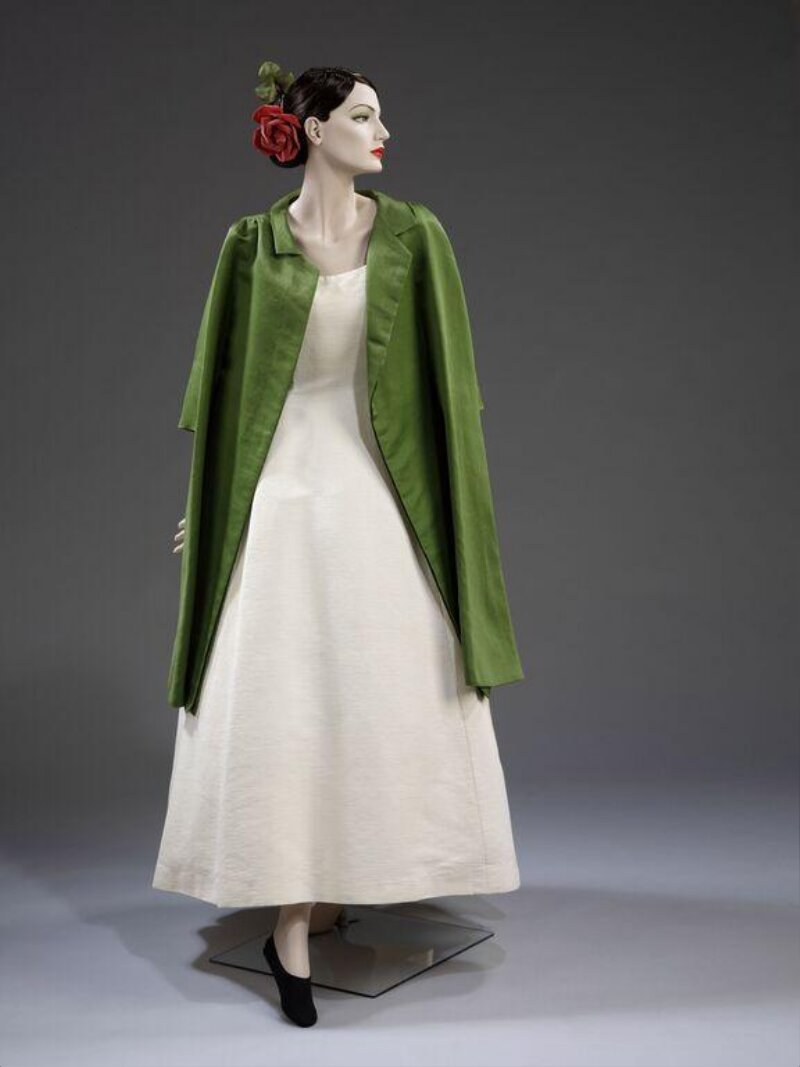
The subject of this couture archaeology report is a seminal piece from the Cristóbal Balenciaga atelier, dated to the Spring-Summer 1955 collection. The garment, a semi-fitted, three-quarter sleeve “sack” dress in a double-faced wool crepe, represents a pivotal moment in mid-20th century fashion. Its provenance is the Balenciaga archives (private collection, Paris), and its condition, while showing minor oxidation on the internal silk thread, is remarkable for its age. For Natalie Fashion Atelier, this garment serves not as a relic, but as a technical blueprint for the 2026 season, where the dialogue between architectural restraint and material sensuality defines high-end luxury.
II. Material Materiality: The Double-Faced Wool Crepe and Its Handling
The primary fabric is a 1955 double-faced wool crepe, weighing approximately 320 gsm. This is not a bonded fabric; rather, it is a woven construction where two distinct layers of wool are interlocked during the weaving process, creating a reversible, non-fraying structure. The face side exhibits a subtle, matte finish with a fine, irregular twill weave, while the reverse is a smoother, slightly lighter shade of charcoal grey. The fabric’s inherent stability—its resistance to draping and its tendency to hold a sharp crease—was Balenciaga’s deliberate choice. It allowed for the creation of the “sack” silhouette without internal boning or heavy interfacing.
Key material observations for 2026 translation: The original wool crepe, while exquisite, lacks the fluidity demanded by contemporary luxury. For the 2026 reimagining, Natalie Fashion Atelier proposes a double-faced cashmere-silk blend (70% cashmere, 30% silk, 280 gsm). This substitution maintains the architectural stability of the original but introduces a subtle liquid sheen and a softer hand, essential for the modern silhouette that requires both structure and movement. The fiber content must be certified by the Loro Piana Archive Mill to ensure the same non-fraying, reversible quality.
III. Technical Deconstruction of Balenciaga’s Construction Techniques
3.1 The “Sack” Silhouette: A Study in Negative Ease
The 1955 dress is defined by its negative ease at the waist and hips, a radical departure from the corseted silhouettes of the 1940s. The garment hangs from the shoulders, with no defined waistline. The key technical innovation is the “floating” back panel. The back of the dress is cut with a single, wide piece of fabric that extends from the shoulder blades to the hem, with no side seams. This panel is attached to the front bodice only at the shoulders and at two small, hidden darts at the mid-back. This creates a pneumatic volume—the fabric billows away from the body, forming a soft, inverted triangle when the wearer moves.
Deconstruction details: The seam allowances are a precise 1.2 cm, hand-stitched with a silk thread (size 50) using a double backstitch for strength. The internal seams are not overlocked; instead, they are left raw, as the double-faced fabric prevents fraying. This raw-edge technique, while functional, also serves a visual purpose—it creates a subtle, textural shadow line that defines the garment’s architecture from the inside out.
3.2 The Collar and Armhole: A Study in Invisible Engineering
The garment features a jewel neckline and a set-in, three-quarter sleeve. The armhole is cut with a very low, extended curve that reaches nearly to the natural waistline. This is not a mistake; it is a deliberate technique to allow the sleeve to hang freely without restricting the body’s movement. The sleeve head is attached with a hand-rolled, bias-cut silk organza strip (1.5 cm wide) that acts as a soft, invisible stay. This strip prevents the sleeve from collapsing while maintaining its sculptural, slightly puffed shape.
Critical observation for 2026: The original silk organza has degraded, becoming brittle. For the 2026 version, we will substitute a micro-encapsulated nylon-silk blend (90% silk, 10% nylon), which provides the same structural integrity but with increased flexibility and longevity. The hand-rolling technique will be preserved, but the strip will be pre-shaped using a heat-set molding process to ensure perfect, repeatable curvature across all sizes.
3.3 The Hem: A Weighted, Invisible Finish
The hem of the 1955 dress is a rolled, hand-stitched edge (0.8 cm wide) with a hidden horsehair braid inserted into the fold. This braid, made from natural horsehair and cotton, is not visible from the exterior but provides a subtle, weighted finish that allows the hem to fall with a crisp, architectural line. The braid is tacked every 2.5 cm with a silk thread, using a catch stitch that allows the fabric to expand and contract with the wearer’s movement.
IV. Translation into 2026 High-End Luxury Silhouettes
4.1 Silhouette Evolution: From “Sack” to “Soft Architecture”
The 2026 translation abandons the strict negative ease of the original in favor of a “soft architecture” silhouette. The new garment—a midi-length coat-dress—retains the floating back panel and the extended armhole curve, but introduces a subtle, dropped waist defined by a hidden, internal drawstring made from a silk-corded, elasticized ribbon. This allows the wearer to adjust the silhouette from a relaxed, “sack” shape to a more defined, A-line form. The drawstring is anchored at the side seams with a jeweled, magnetic closure (18-karat gold-plated, with a matte finish) for ease of use.
4.2 Materiality for 2026: The Cashmere-Silk Double-Face
The double-faced cashmere-silk blend is the cornerstone of the 2026 design. Its reversible nature allows for a color-blocking technique that was impossible with the original monochrome wool. The exterior will be a deep, “Midnight Ink” (a near-black, blue-toned charcoal), while the interior will be a contrasting “Candlelight” (a warm, pale ivory). When the wearer moves, the interior color flashes through the floating back panel and the extended armhole, creating a dynamic, kinetic visual effect. This is a direct homage to Balenciaga’s love of “hidden color”—a technique he used sparingly in his later collections.
4.3 Construction Refinements for Modern Luxury
The 2026 garment incorporates laser-cut, micro-perforated seam tapes (made from the same cashmere-silk blend) to replace the raw-edge seams. These tapes are applied with a heat-activated adhesive that bonds at 120°C, providing a clean, invisible finish that is machine-washable (a requirement for 2026 luxury). The hem retains the horsehair braid, but it is now encased in a silk organza sheath to prevent the horsehair from poking through the delicate cashmere-silk fabric. The braid is weighted with micro-beads of sterling silver (0.5 mm diameter) sewn into the hem every 10 cm, ensuring a perfect, gravity-driven drape.
V. Conclusion: The Legacy of Balenciaga in the 2026 Atelier
The 1955 Balenciaga sack dress is not merely a historical artifact; it is a masterclass in material intelligence and invisible engineering. For Natalie Fashion Atelier, the translation into 2026 luxury is not an imitation, but a dialectical evolution. The key technical innovations—the floating back panel, the extended armhole curve, the weighted hem—are preserved, but they are reimagined through the lens of contemporary material science and consumer desire for versatility. The 2026 coat-dress is a garment that breathes with the wearer, its architecture shifting from rigid to fluid, its color palette revealing hidden depths. This is the true legacy of Balenciaga: not a style, but a philosophy of construction that transcends time. The atelier will produce a limited run of 55 pieces (a nod to the original year), each with a numbered, hand-embroidered label detailing the provenance and technical specifications of the 1955 original.