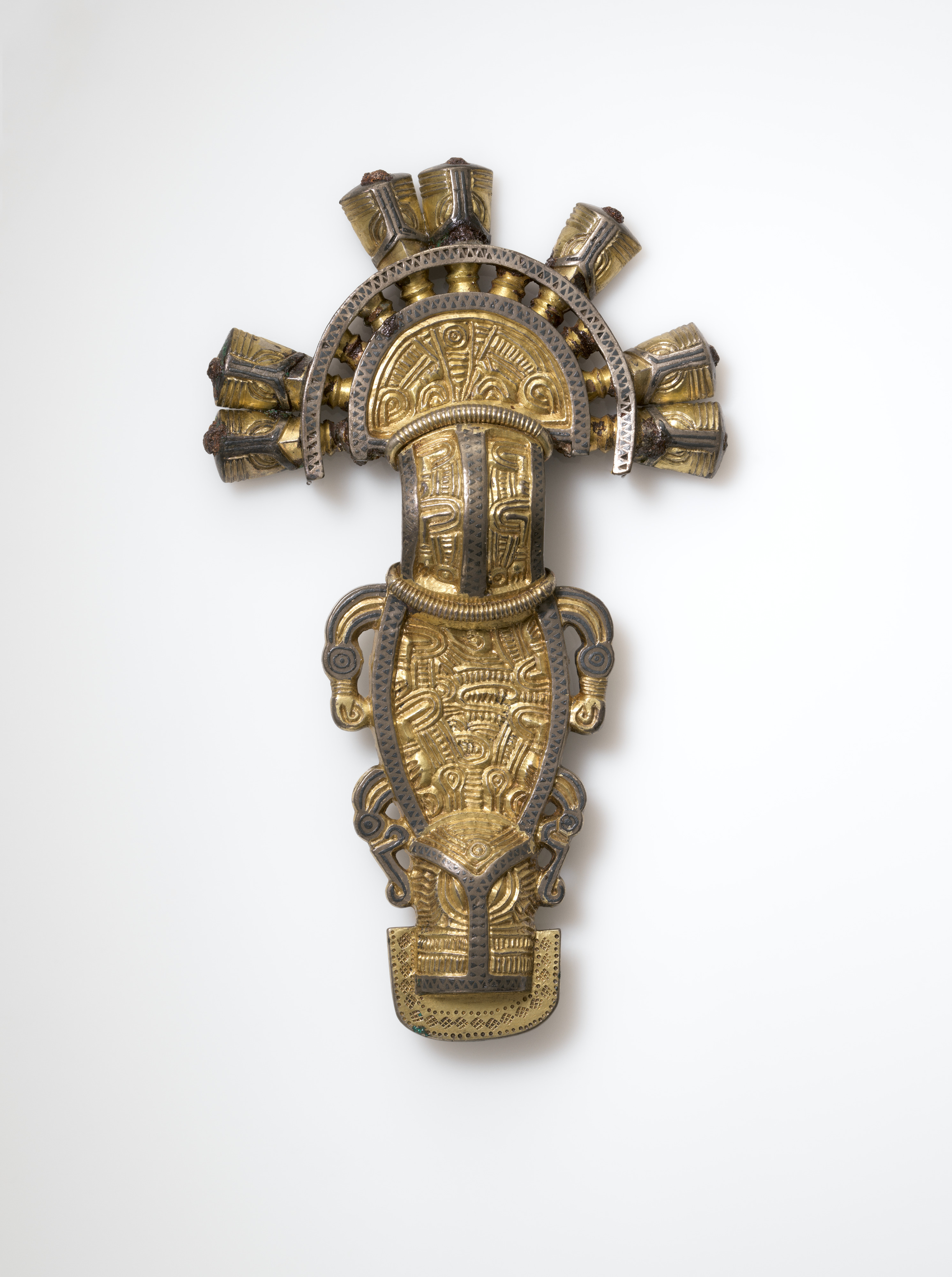
Archaeological Provenance and the Langobardic Bow Brooch
The Langobardic bow brooch, a seminal artifact from the early medieval period (circa 6th–7th century CE), represents a pinnacle of Germanic metalwork integrated with late Roman aesthetic sensibilities. Recovered from funerary contexts in present-day northern Italy, these brooches served as both functional garment fasteners and potent symbols of social status. The specific specimen under analysis—a gilded silver bow brooch inlaid with niello—exemplifies the Langobardic mastery of chiaroscuro through material contrast. The gilded surface, achieved via fire-gilding techniques, creates a luminous, sunlit field, while the niello—a black metallic alloy of sulfur, copper, silver, and lead—is meticulously inlaid into incised geometric and zoomorphic patterns. This interplay of light and dark, of precious metal and matte void, is not merely decorative; it is a sophisticated exercise in visual hierarchy, directing the observer’s gaze along the brooch’s arched bow and onto its radiating footplate. For the 2026 haute couture silhouette, this artifact offers a profound lesson in structural tension. The brooch’s form—a rigid, arched spine that anchors a broader, decorative base—directly informs the architectural draping and asymmetrical closures that will define the coming season’s evening wear.
Deconstructing Classical Elegance: The Niello-Gilt Dialectic
The Luminescence of Gilded Silver
Classical elegance in the Langobardic context is not synonymous with simplicity. It is a dense, layered opulence that relies on material hierarchy. The gilded silver base provides a warm, reflective core, reminiscent of liquid amber. In 2026, this translates to the use of high-shine metallic brocades and liquid lamé that mimic the patina of aged gold. The silhouette is no longer a flat plane; it becomes a sculpted surface where light is captured and redirected. Designers are now exploring asymmetric shoulder constructions that echo the brooch’s bow—a single, sweeping curve that rises from the collarbone and arcs over the deltoid, creating a dynamic, weightless profile. The gilded quality is further replicated through hand-applied metallic foil on silk organza, a technique that allows for gradient luminosity, shifting from a brilliant highlight at the apex of the shoulder to a muted, shadowed tone at the hem. This is not mere ornamentation; it is a structural strategy to define volume without adding bulk.
The Void of Niello: Negative Space as Structure
The niello inlay is the counterpoint to the gilt’s brilliance. Its deep, matte blackness creates a visual incision into the metal, a deliberate void that defines the positive form. In the 2026 silhouette, this principle manifests as strategic cutouts and negative-space tailoring. The niello’s geometric patterns—interlocking spirals and stylized animal heads—inspire a new language of laser-cut leather appliqués and voided velvet. A gown’s bodice might feature a series of precisely placed, blackened apertures that reveal a contrasting underlayer of nude or metallic mesh, creating the same optical tension as the original brooch. The silhouette itself is hollowed out at the waist or back, with the fabric’s absence serving as a structural element, much like the niello serves as a structural boundary for the gilt. This approach demands exceptional engineering; the garment must maintain its integrity while embracing emptiness, a challenge that pushes couture ateliers toward advanced pattern-cutting and the use of rigid, yet flexible, structural netting.
Materiality and Craft: Translating Niello to Textile
From Metal Alloy to Textured Weave
The physical properties of niello—its density, its matte finish, its capacity for fine detail—find a direct analogue in high-density jacquard weaves and embroidered matte sequins. For the 2026 collection, Natalie Fashion Atelier is developing a proprietary fabric: a double-faced silk gazar where one side is treated with a matte, almost powdery finish (the niello), and the reverse retains a subtle sheen (the gilt). This fabric is then hand-embroidered with black glass beads and silver thread to recreate the brooch’s intricate patterns. The silhouette that emerges is one of controlled rigidity: a column gown that stands away from the body, its surface a topographic map of light and dark. The embroidery is not applied as a separate layer; it is integrated into the weave, creating a seamless surface that echoes the brooch’s inlaid technique. This requires a meticulous collaboration between the textile mill and the atelier, with each pattern repeat calibrated to the garment’s structural seams.
The Bow as Architectural Spine
The brooch’s defining feature—its arched bow—is reimagined as a three-dimensional structural element in the 2026 silhouette. This is not a mere accessory; it is the garment’s primary load-bearing component. A series of draped panels, anchored at the shoulder by a rigid, gilded silver clasp (a direct homage to the brooch), cascade down the back in a single, unbroken line. The bow’s curve is replicated in the sculptural boning that shapes the bodice, creating a cantilevered effect that supports the fabric without the need for internal corsetry. The silhouette is thus both ancient and futuristic: a return to the fundamental principle of the brooch as a fastener, yet executed with contemporary materials like carbon-fiber-reinforced resin and memory-metal alloys that allow the garment to hold its shape while remaining lightweight. The niello’s blackness is echoed in the deep, matte finish of the resin, while the gilt is translated into hand-polished brass accents that catch the light at every movement.
2026 Silhouette Synthesis: The Langobardic Line
The Asymmetric Bow Silhouette
The most direct translation of the Langobardic bow brooch into a 2026 silhouette is the asymmetric bow line. This is characterized by a single, exaggerated shoulder that rises in a smooth, sweeping arc, mimicking the brooch’s bow. The opposite shoulder is left bare, creating a dramatic diagonal that draws the eye from the collarbone to the hip. The fabric—a heavy, gilded silk faille—is pleated to follow the arc, with the pleats widening as they descend, creating a fan-like effect. The niello influence appears as black, matte piping that traces the edge of the shoulder and the hem, providing a crisp, graphic boundary. This silhouette is inherently sculptural, requiring the atelier to drape the fabric directly on the mannequin, adjusting the tension of each pleat to achieve the perfect balance between rigidity and flow. The result is a garment that is both a homage to history and a declaration of future luxury.
The Niello-Gilt Gradient
For evening wear, the 2026 collection introduces the niello-gilt gradient, a chromatic and textural transition from deep, matte black to brilliant, reflective gold. This is achieved through a graduated hand-embroidery technique, where black jet beads and silver bugle beads are densely packed at the hem, gradually giving way to gold sequins and gilt thread at the bodice. The silhouette is a mermaid cut, with the gradient following the body’s natural curves. The effect is one of emerging from shadow into light, a direct visual reference to the brooch’s chiaroscuro. The gown’s construction requires meticulous weight distribution; the dense beadwork at the hem must be balanced by lighter, more flexible materials at the torso. The atelier uses a silk charmeuse base for the bodice, transitioning to a structured duchess satin for the skirt, ensuring the garment moves as a single, fluid entity. This is not a costume; it is a wearable artifact that carries the memory of the Langobardic smith’s hand.
Conclusion: The Archive as Blueprint
The Langobardic bow brooch, isolated from its archaeological context, becomes a pure aesthetic blueprint for the 2026 haute couture silhouette. Its dialectic of gilded silver and niello—of light and void, of structure and ornament—offers a timeless vocabulary for luxury. The atelier’s task is not to replicate, but to translate: to understand the brooch’s engineering, its material logic, and its visual hierarchy, and to apply these principles to the human form. The resulting silhouettes—the asymmetric bow line, the niello-gilt gradient, the cantilevered shoulder—are not merely fashionable; they are archaeological in their rigor and avant-garde in their execution. For Natalie Fashion Atelier, the past is not a museum; it is a living laboratory for the future of couture.