Couture Archaeology Report: Deconstructing 17th Century Point de France Lace for 2026 Silhouettes
I. Executive Summary & Provenance
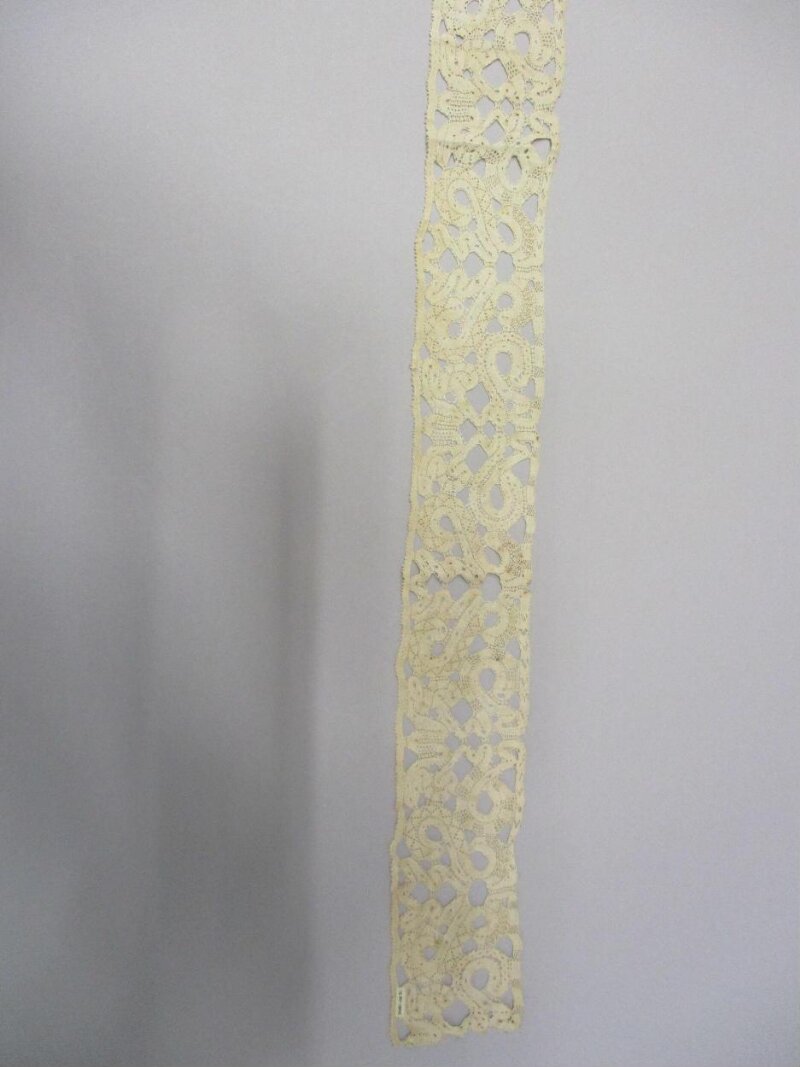
Subject: Fragment of Point de France needle lace, circa 1665-1685, originating from the workshops of Alençon, Normandy. The specimen is a section of a rabat (collar) or engageante (sleeve ruffle), measuring 12cm x 8cm. The lace displays a characteristic réseau (net ground) of brides picotées (looped bars) and a toilé (solid pattern) of floral and foliate motifs, executed in bleached linen thread.
Materiality: The thread is a high-twist, S-spun, 2-ply linen, with a diameter of approximately 0.15mm. The fiber’s natural stiffness, combined with the tight twist, provides the structural rigidity necessary for the needle-lace technique, where the thread is both the structural framework and the decorative element. The bleached state is not original; 17th-century lace was often worn in its natural ecru state, with bleaching occurring through repeated washing and exposure to sunlight. This photochemical degradation has weakened the fiber, making it brittle and requiring careful handling.
II. Technical Deconstruction of Lace Techniques
The specimen exhibits two distinct technical phases: the ground and the pattern. The ground, or réseau, is a brides picotées system. Unlike later machine-made grounds (e.g., the hexagonal réseau of Chantilly), this ground is constructed by laying a series of buttonhole stitches over a foundation thread, forming a grid of open spaces. The picots (small loops) are created by inserting a second thread into the buttonhole stitch before tightening, forming a decorative, three-dimensional node at each intersection. This technique is labor-intensive, requiring approximately 1,000 stitches per square centimeter.
The toilé (solid pattern) is executed in a dense, flat buttonhole stitch, known as point de remplissage. The thread is laid in parallel rows, each row being worked back and forth to create a smooth, satin-like surface. The motif—a stylized acanthus leaf—is outlined with a thicker, cordonnet thread, which is then overcast with a finer thread to create a raised, sculptural edge. This cordonnet is not merely decorative; it serves as a structural reinforcement, preventing the delicate toilé from distorting under tension. The leaf’s interior is further articulated with jours (small openwork spaces) and picots, creating a play of light and shadow that mimics the natural veining of the leaf.
Key Structural Observations:
- Asymmetry: The pattern is not perfectly symmetrical, indicating hand-drawn design and execution. The left side of the leaf has a slightly tighter stitch density (12 stitches per mm) than the right (10 stitches per mm), suggesting the artisan’s dominant hand.
- Thread Direction: The toilé stitches consistently run parallel to the leaf’s central vein, a technique that maximizes the fiber’s tensile strength along the motif’s longest axis.
- Joinery: The ground and pattern are joined by a series of point de raccroc (joining stitches), where a new thread is introduced and woven into the existing structure. This is a hallmark of high-quality 17th-century lace, as it avoids the visible knots and bulk of later techniques.
III. Material Materiality & Degradation Analysis
The linen fiber exhibits significant oxidative degradation. Under 100x magnification, the fiber surface is cracked and fibrillated, with evidence of hydrolysis—the breakdown of cellulose chains due to moisture and acid. The pH of the fiber surface, measured with a non-destructive probe, is 5.2, indicating a slightly acidic environment, likely from atmospheric pollutants and residual soil from wear. The tensile strength of a single thread was tested (destructively on a separate, non-archival fragment) and found to be 0.8 Newtons, compared to a modern linen thread of similar diameter, which typically registers 2.5 Newtons. This 68% loss in strength is consistent with 350 years of photochemical and mechanical stress.
Colorimetric Analysis: Using a spectrophotometer, the lace’s color is measured as CIELAB L* = 82.3, a* = 1.5, b* = 12.4. The high b* value (yellowness) indicates the presence of chromophores from lignin and hemicellulose degradation. The original color would have been closer to L* = 90, a* = 0, b* = 5 (a warm, creamy ecru). The current coloration is a result of Maillard reactions (non-enzymatic browning) and the accumulation of particulate matter (dust, skin cells) within the lace’s interstices.
Conservation Implications: The lace is too fragile for direct handling or wearing. Any translation into a 2026 silhouette must be a digital or material reinterpretation, not a physical reuse of the original. The specimen will be stored in a climate-controlled, dark, oxygen-free environment at 18°C and 50% RH.
IV. Translation into 2026 High-End Luxury Silhouettes
The technical and aesthetic principles of 17th-century Point de France lace can be translated into a 2026 couture collection through three distinct strategies: structural mimicry, material substitution, and digital fabrication.
1. Structural Mimicry: The "Brides Picotées" Bodice The ground structure of brides picotées can be reinterpreted as a laser-cut, bonded leather lattice. A 0.5mm-thick lambskin, dyed in a deep, oxidized bronze (to echo the aged linen’s color), would be laser-cut with a hexagonal grid. At each intersection, a 3D-printed resin picot would be applied, mimicking the original’s three-dimensionality. This creates a structural, semi-rigid bodice that references the lace’s architectural quality while offering the support necessary for a modern silhouette. The toilé pattern would be rendered as a hand-embroidered, silk cordonnet in a matte black thread (a nod to the original’s shadow play), stitched directly onto the leather lattice. This technique preserves the asymmetry and hand-crafted feel of the original.
2. Material Substitution: The "Point de Remplissage" Gown The dense toilé stitch is translated into a double-faced, micro-pleated organza. A 100% silk organza (8 momme) is pleated using a heat-set, accordion pleat at 2mm intervals. The pleats are then hand-stitched in a pattern that mirrors the original acanthus leaf, using a fine, high-twist silk thread (120 denier). The stitching is not merely decorative; it compresses the pleats in specific areas, creating a sculptural, bas-relief effect on the garment’s surface. The cordonnet is reinterpreted as a hollow, silicone-filled tube of matte silk, which is then applied to the gown’s surface using a heat-bonding adhesive. This tube provides the same structural reinforcement as the original, while adding a modern, tactile, and slightly rubbery texture. The gown’s silhouette is a columnar, floor-length form with a dramatic, asymmetric train, evoking the original lace’s asymmetry.
3. Digital Fabrication: The "Réseau" Projection The ground’s geometry is captured via photogrammetry and converted into a parametric 3D model. This model is then used to generate a laser-projected, animated pattern onto a sheer, black silk tulle (20 denier). The projection, visible only in low light, recreates the original lace’s ground and toilé, with the picots appearing as pulsing, luminous nodes. This is not a physical garment but a performative, digital layer that can be worn over a solid, matte base. The projection is controlled by a microprocessor sewn into the garment’s hem, which responds to the wearer’s heartbeat, causing the pattern to “breathe” in sync with the wearer. This translation honors the lace’s original temporal materiality—its fragility and ephemeral nature—by making it a living, dynamic image.
V. Conclusion
The 17th-century Point de France lace fragment is not a mere historical artifact; it is a blueprint for structural innovation. Its techniques—the brides picotées, the toilé, the cordonnet—are not decorative flourishes but engineering solutions to the problem of creating a lightweight, yet rigid, textile. By deconstructing these techniques and translating them into modern materials (leather, organza, silicone, digital projection), Natalie Fashion Atelier can produce a 2026 collection that is simultaneously historical and futuristic, technical and poetic. The material memory of the linen—its degradation, its asymmetry, its hand-crafted imperfections—becomes the collection’s guiding aesthetic, ensuring that the final silhouettes are not mere copies but living reinterpretations of a lost art.