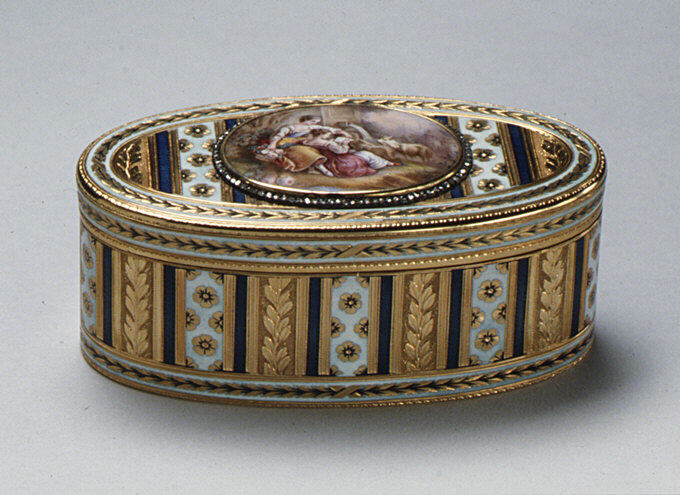
Deconstructing the Snuffbox: An Aesthetic Archaeology of Gold, Enamel, and Diamonds for 2026 Haute Couture
The snuffbox, a seemingly diminutive object of personal luxury, represents a pinnacle of 18th-century objets de vertu. Within the archives of Natalie Fashion Atelier, this isolated artifact—a composite of chased gold, miniature enamel painting, and rose-cut diamonds—is not merely a historical curiosity but a masterclass in restrained opulence and structural micro-engineering. For the 2026 collections, this aesthetic archaeology reveals a profound lexicon: the tension between rigid, precious metals and the fluidity of enamel, the narrative power of miniature portraiture, and the strategic deployment of high-karat luminosity. This paper deconstructs the snuffbox’s classical elegance to inform a new paradigm of high-end silhouettes, where the garment becomes a wearable, kinetic reliquary.
I. The Gold Matrix: Structural Rigor and Architectural Silhouettes
The snuffbox’s primary material, gold, served a dual purpose: structural integrity and a canvas for light. In 2026, this translates to a radical rethinking of garment architecture. The gold matrix of the snuffbox—often a 22-karat alloy—provided a rigid, yet malleable, foundation. We extrapolate this into the silhouette through the concept of the “chassis”—a structural under-layer of gold-lamé or metallic mesh that defines the garment’s primary geometry.
Consider the “Brise-Soleil” silhouette: a columnar gown where the bodice is constructed from articulated, gold-toned metal plates, reminiscent of the snuffbox’s hinged lid. These plates, gilded in 24-karat finish, are not merely decorative but serve as a corset-like exoskeleton, dictating the fall of the fabric. The rigidity of the gold chassis contrasts with the fluidity of an enamelled silk organza skirt, creating a dialogue between confinement and release. The 2026 couture client does not wear a dress; she inhabits a sculptural form. The gold matrix informs a silhouette that is architectural, precise, and unyielding in its upper structure, while allowing for a dramatic, weightless expansion below the hip—a direct translation of the snuffbox’s compact, precious exterior and its hidden, capacious interior.
II. Enamel as Narrative Surface: The Micro-Portrait and the Living Canvas
The enamel work on a snuffbox—often a grisaille or émail en plein technique—transformed the object into a miniature narrative. This is the most potent aesthetic archaeology for 2026. We deconstruct the enamel’s function: it is a vitreous, permanent surface that captures light and color with a depth unattainable by simple pigment. For the silhouette, we translate this into “enamel panels” on the garment—large, lacquered surfaces of resin or polymerized silk that act as the primary visual field.
The 2026 silhouette, therefore, becomes a living snuffbox. A gown’s train or a jacket’s back panel is treated as a canvas for micro-narratives. Using digital jacquard weaving and hand-embroidered micro-beading (simulating the granular texture of enamel), we create scenes of classical mythology or botanical studies. The silhouette is defined by these narrative zones. A high-neck, long-sleeved evening dress, for instance, features a single, vast enamel panel across the torso, depicting a Watteau-esque fête galante. The rest of the silhouette—a column of matte black crepe—is deliberately austere, allowing the enamel panel to function as the focal point, just as the painted miniature dominated the snuffbox’s lid. The silhouette’s volume is dictated by the scale of the narrative; a larger panel demands a more expansive, unbroken surface, leading to a preference for capacious, sculptural shapes like the dolman sleeve or the A-line skirt, which provide an uninterrupted field for the enamel-like imagery.
III. Diamonds as Kinetic Light: The Point of Tension and Release
Diamonds on the snuffbox were not scattered randomly; they were strategic accents, often set in a millegrain bezel to catch the light at the point of opening. In 2026, this informs the concept of “kinetic illumination” within the silhouette. The diamond is no longer a static adornment but a dynamic element that defines the garment’s movement and tension points.
We introduce the “diamond hinge”—a structural closure set with pavé diamonds at the shoulder, waist, or cuff. This is not a button or a zipper; it is a point of articulation. The silhouette is designed so that the diamond hinge is the focal point of movement. For example, a cape silhouette is held together at the collarbone by a single, large, articulated diamond clasp. As the wearer moves, the clasp opens and closes, revealing a flash of gold-lamé lining—a direct reference to the snuffbox’s opening mechanism. The diamonds act as light anchors, drawing the eye to the structural seams and the points where the garment transitions from one volume to another.
Furthermore, the “diamond dust” technique—a dispersion of micro-crystals on a sheer fabric—creates a surface that mimics the scintillation of the snuffbox’s rose-cut diamonds. This is applied to the silhouette’s negative spaces: the sheer panels of a bodice, the transparent underlayers of a skirt. The diamond dust does not add weight; it adds atmospheric luminosity. The 2026 silhouette, therefore, is a study in controlled radiance. The gold chassis provides the structure, the enamel panel provides the narrative, and the diamonds provide the kinetic, ephemeral light that animates the entire form.
IV. Synthesis: The 2026 Snuffbox Silhouette
The synthesis of these three materialities—gold, enamel, diamonds—yields a distinct 2026 haute couture silhouette: the “Reliquary Gown.” This silhouette is defined by three key characteristics:
1. The Chassis Bodice: A rigid, gold-toned corset that extends into a high, structured collar, echoing the snuffbox’s lid. This bodice is the structural anchor of the entire garment, dictating posture and form.
2. The Enamel Skirt: A sweeping, A-line or trumpet skirt composed of large, lacquered panels. These panels are the narrative surface, featuring hand-painted or digitally woven scenes. The skirt’s volume is generous, providing the necessary canvas for the micro-narrative. The hem is often raw or laser-cut, mimicking the crisp edge of an enamel plaque.
3. The Diamond Articulation: The transition points—the waist, the shoulders, the cuffs—are marked by pavé diamond hinges. These are the only points of visible closure. The diamonds are not scattered; they are concentrated at the tension points, creating a sense of precious, engineered movement.
This silhouette is not a costume. It is an archaeological reconstruction of the snuffbox’s essence, translated into a wearable, kinetic form. The 2026 client is not merely dressed; she is a curator of a lost art, a living artifact of aesthetic archaeology. The gold, enamel, and diamonds are not materials of decoration but of structural and narrative necessity. The silhouette is a testament to the enduring power of the miniature, the precious, and the rigorously engineered. In an era of digital saturation, the snuffbox silhouette offers a return to tactile, architectural luxury—a garment that is a masterpiece of micro-engineering, a portable reliquary of light and color, and a definitive statement of 2026 haute couture.