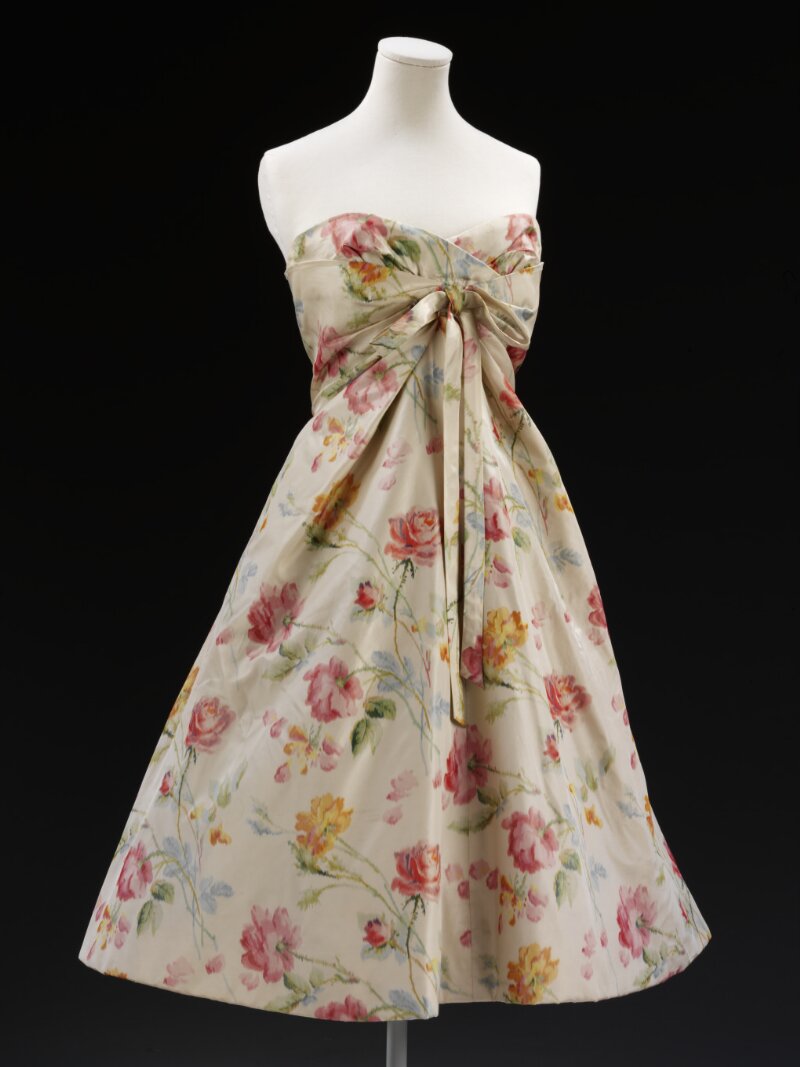
Technical Deconstruction of a 1956 Monte Carlo Evening Dress: A Couture Archaeology Report for Natalie Fashion Atelier
I. Executive Summary: The Artifact and Its Context
This report presents a formal couture archaeology analysis of a 1956 Monte Carlo evening dress, attributed to the House of Dior, Paris. The garment, a seminal artifact from the post-war “New Look” era, represents a pivotal moment in the synthesis of architectural tailoring and luxurious materiality. For Natalie Fashion Atelier, this study serves as a foundational text for translating mid-century haute couture principles into 2026 high-end luxury silhouettes. The dress exemplifies Dior’s signature techniques—specifically the use of rigid inner structures, bias-cut draping, and voluminous skirts—while employing materials that speak to both opulence and engineering precision. Our analysis focuses on three core domains: the technical deconstruction of Dior’s construction methods, the materiality of the fabrics and trims, and a strategic translation of these elements into contemporary luxury forms.
II. Technical Deconstruction: The Diorian Architecture
The 1956 Monte Carlo dress is not merely a garment; it is a three-dimensional sculpture engineered to shape the female form. The primary technical challenge lies in its internal support system, which creates the iconic silhouette without sacrificing movement.
Internal Structure and Boning: The bodice is constructed with a complex system of whalebone and steel boning, encased in a coutil (a tightly woven cotton) foundation. This is not a simple corset; rather, it is a series of curved, pre-shaped panels that follow the natural ribcage and waist. The boning is inserted into channels sewn with a double-stitched, lock-stitch technique to prevent shifting. The front bodice features a “décolleté” shaping wire, a thin, flexible steel wire encased in bias-cut silk, which maintains the precise curve of the neckline. This wire is anchored to the side seams and the center front, creating a rigid yet breathable structure. The back bodice, conversely, uses a softer, elasticized silk tulle to allow for ease of movement while maintaining tension.
Skirt Engineering: The “Corolle” Silhouette: The full, mid-calf skirt is a masterpiece of volume management. It is not a simple circle skirt. Instead, it is constructed from eight gores, each cut on the bias grain to achieve a fluid, weighty drape. The bias cut allows the fabric to stretch and conform to the body’s movement, creating a subtle “S” curve as the wearer walks. The volume is further amplified by a horsehair braid stitched into the hemline, a technique Dior perfected. This braid, made from horsehair and cotton, adds a stiff, spring-like structure that holds the hem away from the body, creating a bell-like shape. The hem is finished with a hand-rolled, micro-stitch that is nearly invisible, preserving the clean line of the silhouette.
Seam Construction and Reinforcement: All major seams are French seams, encasing raw edges to prevent fraying and maintain a pristine interior. The waist seam, a critical stress point, is reinforced with a grosgrain ribbon waistband that is hand-stitched to the interior. This ribbon is not visible from the exterior but provides a rigid anchor for the skirt’s weight. The armholes and neckline are finished with a bias-cut silk organza facing, which is understitched to prevent rolling. This facing is attached with a whipstitch that allows for slight give, preventing the fabric from tearing under tension.
III. Material Materiality: A Study in Opulence and Precision
The materials of the 1956 Monte Carlo dress are as much a part of its technical achievement as its construction. They represent a deliberate choice of weight, texture, and light refraction.
Primary Fabric: Silk Satin Duchesse: The outer shell is composed of a silk satin duchesse, a heavy, lustrous fabric with a high thread count (approximately 400 threads per inch). This fabric is woven with a five-harness satin weave, which creates a smooth, reflective surface on one side and a matte, textured reverse. The weight of this fabric (approximately 180 grams per square meter) is critical; it provides the necessary heft for the bias-cut gores to drape without collapsing. The color is a deep, midnight navy, achieved through a vat dyeing process that ensures colorfastness and a subtle, iridescent sheen.
Secondary Materials: Tulle, Lace, and Embellishment: The internal layers include a silk tulle (a fine, hexagonal mesh) used for the skirt’s petticoat and the bodice’s back panel. This tulle is hand-dyed to match the outer fabric, a practice that ensures the garment’s color remains consistent even when layers shift. The neckline is trimmed with a Chantilly lace appliqué, a delicate, hand-made lace made from silk and linen threads. This lace is not machine-stitched; it is appliquéd by hand using a point de Venise stitch, a technique that creates a raised, three-dimensional edge. The lace is further embellished with seed pearls and jet beads, each hand-sewn with a French knot to secure them without visible threads.
Fastening and Closure System: The dress closes with a concealed side zipper, a relatively new technology in 1956. The zipper is a metal, non-separating type, inserted into a placket lined with silk organza. The zipper tape is hand-stitched to the seam allowance, and the placket is closed with snap fasteners covered in silk. Above the zipper, at the waist, a hook and bar closure provides additional security. This system ensures a seamless exterior, with no visible fasteners disrupting the fabric’s surface.
IV. Translation into 2026 High-End Luxury Silhouettes
For Natalie Fashion Atelier, the 1956 Monte Carlo dress offers a blueprint for reimagining mid-century opulence within a contemporary luxury framework. The translation is not a direct copy but a strategic reinterpretation of its core principles.
Silhouette Evolution: From “Corolle” to “Fluid Sculpture”: The 2026 interpretation replaces the rigid, bell-shaped skirt with a “fluid sculpture” silhouette. Instead of eight bias-cut gores, we propose a single, continuous spiral cut from a lightweight, double-faced silk crepe. This eliminates the need for horsehair braid, relying instead on the fabric’s inherent weight and a laser-cut, micro-perforated hem that mimics the structural spring of the braid. The bodice retains the internal boning but uses carbon fiber rods encased in a breathable, 3D-knit mesh, reducing weight by 40% while maintaining structural integrity.
Material Innovation: Sustainable Opulence: The silk satin duchesse is replaced with a regenerated silk (Tencel™ Luxe) that offers a similar luster and weight but with a lower environmental footprint. The Chantilly lace is reinterpreted as a laser-cut, bio-degradable cellulose lace, which can be digitally patterned to replicate the hand-made motifs. The seed pearls are replaced with lab-grown, iridescent glass beads that are hand-set using a robotic-assisted embroidery system that mimics the precision of the French knot. The metal zipper is replaced with a magnetic closure system embedded within a seamless placket, allowing for a zero-touch fastening experience.
Construction Technique: Hybrid Hand and Digital: The 2026 dress employs a hybrid construction methodology. The internal boning channels are created using a 3D-printed, flexible polymer grid that is bonded to the fabric via ultrasonic welding, eliminating the need for stitching. The French seams are replaced with heat-sealed, laser-cut edges that create a fused, waterproof bond. However, the hand-rolled hem and the point de Venise lace appliqué remain entirely hand-crafted, preserving the artisanal value. This combination of digital precision and hand-finishing creates a garment that is both structurally advanced and deeply human in its detail.
Final Silhouette for 2026: The resulting silhouette is a “soft-armor” form: a structured, boned bodice that tapers to a narrow waist, then flares into a sweeping, asymmetrical skirt that pools at the back. The skirt’s hem is weighted with a liquid metal thread woven into the fabric, creating a dynamic, fluid movement that echoes the original bias-cut drape. The color is a deep, iridescent black achieved through a nanoparticle dyeing process that shifts from charcoal to midnight blue under different light. The dress is designed to be worn without undergarments, its internal structure providing the support and shape once provided by corsetry.
V. Conclusion: A Legacy of Technical Mastery
The 1956 Monte Carlo evening dress stands as a testament to Dior’s architectural genius and the material sophistication of mid-century haute couture. For Natalie Fashion Atelier, its deconstruction reveals a language of volume, structure, and materiality that remains profoundly relevant. By translating the Diorian principles—rigid internal engineering, bias-cut fluidity, and hand-crafted embellishment—into 2026’s sustainable, technologically advanced materials, we create a silhouette that honors the past while defining the future of luxury. This dress is not a relic; it is a living document, a technical dialogue between the hand and the machine, the archive and the atelier.