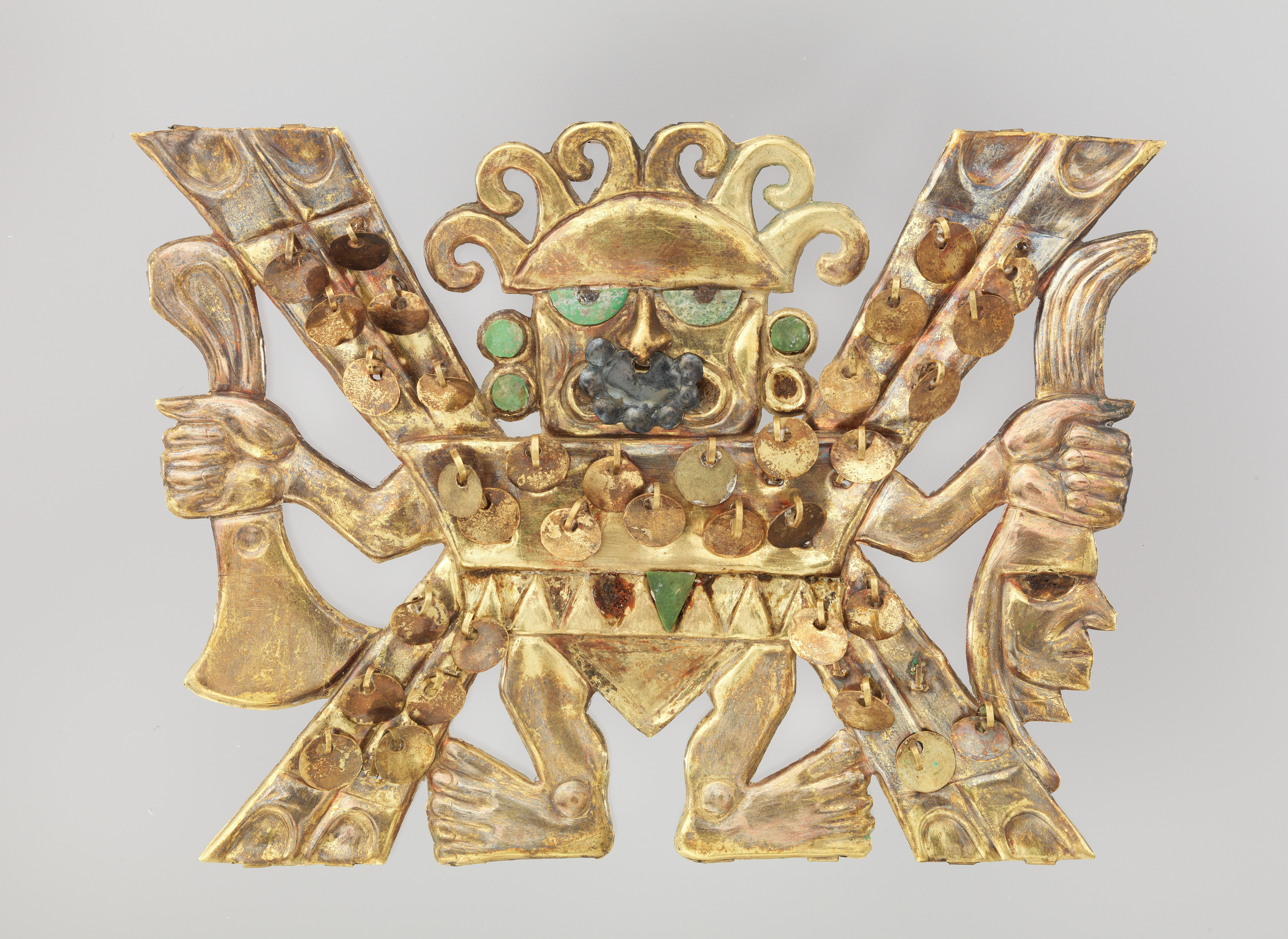
Aesthetic Archaeology: The Moche Nose Ornament as a Catalyst for 2026 Silhouettes
At Natalie Fashion Atelier, we engage in a rigorous dialogue with history, not as mere preservationists but as aesthetic archaeologists. We excavate the formal, material, and symbolic logic of artifacts that have been isolated from their original context, allowing their pure visual language to speak to contemporary luxury. The subject of this research—a Moche nose ornament crafted from gilded copper, silver, and stone, featuring a decapitator motif—presents a paradox of elegance and violence. This artifact, removed from its ritualistic environment, offers a profound lexicon for the 2026 haute couture silhouette. Its formal tension between precious metalwork and brutal iconography, between the organic curve of the nose bridge and the sharp geometry of the blade, provides a masterclass in constructing power within the feminine form.
Materiality and the Gilded Edge: The 2026 Metal Framework
The Moche artisan’s choice of materials—gilded copper, silver, and stone—was not arbitrary. Gilded copper, achieved through a sophisticated depletion gilding process, creates a surface of controlled luminosity. It is not the blinding flash of pure gold, but a warmer, more grounded radiance. Silver, often used for the blade or the decapitator’s headdress, introduces a cold, reflective counterpoint. Stone, frequently turquoise or lapis lazuli, provides a matte, tactile interruption. For the 2026 silhouette, this material hierarchy translates into a layered metal structure within the garment itself.
We propose a gilded copper exoskeleton for the evening gown: a structural cage that defines the silhouette’s upper torso and shoulders, echoing the ornament’s curved form. This is not a soft drape but a rigid, architectural armature. The silver appears as a secondary, sharper element—perhaps a blade-like seam that runs from the collarbone to the waist, a metallic insertion that bisects the garment’s volume. The stone is not a mere embellishment but a tactile counterweight: cabochon-set lapis lazuli at the sternum or the hip, grounding the visual flow and providing a moment of stillness. The 2026 silhouette thus becomes a wearable artifact, where the metal is not decorative but structural, creating a silhouette that is both armored and fluid.
Deconstructing the Decapitator: The Geometry of Power and the Silhouette
The decapitator motif—a figure holding a severed head or a blade—is the artifact’s central iconographic element. In Moche culture, this represented ritual sacrifice, the cycle of life and death, and the transfer of spiritual power. For the haute couture silhouette, we must deconstruct this classical elegance into its pure geometric components: the circle (the head), the line (the blade), and the curve (the arm wielding it).
The 2026 silhouette will not depict violence literally. Instead, it will abstract the gesture. The circular volume of the head is reinterpreted as a dramatic, sculptural sleeve or a high collar that frames the face—a halo of power. This volume is constructed from layered organza or horsehair, stiffened to hold its shape, yet transparent enough to reveal the neck and shoulders beneath. The line of the blade becomes a sharp, asymmetrical cut in the skirt—a slash of absence that reveals the leg, creating a dynamic, unbalanced silhouette. The curve of the arm translates into a sweeping, diagonal seam that traverses the bodice, guiding the eye from the shoulder to the opposite hip, creating a sense of latent movement and tension.
This geometric abstraction creates a silhouette that is both confrontational and elegant. The wearer is not a victim but the wielder of power. The garment’s structure—the rigid collar, the sharp cut, the diagonal line—mimics the decisive, authoritative gesture of the decapitator, but reframed within the context of 2026 luxury as a symbol of controlled agency and decisive elegance.
Contrast and Tension: The 2026 Silhouette as a Study in Opposites
The Moche nose ornament thrives on contrast: the warmth of gilded copper against the coldness of silver; the smoothness of polished metal against the granularity of stone; the organic form of the nose against the brutal iconography. The 2026 silhouette must embody this same dialectical tension.
We propose a dual-fabric approach. The primary silhouette is constructed from a heavy, matte, black wool crepe—a ground of silent authority. This provides the volume and structure. Against this, we introduce panels of gilded metallic mesh (a modern interpretation of the copper) and liquid silver satin. The mesh is used for the exoskeleton, creating a translucent armor over the wool. The satin is reserved for the sharp, blade-like insertions. The contrast is not just visual but tactile: the rough, dry hand of the wool against the slick, cold hand of the satin; the heavy, grounded feel of the crepe against the airy, shimmering mesh.
This tension extends to the silhouette’s volume. The upper body is structured and armored, with strong, defined shoulders and a high, sculpted neckline. The lower body, however, is fluid and expansive—a floor-length skirt that moves with a liquid, almost violent grace. This juxtaposition of rigidity and fluidity mirrors the artifact’s own duality: the fixed, precious metalwork against the implied, dynamic action of the ritual. The 2026 silhouette is not a single shape but a dialogue between opposing forces, creating a visual and emotional charge that defines true luxury.
From Artifact to Attire: The 2026 Collection Silhouette
Translating the Moche nose ornament into a wearable 2026 silhouette requires a systematic abstraction. The final design for the Natalie Fashion Atelier collection will be a gilded copper exoskeleton gown.
- Silhouette Profile: An inverted triangle, with a strong, broad shoulder line tapering to a narrow waist, then releasing into a full, A-line skirt. This profile echoes the ornament’s own shape: wide at the top (the nose bridge and the decapitator’s headdress), narrowing at the center, and then opening again at the base (the blade and the severed head).
- Key Structural Elements: The gilded copper exoskeleton is a series of curved, overlapping bands that wrap the torso, leaving strategic gaps of black wool crepe. A single, sharp silver seam runs from the right shoulder to the left hip, mimicking the blade’s trajectory. A large, cabochon-set lapis lazuli stone is placed at the left hip, acting as a visual anchor and a counterweight to the asymmetry.
- Volume and Movement: The skirt is constructed from multiple panels of black wool crepe, cut on the bias to allow for a fluid, heavy drape. The hem is uneven, with a dramatic train at the back and a sharp, asymmetrical cut at the front, echoing the blade’s geometry.
- Color Palette: The palette is deliberately restrained: matte black (the wool), warm gilded copper (the exoskeleton), cold silver (the seam), and deep turquoise (the stone). This limited palette forces the eye to focus on the interplay of form, texture, and light.
This silhouette is not a costume. It is a contemporary artifact that carries the weight of history without being burdened by it. The 2026 woman who wears this garment is not reenacting a Moche ritual; she is channeling its essence—the power, the precision, the tension between creation and destruction. The silhouette is a statement of architectural authority, a testament to the enduring power of aesthetic archaeology to inform the future of luxury. The Moche nose ornament, isolated from its past, becomes a blueprint for a new kind of elegance: one that is sharp, structured, and unapologetically powerful.