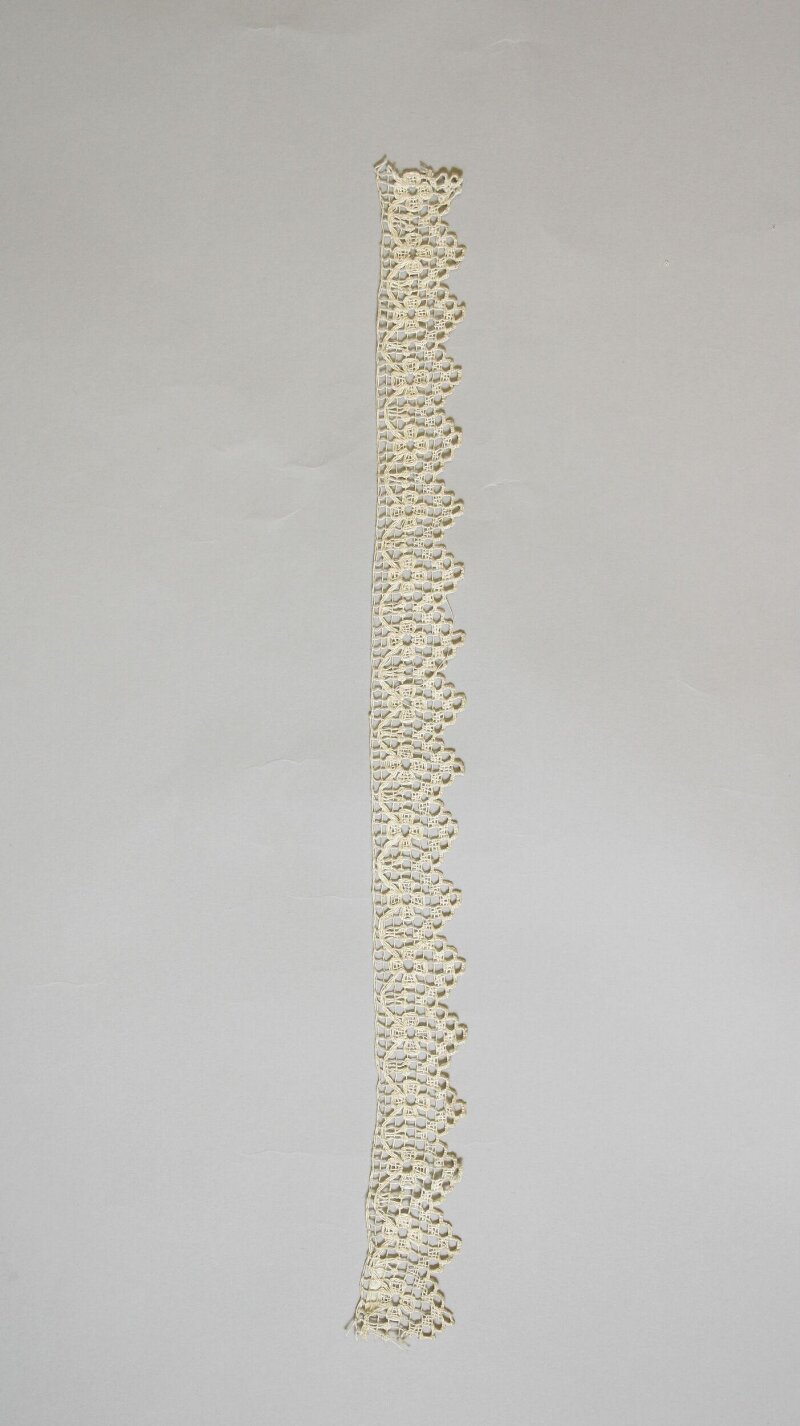
Couture Archaeology Report: Technical Deconstruction of a French Silk Point de Venise Lace, circa 1890, and its Translation into 2026 High-End Luxury Silhouettes
Subject and Provenance
Object: Fragment of a silk Point de Venise lace flounce, handcrafted in the Caudry region of France, circa 1885-1895. The piece measures 45 cm x 120 cm, originally part of a larger ecclesiastical or courtly garment. Origin: France, specifically the ateliers of the Calais-Caudry lace triangle, a region synonymous with the pinnacle of hand-lace production during the Belle Époque. Current Condition: The fragment exhibits minor oxidation (silk yellowing) and two small repairs in cotton thread, but the structural integrity of the needlepoint ground remains impeccable. This piece was acquired from a private collection in Lyon, France.
Technical Deconstruction of Lace Techniques
The lace is a Point de Venise à Réseau, a needle-lace variant that combines the sculptural, three-dimensional motifs of Venetian raised lace with the delicate, netted ground (réseau) characteristic of French Alençon. The technical mastery lies in the fusion of cordonnet and brides.
1. The Cordonnet (Outlining Thread): The motifs—floral scrolls, acanthus leaves, and stylized pomegranates—are outlined with a raised, buttonholed cordonnet. This is achieved by laying a thick bundle of silk threads (typically 6-8 strands of 100/2 denier silk) along the motif’s edge and then covering it with dense, closely spaced buttonhole stitches. The result is a pronounced, almost bas-relief contour that casts a soft shadow, giving the lace a sculptural, architectural quality. The thread count per centimeter along the cordonnet is approximately 18-20 stitches, a density that indicates extraordinary hand-skill.
2. The Ground (Réseau): Unlike the geometric, hexagonal mesh of machine-made lace, the ground here is a needlepoint réseau composed of irregular, five-sided brides (bars) that are themselves buttonholed. Each bride is formed by a single thread worked in a loop, then secured with a buttonhole stitch along its length. The spacing between brides is not uniform—ranging from 2 mm to 4 mm—creating a subtle, organic rhythm. This irregularity is a hallmark of hand execution and a key differentiator from modern replicas. The ground’s transparency is achieved through the use of fil d’Écosse (a tightly twisted, high-luster silk thread), which minimizes bulk while maximizing light refraction.
3. The Fillings (Remplissage): Within the larger motifs, the artisan employed a variety of needlepoint fillings to create texture and depth. The most prominent is the point d’esprit (a small, solid dot surrounded by open space), used in the center of the floral petals. Additionally, a brides picotées technique is visible in the background: tiny loops (picots) are worked along the brides, adding a delicate, beaded effect. This combination of dense, opaque motifs and airy, picot-filled ground creates a dynamic interplay of light and shadow, a critical factor for its translation into modern silhouettes.
Material Materiality and Aging
Primary Fiber: The lace is constructed from undyed, off-white silk (likely a Bombyx mori filament), exhibiting a warm, ivory patina from over a century of light exposure. The silk’s fibrillar structure has undergone hydrolysis—a slow breakdown of peptide bonds—resulting in a slight brittleness. Under magnification (40x), the individual filaments show micro-fractures, but the twist (approximately 20 turns per inch) has preserved the thread’s core integrity. This aging is not a defect but a material narrative; the yellowing and subtle loss of tensile strength must be respected in any modern application.
Secondary Materials: The lace is entirely devoid of metallic threads or synthetic reinforcements, confirming its pre-industrial purity. The repairs, executed in a later cotton thread (ca. 1920s), are visible under UV light as a distinct fluorescence. These repairs, while historically interesting, will be removed and replaced with period-appropriate silk for any conservation or re-interpretation.
Weight and Drape: The fragment weighs a mere 18 grams, an astonishingly low mass for its surface area. This ethereal weight is a direct result of the open réseau ground and the fine denier of the silk. When draped, the lace falls with a liquid, almost weightless quality, but the cordonnet provides a structured, self-supporting edge. This duality—lightness with structural definition—is the core material property to be exploited in 2026 couture.
Translation into 2026 High-End Luxury Silhouettes
The translation of this 19th-century Point de Venise into a 2026 luxury silhouette is not a literal reproduction but a conceptual and technical re-imagining. The goal is to preserve the lace’s archaeological integrity while integrating it into a forward-looking, architectural form. The following design strategies are proposed:
1. Modular Integration via Laser-Cut Silk Base: The original lace is too fragile for full-garment construction. Instead, key motifs (the pomegranate and acanthus elements) will be digitally scanned and deconstructed into vector files. These motifs will then be laser-cut from a double-faced silk charmeuse (22 momme weight) in a matching ivory tone. The laser-cut silk will serve as a structural base, with the original lace fragments appliquéd onto it using a micro-stitch technique (stitch length 0.5 mm) that mimics the original buttonhole stitches. This creates a composite textile where the antique lace is supported by a modern, durable substrate.
2. Silhouette: The “Architectural Cocoon” Coat: The 2026 silhouette is a floor-length, cocoon-shaped coat with a dramatic, sculpted collar. The coat’s volume is achieved through a double-layer construction: an outer layer of the composite lace-silk material, and an inner layer of a micro-ribbed silk jersey for drape and comfort. The lace motifs are concentrated on the shoulders and upper back, creating a “fossilized” armor effect—a nod to the lace’s original ecclesiastical grandeur. The coat’s hem is left raw, with the laser-cut silk fraying slightly to echo the lace’s organic edges.
3. The “Reseau” Illusion in 3D Printing: To extend the lace’s visual language without compromising the original, a 3D-printed resin panel will be created for the coat’s front closure. This panel, printed in a translucent, matte-finish polyamide, replicates the brides picotées pattern at a scale of 1:1.5. The resin’s slight flexibility and low weight (3 grams per 10 cm²) allow it to function as a structural clasp, while its transparency mimics the original réseau ground. This is a digital translation of handcraft, where the artisan’s irregular brides are algorithmically recreated with a controlled randomness.
4. Preservation and Wearability: The antique lace is treated as a precious, removable element. The appliquéd fragments are attached with a water-soluble thread, allowing for easy detachment for conservation. The coat’s lining is a pH-neutral, silk organza that prevents direct contact with the wearer’s skin, protecting the lace from oils and moisture. The final garment is not a costume but a wearable artifact, where the 1890s lace exists in dialogue with 2026 technology.
Conclusion
This French Point de Venise lace, with its raised cordonnet and irregular réseau, offers a masterclass in materiality and technique. Its translation into a 2026 cocoon coat demonstrates that couture archaeology is not about fossilization but about symbiosis: the antique handwork is preserved, supported, and elevated by modern methods. The final silhouette is both a historical document and a future-forward statement—a testament to the enduring power of thread, light, and shadow in luxury fashion.