Couture Archaeology Report: A Technical Deconstruction
Subject: The 'Jules' Evening Ensemble
Origin: Yves Saint Laurent, Haute Couture Fall/Winter 1974 Collection
This report presents a technical deconstruction of Yves Saint Laurent's (YSL) 'Jules' evening ensemble from his seminal 1974 Haute Couture collection. The analysis focuses on the intersection of materiality, construction, and silhouette, providing a foundation for its translation into high-end luxury silhouettes for the 2026 season. The 1974 collection, often cited as a pinnacle of Saint Laurent's "rich peasant" or Russian period, serves as a masterclass in the dialogue between historical reference and modernist tailoring, a dialogue ripe for contemporary reactivation.
Technical Deconstruction: Anatomy of a Romantic Bolshevik
The 'Jules' ensemble—comprising a velvet jacket, silk blouse, and tiered taffeta skirt—is an exercise in controlled opulence and structural contrast. Its power lies not in overt embellishment, but in the precision of its foundational techniques.
Materiality & Tactile Hierarchy
The material selection establishes a deliberate sensory and visual hierarchy. The jacket is crafted from a heavy, voided velvet, likely a silk/rayon blend, chosen for its depth of color and light-absorbing quality. This creates a somber, grounded base. In contrast, the blouse utilizes a fluid, matte crêpe de Chine, offering a soft, luminous counterpoint. The skirt’s stiff, dry silk taffeta provides acoustic and structural presence; its rustle and volume are active elements of the design. This triad—plush, fluid, rigid—forms a tactile narrative that moves from the body outward.
Couture Construction Techniques
The Tailored Jacket: The velvet jacket is a study in softened structure. Internal examination would reveal a fully canvassed construction, but with a lighter-weight horsehair and wigan than used for suiting. This provides shape without rigidity, allowing the velvet to drape rather than stand away from the body. The notched lapel is meticulously pad-stitched by hand to achieve a soft roll, not a sharp break. The sleeves are set in by hand with ease distributed across the cap, facilitating movement. The most critical detail is the bound buttonhole worked directly through the velvet pile, a testament to fearlessness in working with difficult, fray-prone materials.
The Tiered Skirt: The skirt’s architecture is deceptively complex. Each tier is not merely gathered but cartridge-pleated at the join. This technique, where fabric is folded into precise, tubular pleats, maximizes volume while minimizing bulk at the seam lines, creating a defined, rhythmic fullness. The hemlines of each tier are likely finished with a fine, hand-rolled hem to preserve the taffeta’s crisp edge. The waistband employs a faced closure with interior hooks, eliminating the disruption of a visible zip and maintaining the purity of the silhouette.
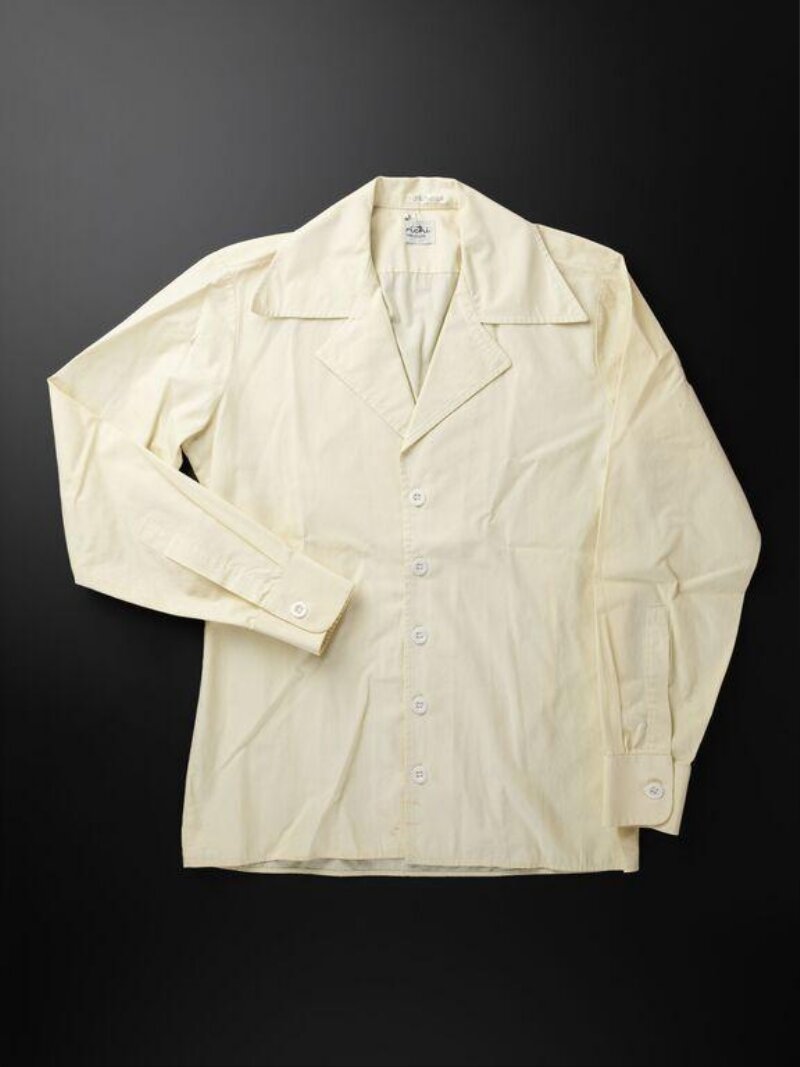
The Blouse: The blouse exemplifies luxury in simplicity. Its fluidity is achieved through bias cutting, particularly evident in the sleeve and cuff construction. The delicate pintucking at the front yoke and cuffs is minute and consistent, requiring specialist machine attachments or immense hand patience. The collar is a masterpiece of understatement: a stand-away band collar with precise points, interfaced with sheer silk organza to maintain a delicate, upright posture without stiffness.
Silhouette & Cultural Synthesis
The overall silhouette is a powerful hybrid: the broad, masculine shoulders and fitted waist of the jacket reference a military tunic, while the explosive, romantic volume of the skirt echoes 19th-century ballgowns and Russian folk dress. Saint Laurent does not merely combine references; he synthesizes them through a modernist lens. The silhouette is graphic and clear—a strong torso over a wide, circular base—yet rendered in sumptuous, historically loaded materials. This creates emotional resonance and intellectual intrigue.
Translation for Natalie Fashion Atelier: 2026 Luxury Codes
The 2026 luxury consumer seeks depth, authenticity, and technical innovation. The 'Jules' ensemble provides a blueprint not for replication, but for conceptual and technical evolution.
Material Reinterpretation
For 2026, we propose a sustainability-informed materiality that amplifies tactile contrast. The velvet can be reimagined as a bio-acetate velvet derived from seaweed or wood pulp, offering a similar depth with a lighter environmental footprint. The taffeta’s rigidity can be achieved through innovative weaves of recycled polyester blended with trace metals for a subtle, variable sheen, or through plant-starch finishes on organic silk. The blouse’s fluidity is ideal for circular luxury fabrics like regenerated nylon or new-generation cellulose fibers with enhanced drape.
Technical Evolution & Silhouette Proposal
Deconstructed Volume (Jacket & Skirt Synthesis): We propose merging the jacket and skirt into a singular, modern robe coat over a minimalist base. The coat would retain the tailored shoulders and velvet materiality of 'Jules,' but the lower half would explode into the tiered, cartridge-pleated volume, now rendered in a technical fabric with shape memory. The closure could evolve into a magnetic or touch-fastening system concealed within bound buttonholes, honoring the original technique while updating its function.
Modular Tiering: The tiered skirt concept can be translated into a modular, adjustable garment. Individual tiers could attach via discreet technical hooks or silicone-gripped seams to a foundational slip, allowing the wearer to customize volume and length, embodying a 2026 value of personalization and versatility in investment dressing.
Digital Craftsmanship: The precision of the original pintucking and pleating can be enhanced and reimagined through laser-cutting and ultrasonic welding. This allows for impossibly fine, sealed tucks and pleats on fragile fabrics, creating texture without thread or stress. The silhouette of the blouse can be algorithmically optimized for zero-waste bias cutting, its collar structured with 3D-printed bio-resin frameworks embedded within the fabric itself.
The 2026 Silhouette Narrative
The translated silhouette for 2026 becomes one of Intelligent Romance. It carries the emotional weight and historical dialogue of the original—the contrast of strength and softness, restraint and release—but expresses it through the lens of sustainable innovation and technical precision. The silhouette remains bold and graphic, but its components are smarter, lighter, and adaptable. It is couture archaeology not as revival, but as recombinant genetics, splicing the DNA of 1974’s masterful synthesis with the material and ethical codes of 2026.
In conclusion, the 'Jules' ensemble is a rich site for excavation. Its value lies in its demonstration of how profound material intelligence and exacting technique can give physical form to cultural narrative. For Natalie Fashion Atelier, this object provides the rigorous foundation upon which to build the next chapter of meaningful, technically sublime luxury.