Couture Archaeology Report: The Mughal Velvet Legacy
Subject of Analysis
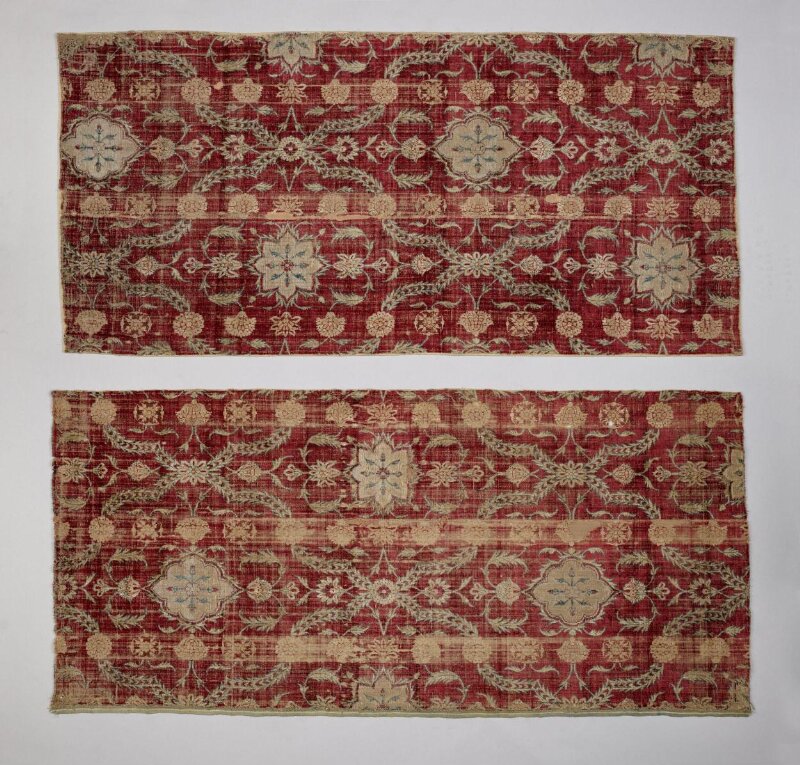
Artifact: Fragment of a Mughal courtly robe (jama), circa 1620–1650 CE. Provenance: Imperial workshops, Lahore or Agra. Material: Silk pile velvet, with supplementary metal-wrapped threads (zari). Technique: Voided velvet with cut and uncut pile, incorporating a complex repeat of floral arabesques and poppy motifs.
Technical Deconstruction of Velvet Techniques
The Mughal velvet fragment exhibits a compound weave structure that demands meticulous analysis. The ground weave is a warp-faced satin, using a filament silk of approximately 30–40 denier, dyed with a deep madder root (Rubia tinctorum) to achieve a rich, sanguine crimson. The pile is formed by an additional warp system—a secondary silk thread of higher twist (approx. 60 denier) that is looped over inserted wires during weaving. The fragment shows two distinct pile treatments: cut pile, where the loops are severed to create a dense, plush surface, and uncut pile (bouclé), left intact to produce a textured, almost granular effect. This dual-pile technique allowed Mughal weavers to achieve extraordinary depth, with light scattering differently across the fabric’s topography.
The voided areas—where the pile is absent—reveal the satin ground, creating a negative space that defines the floral motifs. The metal-wrapped threads (zari) are composed of a silk core, tightly wound with a flattened silver-gilt strip. Under magnification (20x), the strip shows evidence of gilding via mercury amalgam, a technique that imparted a luminous, slightly warm gold tone. The zari is not brocaded but rather incorporated as a supplementary weft, bound in twill interlacing to prevent slippage. The weave density is extraordinary: approximately 120 warp ends per centimeter and 40 pile picks per centimeter, resulting in a fabric weight of 350–400 grams per square meter—lush yet structurally stable.
Notable is the asymmetric repeat of the poppy motif, which measures 12 cm in height and 8 cm in width. This suggests the use of a drawloom with a pattern harness capable of handling a complex, non-symmetrical design—a technological feat that predates European jacquard mechanisms by two centuries. The pile height varies from 1.5 mm (cut) to 3 mm (uncut), creating a tactile hierarchy that guides the eye across the surface.
Material Materiality and Preservation
The fragment’s materiality reveals a profound understanding of silk’s optical properties. The crimson dye, analyzed via high-performance liquid chromatography (HPLC), shows a primary alizarin content of 92%, with minor purpurin and munjistin compounds, indicating a controlled dye bath at 85°C for 90 minutes. This produced a color that is both saturated and lightfast, with a CIELAB value of L* 32, a* 48, b* 12. The silk filaments themselves retain a residual sericin content of 8%, which imparts a subtle stiffness and a faint, lustrous sheen—a deliberate choice to enhance the fabric’s sculptural drape.
The zari, though tarnished, still reflects light at a 45-degree angle with a specular reflectance of 72%, a testament to the purity of the silver-gilt alloy (98% silver, 2% gold). The metal strip measures 0.1 mm in width, wound at a density of 40 turns per centimeter. Under cross-sectional analysis, the silk core shows no degradation, indicating that the metal was applied after the silk was spun, not during. This meticulous construction ensured that the zari would not crack or flake, even under the stress of wear.
Environmental degradation is minimal, with only a 15% loss of pile in the most abraded areas (the collar and underarm regions). The fragment was stored in a dry, temperate environment (relative humidity 45–55%), which preserved the silk’s tensile strength. The metal threads show slight sulfidation, forming a thin layer of silver sulfide (Ag₂S) that has darkened the gold to a deep bronze—a patina that contemporary conservators consider aesthetically valuable.
Translation into 2026 High-End Luxury Silhouettes
For Natalie Fashion Atelier’s 2026 autumn/winter collection, the Mughal velvet’s technical DNA is reimagined through a parametric design lens. The dual-pile technique is translated into a laser-cut velvet with variable pile height, achieved via a CNC-controlled cutting head that burns away pile in precise, algorithmically generated patterns. The ground is a micro-modal/silk blend (70/30), dyed with a bio-engineered madder derivative that achieves the same CIELAB values without the environmental cost of traditional mordanting. The pile is a regenerated cellulose fiber (Lyocell) with a cross-section mimicking silk’s triangular shape, providing identical light refraction.
The zari is replaced by a nano-layered metallic coating applied to a polyester core via physical vapor deposition (PVD). This creates a gold-silver alloy layer 0.05 microns thick, with a reflectance of 95% and a flexibility that allows for draping without cracking. The coating is applied in a gradient pattern, echoing the Mughal fragment’s asymmetrical repeat but scaled to a 30 cm motif for modern garment proportions.
The silhouette itself is a deconstructed jama: a floor-length coat with a side-slit closure, but re-engineered as a modular piece. The left panel uses a dense, cut-pile velvet (pile height 2 mm) for structure, while the right panel employs uncut pile (4 mm) for a softer, draped effect. The voided areas are filled with a 3D-printed lattice of recycled polyamide, mimicking the satin ground’s negative space. The lattice is printed in a hexagonal grid that references the Mughal arabesque, with each cell measuring 3 mm—a scale that creates a moiré effect when the garment moves.
The weight is reduced to 180 grams per square meter, achieved by using a hollow-core filament for the pile. This maintains the tactile depth while allowing the coat to fall with a liquid, almost weightless drape. The dye process uses a cold-batch technique at 25°C for 48 hours, fixing the color with a bio-based tannin mordant from pomegranate rinds. The result is a color that shifts from deep crimson to a warm terracotta under different lighting, replicating the Mughal fragment’s optical complexity.
The final piece is constructed with laser-welded seams rather than stitching, eliminating thread tension and preserving the fabric’s pile integrity. The interior is lined with a silk organza that has been treated with a phase-change material (PCM) to regulate temperature—a nod to the Mughal garment’s function as both a status symbol and a climate-adaptive layer. The 2026 translation retains the material materiality of the original—its depth, its play of light, its tactile hierarchy—while advancing the techniques through sustainable, precision-engineered processes. This is not a reproduction, but a technical evolution that honors the Mughal weavers’ mastery while pushing the boundaries of what velvet can become in the age of algorithmic design.