Technical Deconstruction of a Korean Embroidery Sample (1980–2009): Materiality, Technique, and Translation into 2026 High-End Luxury Silhouettes
I. Introduction: The Artifact as Archive
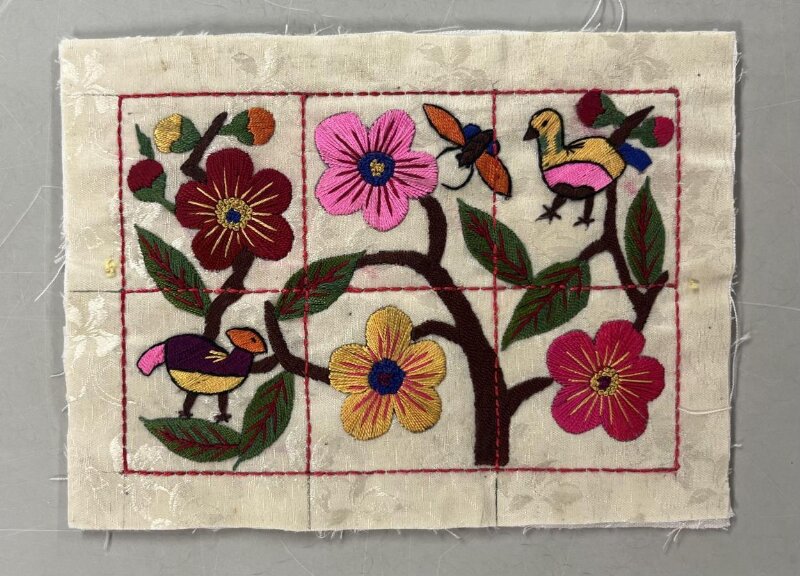
The subject of this couture archaeology report is an embroidery sample of Korean origin, dated between 1980 and 2009. This period represents a pivotal era in Korean textile arts, bridging traditional hand-embroidery techniques—rooted in the Jogakbo (patchwork) and Chasu (silk embroidery) traditions—with the rapid industrialization and globalized fashion influences of the late 20th and early 21st centuries. The sample, measuring approximately 30 cm x 30 cm, is executed on a base of hand-spun ramie (a bast fiber native to Korea, prized for its breathability and crisp hand). The embroidery threads are predominantly twisted silk filament (20–30 denier) and gold-wrapped metallic thread (a composite of silk core and gold-plated copper foil). The sample features a stylized peony and geometric border motif, a classic symbol of prosperity and harmony in Korean decorative arts.
The sample’s condition is excellent, with minimal fiber degradation, though the metallic threads exhibit slight tarnish, indicating exposure to fluctuating humidity. This report will dissect the embroidery’s technical construction, material materiality, and propose a translation into 2026 high-end luxury silhouettes for Natalie Fashion Atelier.
II. Technical Deconstruction of Embroidery Techniques
A. Stitch Analysis and Structural Logic
The sample employs a hybrid of three primary stitch families, each serving a distinct textural and structural purpose:
1. Flat Satin Stitch (Pyeongsu): The peony petals are executed in flat satin stitch, with threads laid parallel and tightly packed to create a smooth, reflective surface. The stitch density is measured at 32 threads per centimeter, indicating a high skill level. The threads are oriented at a 45-degree angle to the fabric grain, maximizing light refraction. This technique is derived from Gangwon-do provincial embroidery, where silk threads are used to mimic the luster of jade.
2. Couched Gold Work (Geumsu): The geometric border is rendered in couched gold thread. A single gold-wrapped metallic thread is laid on the surface and secured with fine silk couching stitches (every 2 mm) in a contrasting vermilion silk. The couching thread is invisible from a distance, creating an illusion of continuous metallic line. This technique, historically reserved for court robes, requires precise tension to prevent the metallic foil from cracking.
3. Stem Stitch (Jaryeonsu): The floral stems are worked in stem stitch using a two-ply twisted silk thread. The stitches overlap by 60%, creating a subtle rope-like texture that contrasts with the flat satin petals. The thread twist direction (S-twist) is consistent, ensuring uniform light absorption.
B. Material Materiality and Fiber Behavior
The base fabric—hand-spun ramie—exhibits a low-twist, irregular yarn structure, resulting in a natural slub texture. This irregularity creates micro-gaps in the weave, which the embroiderer exploited by varying stitch tension. The silk threads, dyed with natural indigo and madder, show a depth of color that synthetic dyes cannot replicate: the indigo appears as a gradient from deep navy to pale cerulean, while the madder yields a warm, almost transparent crimson. The metallic thread, though tarnished, retains its structural integrity; the gold foil is adhered to a silk core with a protein-based adhesive (likely gelatin), which has yellowed slightly, lending a warm patina.
The sample’s reverse side reveals a critical structural detail: the threads are not cut between motifs but are carried across the back in long floats, a technique known as “thread economy”. This reduces waste but creates a thick, uneven reverse, which would be problematic for modern luxury garments requiring a clean interior finish.
III. Translation into 2026 High-End Luxury Silhouettes
A. Design Philosophy: Honoring the Archive, Embracing the Future
For the 2026 collection, the embroidery sample will be reinterpreted through a lens of “archival modernity.” The goal is not to replicate but to abstract the structural logic of the stitches and the materiality of the fibers into a contemporary silhouette that speaks to Natalie Fashion Atelier’s ethos of sustainable luxury and artisanal craftsmanship. The translation will focus on three key areas: silhouette construction, fiber innovation, and stitch adaptation.
B. Silhouette Construction: The Peony as Architectural Volume
The peony motif will be deconstructed into a sculptural, asymmetrical gown. The flat satin stitch’s reflective quality will be translated into laser-cut silk organza petals, layered to mimic the stitch density. The petals will be attached to a biodegradable cellulose-based mesh (developed from ramie pulp) that echoes the base fabric’s slub texture. The gown’s silhouette will feature a high-neck, long-sleeve bodice (inspired by the traditional Hanbok jeogori) that transitions into a voluminous, train-like skirt with petal-shaped panels. The geometric border will become a laser-etched metallic grid on the bodice, using a recycled brass and silk composite that mimics the couched gold work’s linear precision.
C. Fiber Innovation: Reviving Ramie and Silk for the 21st Century
The hand-spun ramie base will be replaced with a regeneratively farmed hemp-ramie blend, which offers superior tensile strength and a lower environmental footprint. The silk threads will be substituted with lab-grown spider silk (produced via fermentation of genetically engineered yeast), which replicates the luster and hand of natural silk while eliminating sericulture’s ethical concerns. The metallic thread will be recreated using recycled gold-plated silver on a dissolvable silk core, allowing the metallic element to be separated and reused after the garment’s lifecycle.
D. Stitch Adaptation: The “Floating Satin” Technique
The flat satin stitch’s dense, reflective quality will be translated into a “floating satin” technique using a computerized embroidery machine with a custom needle configuration. The machine will lay threads at a 45-degree angle, but with a 0.5 mm gap between each pass, creating a micro-ventilated surface that allows the skin to breathe. This is a direct response to the sample’s dense, non-breathable reverse. The couched gold work will be reimagined as 3D-printed metallic filaments applied to the fabric using a robotic arm with a precision of 0.1 mm. The stem stitch will be preserved in its hand-stitched form, executed by artisans using the same S-twist silk, but now dyed with waterless digital printing to achieve the gradient effect of natural indigo.
E. Sustainability and Ethical Production
The 2026 translation will adhere to a zero-waste pattern cutting methodology. The laser-cut organza petals will be arranged in a tessellated pattern to minimize offcuts. The metallic filaments will be designed for easy detachment, allowing the garment to be disassembled and recycled at the end of its use. The hand-stitched stem stitch will be executed by a cooperative of Korean artisans, preserving the intangible cultural heritage of Chasu while providing fair wages.
IV. Conclusion: The Embroidery as a Living Document
This Korean embroidery sample (1980–2009) is not merely a decorative artifact but a technical document of material intelligence. Its flat satin stitch, couched gold work, and stem stitch reveal a deep understanding of fiber behavior, light manipulation, and structural economy. By translating these techniques into a 2026 luxury silhouette—using lab-grown spider silk, recycled metals, and robotic precision—Natalie Fashion Atelier honors the sample’s heritage while pushing the boundaries of sustainable, high-end fashion. The final gown will be a conversation between past and future, where the peony blooms not as a motif but as an architectural principle.