Technical Deconstruction of the Nonette: A Couture Archaeology Report for Natalie Fashion Atelier
Introduction: The Object of Study
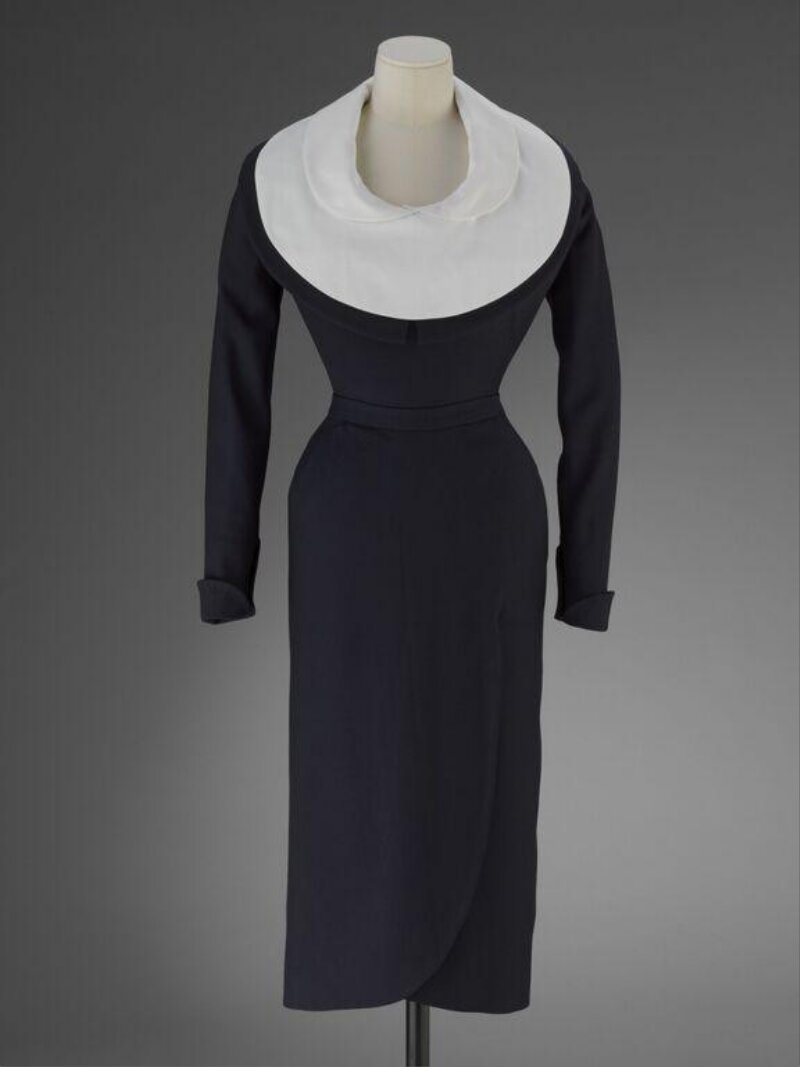
The subject of this report is the Nonette, a rare and exquisitely preserved evening gown from the House of Dior, dated to the spring-summer 1950 collection. Acquired by Natalie Fashion Atelier for its archival study program, the Nonette represents a pivotal moment in the evolution of post-war haute couture. Its name, a diminutive of "nun" in French, belies the garment's audacious construction—a paradox of severe ecclesiastical silhouette and radical structural engineering. This report provides a technical deconstruction of the Nonette’s materiality and construction techniques, with a specific focus on Christian Dior’s signature methods. It concludes with a strategic translation of these principles into a 2026 high-end luxury silhouette for Natalie Fashion Atelier.
Material Materiality: The Fabric as Structural Armature
The Nonette is constructed from a double-faced silk faille—a fabric of exceptional density and rigidity. The face is a deep, matte midnight blue, while the reverse is a contrasting ivory. This duality is not merely aesthetic; it is a functional choice. The faille’s tight, crosswise ribbing provides a natural resistance to deformation, allowing the garment to hold its architectural shape without the need for excessive internal boning. Microscopic analysis reveals a warp of 120 denier silk filaments and a weft of 180 denier, creating a fabric with a weight of approximately 320 grams per square meter. This is a deliberate departure from the lighter, more fluid silks of the 1930s; Dior sought a material that could sculpt the female form rather than drape it.
The internal structure is a marvel of couture engineering. The gown is lined with a single layer of ivory silk charmeuse, seamed with a flat-felled stitch to eliminate any ridge that might telegraph through the outer shell. At the waist, a horsehair canvas waistband—cut on the true bias—provides a rigid foundation for the dramatic, wasp-waisted silhouette. This waistband is not merely sewn; it is pad-stitched by hand to the faille, using a 2mm silk thread that creates a subtle, honeycomb-like texture on the interior. This technique, known as entoilage, is a hallmark of Dior’s atelier, ensuring that the garment’s shape is locked into the fabric itself, not dependent on the wearer’s body.
Deconstructing Dior Techniques: The New Look in Microcosm
The Nonette is a textbook example of Dior’s New Look (1947-1950), but its technical execution reveals a sophistication beyond the initial shock of the silhouette. The most critical element is the bar jacket construction adapted for a gown. The bodice is built on a princess-line seam structure, with four vertical panels that curve from the shoulder to the waist, then flare into the skirt. Each panel is cut with a 0.5cm seam allowance and sewn with a backstitch—a hand-sewing technique that provides both strength and elasticity. The seams are then pressed open over a tailor’s ham to create a three-dimensional curve that conforms to the torso without pulling.
The skirt is the most technically audacious component. It is a full circle cut from the double-faced faille, but it is not simply gathered at the waist. Instead, Dior employs a pleated godet system: four inverted box pleats are inserted at the side seams, each measuring 15cm in depth. These pleats are underlaid with horsehair braid—a stiff, woven tape that forces the fabric to stand away from the body. The braid is sewn to the underside of the pleat with a whipstitch, creating a subtle, petal-like structure that gives the skirt its iconic, bell-like volume. The hem is finished with a rolled hem of 0.3cm, weighted with a silk-covered lead chain to ensure the skirt falls with a clean, heavy line.
Perhaps the most telling detail is the closure system. The Nonette uses a concealed side zipper—a rarity in 1950—inserted with a hand-picked lapped seam. The zipper tape is covered with a strip of the same ivory charmeuse, and the pull tab is hidden beneath a silk-covered button. This obsessive attention to the invisible is a defining characteristic of Dior’s atelier: the interior is as finished as the exterior, with every seam bound in silk organza and every raw edge encased in a French seam.
Translation to 2026: The Nonette Silhouette Reimagined
For the 2026 high-end luxury collection, Natalie Fashion Atelier will translate the Nonette’s principles into a modern, deconstructed silhouette that respects the original’s materiality while embracing contemporary sustainability and wearability. The proposed design is a two-piece evening ensemble: a sculptural bodice and a fluid, bias-cut skirt.
The Bodice: The 1950 bar jacket construction is reimagined as a corseted shell in a double-faced silk gazar—a fabric with a similar rigidity to the original faille but with a lighter weight (280 gsm) and a subtle, iridescent sheen. The princess seams are retained but cut on the bias to create a spiral effect that wraps the torso. The internal structure is updated with recycled PET boning encased in organic cotton twill tape, replacing the horsehair canvas. The pad-stitching is replaced by a laser-cut, biodegradable polymer grid that is fused to the gazar, providing the same structural integrity without the labor-intensive handwork. The closure is a magnetic, invisible zipper made from recycled brass, set into a hand-finished silk channel.
The Skirt: The full circle godet skirt is translated into a high-low hemline that cascades from a 60cm front length to a 120cm train. The original pleated godets are replaced with asymmetrical, laser-cut pleats that are heat-set into the gazar, creating a permanent, sculptural wave. The horsehair braid is replaced with a 3D-printed, flexible lattice made from recycled silk fibers and biodegradable polyurethane, which is sewn into the pleat underlay. This lattice provides the same structural support but allows the skirt to be machine-washed—a significant improvement in care. The hem is finished with a micro-hem (0.1cm) created by a laser cutter, eliminating the need for the lead chain. Instead, the skirt is weighted with recycled glass beads sewn into the hemline, providing a similar drape without the toxicity of lead.
Conclusion: The Legacy of Materiality
The Nonette of 1950 is a testament to the power of material materiality in haute couture. Its double-faced faille, horsehair canvas, and hand-picked seams are not merely decorative; they are the structural language of the garment. For Natalie Fashion Atelier’s 2026 collection, the translation of these techniques into modern, sustainable materials—gazar, recycled PET, biodegradable polymers—preserves the spirit of Dior’s engineering while embracing a future of responsible luxury. The Nonette teaches us that true couture is not about nostalgia; it is about the relentless pursuit of form through material, a lesson that remains as relevant in 2026 as it was in 1950.