Deconstructing the Colonial Palimpsest: The Cotton Plain-Weave Hanging as a Blueprint for 2026 Haute Couture
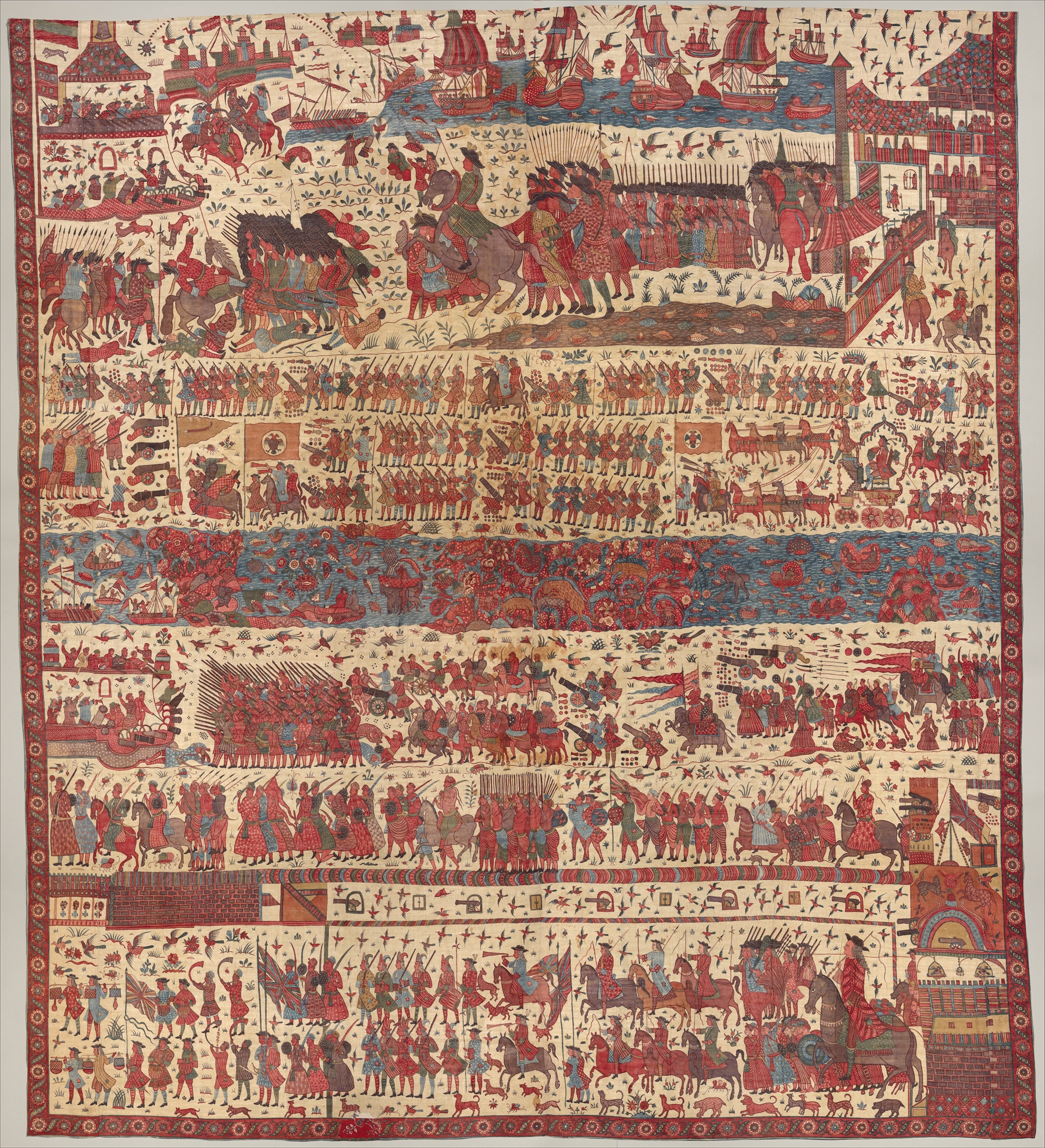
In the silent archives of aesthetic archaeology, certain artifacts transcend their historical moment to become potent catalysts for future form. The hanging depicting a European conflict on South Indian soil, executed on a humble cotton plain weave, is precisely such an object. At first glance, it is a document of geopolitical encounter—a visual record of clashing empires. Yet, for the discerning eye of the Natalie Fashion Atelier, it is a masterclass in the subversion of material hierarchy, a treatise on the narrative power of surface, and a profound lesson in the tension between rigidity and fluidity. This research artifact deconstructs the classical elegance embedded within this drawn, painted, mordant, and resist-dyed textile, and translates its core principles into the architectural language of 2026 high-end silhouettes.
Materiality as a Dialectic: The Humble Ground of Luxury
The foundational element of this artifact is its material: cotton, plain weave. In the Western canon of luxury, cotton has long been relegated to the realm of the quotidian, the comfortable, the domestic. It is the antithesis of the aristocratic silk or the regal velvet. Yet, this hanging presents a radical inversion. The plain weave—the simplest, most democratic of textile structures—becomes the ground upon which an extraordinarily complex narrative is built. This is not a passive backdrop; it is an active participant. The very simplicity of the weave creates a surface of immense optical and tactile potential. The threads, undyed and unadorned in their raw state, offer a neutral, absorbent field that demands the intervention of the artist.
For the 2026 silhouette, this principle translates into a deliberate embrace of unexpected foundational fabrics. We are moving beyond the obsession with rare silks and cashmeres as the sole markers of luxury. The new luxury lies in the juxtaposition of the humble and the extraordinary. Imagine a tailored jacket in a heavy, unbleached cotton twill, its structure severe and architectural. The "luxury" is not in the fiber itself, but in the treatment—the precise, almost brutalist cut, the hand-finished seams, the absence of any lining that would soften its stark integrity. This is the plain weave of the silhouette: a clean, unadorned volume that serves as the canvas for the narrative to come.
The Drawn and Painted Line: Calligraphy of Conflict and Control
The technique of drawn and painted imagery on this hanging is not mere decoration; it is a form of controlled chaos. The artist’s hand is evident in every stroke, every wash of pigment. The depiction of a European conflict—with its rigid formations, its ceremonial weaponry, its colonial order—is rendered through a distinctly South Indian aesthetic lens. The lines are not mechanically precise; they are calligraphic, possessing a life and a rhythm of their own. This is where the classical elegance of the piece resides: in the tension between the subject’s desire for order and the artist’s inherent fluidity of expression.
In 2026 haute couture, this translates to a new approach to surface embellishment. We move away from the static, beaded embroidery that merely covers the fabric. Instead, we embrace the drawn line as a structural element. Consider a column gown in black matte crepe. The silhouette is pure, minimalist, a vertical line of power. The narrative is introduced through hand-painted pigment—a series of gestural, almost violent strokes in metallic gold and deep indigo that trace the line of the spine, wrap around the hip, and cascade down the hem. This is not a pattern; it is a record of the hand, a calligraphy of movement that mimics the artist’s original gesture. The "conflict" here is between the rigid geometry of the silhouette and the organic, unpredictable flow of the painted line.
Mordant and Resist: The Architecture of Negative Space
The most sophisticated technical lesson from this hanging lies in the dual processes of mordant and resist dyeing. The mordant fixes the dye to the fiber, creating a permanent, saturated mark. The resist, conversely, prevents the dye from penetrating, preserving the pristine white of the ground. This is a dialogue of presence and absence, of positive and negative space. The European soldiers, their uniforms, their horses—all are defined as much by the areas of untouched cotton as by the dyed forms. The void is as narratively potent as the volume.
For the 2026 silhouette, this principle informs a radical new understanding of cut and construction. The resist becomes the seam, the mordant becomes the drape. Imagine a deconstructed trench coat in a heavy, natural linen. The garment is not assembled from traditional pattern pieces. Instead, it is cut in one continuous piece, with strategic areas treated with a resist agent. When the fabric is dyed in a deep, architectural charcoal, the resisted areas remain white, creating negative-space seams that define the armhole, the collar, the pocket. The garment’s structure is not sewn; it is revealed through the dyeing process. The "conflict" is between the solid, dyed mass of the coat and the white, unpigmented lines that articulate its form. This is aesthetic archaeology in practice: excavating the silhouette from the fabric itself.
The 2026 Silhouette: A Synthesis of Tensions
The final translation of this hanging into a high-end silhouette for 2026 is not a literal reproduction. It is a synthesis of its core tensions: the humble versus the precious, the rigid versus the fluid, the permanent versus the ephemeral. The resulting garment is a masterpiece of controlled contradiction.
The Silhouette: The "Colonial Palimpsest" Gown
The foundation is a floor-length, bias-cut gown in a double-faced cotton sateen. The outer face is a deep, matte indigo, achieved through a complex, multi-stage vat dye. The inner face is left in its natural, unbleached state. The cut is deliberately severe: a high, mandarin collar, long sleeves that taper to a point over the hand, and a skirt that falls in a single, unbroken column. This is the plain weave of the silhouette—the disciplined, architectural ground.
The narrative is introduced through hand-painted mordant and resist. A master artisan, using a fine brush, applies a resist paste in a pattern of fragmented, calligraphic lines that evoke the map of a forgotten battle. The gown is then dipped in a bath of metallic copper, which fixes only to the areas not protected by the resist. The result is a ghostly map of copper lines across the indigo field—a palimpsest of conflict. The resist is then removed, revealing the pristine white of the inner face in the negative spaces.
The final act of construction is the drape. The gown is not sewn at the sides. Instead, it is wrapped and pinned on the body, using the painted lines as guides. The "seams" are the resist lines themselves, which become the structural anchors of the garment. The gown is a living artifact, a dialogue between the artist’s hand, the dyer’s chemistry, and the wearer’s form. It is a 2026 silhouette that does not merely reference the past; it embodies the process of its own creation, a testament to the enduring power of the humble cotton plain weave to inform the highest expression of luxury. This is the Natalie Fashion Atelier signature: not a reproduction of history, but a re-inscription of its most potent aesthetic principles onto the body of the future.