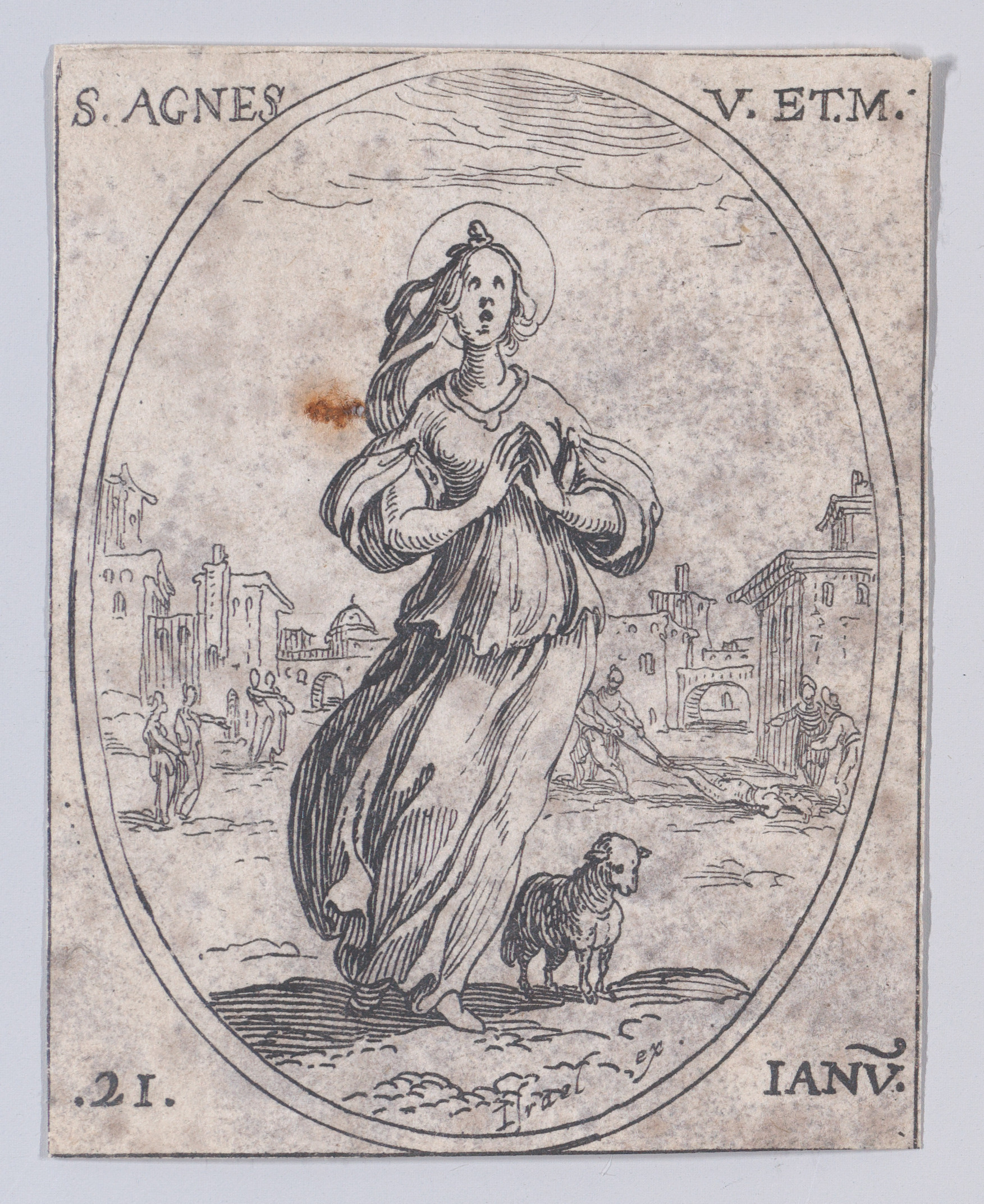
Archaeology of the Chaste Silhouette: Deconstructing Ste. Agnés
Within the rigorous discipline of aesthetic archaeology, the 17th-century etching of Ste. Agnés, vierge et martyre from Jacques Callot's "Les Images De Tous Les Saincts et Saintes de L'Année" presents a profound case study in distilled classical elegance. This second state (Lieure) is not merely a devotional image but a masterclass in silhouette, drapery, and symbolic materiality. Isolated from its liturgical context for our analysis, the figure of St. Agnes becomes a pure archetype. Her form is defined by a cascading, columnar robe, a mantle draped with geometric precision, and an aura of serene containment. The etching's lines—simultaneously delicate and decisive—do not merely outline a saint; they map a philosophy of form where modesty generates immense visual power, and restraint implies a luxurious abundance of spirit. This technical report deconstructs these elements to forecast their re-emergence in the 2026 haute couture lexicon, where values of purity, permanence, and profound craftsmanship are paramount.
Technical Deconstruction: The Architecture of Sanctity
The elegance of Callot's Ste. Agnés is architectural, built upon a foundation of contrapposto in repose. While classical contrapposto implies dynamic tension, Agnes embodies a still, vertical equilibrium. The primary robe falls from the shoulders in uninterrupted, parallel lines, creating a cylindrical core. This is the foundational "column dress," a silhouette that speaks of integrity and strength. The true complexity lies in the mantle. Draped over the left shoulder, it crosses the body in a diagonal axis, pulled taut across the torso before being gathered over the right arm. This diagonal creates a series of controlled triangular folds—sharp, geometric, and logically resolved—that contrast with the soft, vertical pleats of the under-robe. The lamb at her feet, her attribute, provides a small, curvilinear counterpoint to this dominant geometry. The etching medium itself is crucial: the second state's clarity shows no excess. Each line is essential, denoting a fold's origin, tension, and terminus. This is draping as technical drawing, where negative space is as formative as the mark itself, defining the body through strategic concealment and revelation.
Material Translation: From Printed Line to Haute Textile
Informing 2026 luxury, this analysis moves from line to substance. The 2026 silhouette will embrace a neo-columnar integrity, moving away from deconstructed fragmentation toward a purified, monolithic line. This is not a simple shift; it is an intellectual recalibration towards dignity. The Callot etching directly informs this through three material translations. First, the parallel vertical pleat, executed in haute couture, will be achieved not with mere cutting but with foundational garment engineering—think bias-cut silk gazar fused to a structured under-bodice, or weightless wool crepe meticulously knife-pleated and set to maintain its architectural fall. Second, the diagonal mantle finds its expression in the asymmetric surplice wrap, a key 2026 outer-silhouette element. It will be rendered in dense cashmere velours or technical matte satin, cut precisely to replicate that geometric tension, clasped with a minimalist, jeweled fibule (brooch) at the shoulder. Third, the symbolic materiality of the lamb translates to a focus on innocent, tactile textures: curled lambswool trims, guipure lace mimicking fleece, or pearlescent embroideries that catch the light like an aura. The palette derives from the etching's monochrome—a spectrum of mineral whites, parchment, and graphite, punctuated by the vermillion of martyrdom as a single, devastating lip or lining.
Informing the 2026 Silhouette: A New Modesty
The 2026 luxury consumer seeks not just product but philosophy and permanence. The Ste. Agnés archetype provides a resonant framework. Her silhouette rejects overt sensuality in favor of a potent, cerebral elegance. This aligns with a growing desire for considered consumption and attire that conveys authority through subtlety, not spectacle. The 2026 collection informed by this study will feature looks built on this principle: a floor-length column gown with a high neckline, its only detail being the miraculous, Callot-inspired diagonal drape across the torso, secured under a sculptural arm. Daywear will reinterpret the mantle as a structured cape-over-robe system, where layers are integral, not additive, creating clean, graphic lines against the body. The chastity of the silhouette becomes a canvas for extreme textile development—the true luxury is in the hand of a fabric that appears simple but whose development required hundreds of hours.
The Atelier Directive: Craftsmanship as Devotion
Finally, the etching’s "second state" is a critical metaphor. It represents the point of perfected clarity before further reproduction. For Natalie Fashion Atelier, each 2026 piece must embody this definitive "second state"—the apex of craftsmanship where every decision is intentional and irrevocable. The technical construction must mirror the etching's economy of line: internal corsetry to achieve the columnar form without visible constraint, hem weights calibrated for that specific drape, seams placed and finished to become invisible from the exterior. This is haute couture as aesthetic archaeology, where we excavate a principle (chaste geometry) and re-materialize it with contemporary mastery. The client is not purchasing a dress referencing a saint; she is investing in a garment that embodies the same principles of purity, structure, and enduring elegance that Callot’s needle etched into copper centuries ago. The 2026 silhouette, therefore, is a dialogue across time—a reaffirmation that in an age of noise, the most powerful statement is a singular, perfected, and serene line.