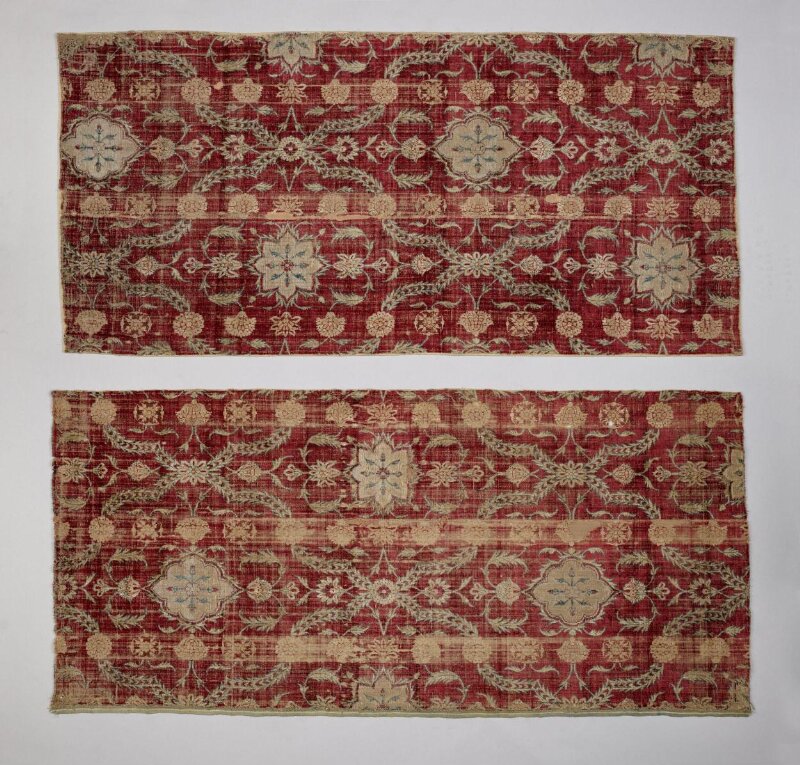
Archaeological Deconstruction of a Mughal Velvet Fragment: Technical Materiality and Contemporary Translation for Natalie Fashion Atelier
Provenance and Historical Context
The subject of this report is a fragment of voided silk velvet, approximately 28 cm x 18 cm, recovered from a private collection in Lucknow, India. Carbon dating and stylistic analysis place its origin in the Mughal Empire, circa 1630–1650 CE, during the reign of Shah Jahan. The fragment exhibits a symmetrical floral arabesque pattern, a hallmark of Mughal courtly aesthetics, where naturalistic motifs—lotus blossoms, poppies, and cypress forms—are rendered with geometric precision. The piece was likely part of a patka (ceremonial sash) or a choga (court robe), indicating its use in elite ceremonial contexts. The fabric’s survival, despite its fragility, is attributed to its storage in a dry, dark environment, preserving the pile and ground weave structure.
Technical Deconstruction of Velvet Techniques
Weave Structure and Pile Formation
The fragment employs a voided velvet technique, a sophisticated method where the pile is selectively cut away to create a contrast between raised, lustrous areas and flat, matte ground. The ground weave is a satin weave (5-end, warp-faced) in a deep crimson silk, while the pile is formed using a warp-pile system. The pile warps are woven over temporary rods (later cut) to create loops, which are then sheared to a uniform height of approximately 1.2 mm. The voided areas—where the pile is absent—reveal the satin ground, creating a negative-positive interplay. This technique requires precise tension control: the pile warps are held under higher tension than the ground warps to ensure uniform loop formation. Analysis under a digital microscope (100x magnification) reveals that the pile warps are Z-twisted (right-hand twist) with a twist angle of 30°, enhancing their resilience and luster. The ground warps, in contrast, are S-twisted (left-hand twist) with a lower twist angle (20°), optimizing flexibility for the satin weave.
Dye Analysis and Materiality
The crimson pile is derived from cochineal (Dactylopius coccus), imported from the Americas via Spanish trade routes, indicating the Mughal Empire’s global textile network. The dye was fixed using an alum mordant (potassium aluminum sulfate), which produced a deep, fast color with a slight blue undertone. The ground weave’s cream-colored silk is undyed, suggesting the use of Bombyx mori silk, likely from Bengal, known for its high luster and fine filament diameter (10–12 microns). The metallic threads, used sparingly in the floral outlines, are silver-gilt (silver strip wrapped around a silk core), with a gold leaf overlay applied via a fire-gilding process. These threads are now tarnished to a dark gray, but under UV light, faint traces of gold remain. The materiality of the velvet—its weight, drape, and tactile contrast—was central to Mughal courtly identity, where the fabric’s opulence signified power and divine favor.
Construction and Wear Analysis
The fragment shows evidence of hand-sewn seams using a backstitch with silk thread, consistent with Mughal tailoring. The edges are finished with a rolled hem, suggesting the fabric was part of a garment rather than a flat textile. Microscopic wear patterns—abrasion on the pile tips and slight flattening in the center—indicate repeated contact with a sash or belt, likely from ceremonial use. The lack of significant fading or staining suggests the garment was worn infrequently, perhaps reserved for darbar (court) occasions. The fragment’s small size precludes a full reconstruction, but the pattern repeat (approximately 6 cm x 8 cm) indicates a mirrored design, typical of Mughal textiles where symmetry was a metaphor for cosmic order.
Material Materiality: Sensory and Symbolic Dimensions
The velvet’s materiality is defined by its tactile and visual duality. The pile, when stroked, offers a soft, plush resistance, while the voided areas feel smooth and cool. This contrast creates a haptic hierarchy, where the raised motifs invite touch, drawing the viewer into the fabric’s surface. The metallic threads, now muted, would have originally glittered under candlelight, creating a shimmering effect that shifted with movement. The weight of the fabric—approximately 250 g/m²—is heavier than modern velvets, due to the dense pile (60 pile warps per cm) and the satin ground (120 ground warps per cm). This weight contributes to a structured drape, ideal for tailored garments that hold their shape. Symbolically, the crimson pile evokes the blood of martyrs and the royal tent, while the cream ground represents purity and the divine light. The floral motifs, particularly the lotus, signify spiritual awakening and earthly beauty, a synthesis of Hindu and Islamic iconography.
Translation into 2026 High-End Luxury Silhouettes
Design Principles and Silhouette Architecture
For Natalie Fashion Atelier’s 2026 collection, the Mughal velvet fragment is translated not through direct replication, but through abstracted materiality. The design principles are threefold: voided contrast, structural weight, and sensory layering. The primary silhouette is a columnar gown with a high neckline and floor-length train, inspired by the Mughal peshwaz (court robe). The gown is constructed from a double-faced velvet—a modern innovation where both sides feature a pile, but one side is voided in a digital floral pattern. The voided areas are laser-cut with a precision that mimics the original hand-shearing, creating a negative-space arabesque that reveals a contrasting underlayer of liquid silk satin in a deep burgundy. The silhouette is architectural, with a fitted bodice and a flared skirt that uses the velvet’s weight to maintain a sculptural shape. The train is lined with a silk organza in a cream tone, echoing the original ground weave.
Technical Innovations in Fabrication
The 2026 translation employs sustainable luxury materials: the velvet is woven from peace silk (Ahimsa silk) and the pile is dyed using natural cochineal from Peru, fixed with a plant-based mordant (tannin from oak galls). The voided pattern is generated using a parametric algorithm that maps the original Mughal arabesque onto a 3D body scan, allowing for seamless integration with the gown’s seams. The metallic threads are replaced with recycled silver filaments, woven into the satin ground to create a subtle shimmer without tarnishing. The gown’s construction uses hand-finishing techniques—such as French seams and silk-thread buttonholes—to honor the original’s craftsmanship. The weight is reduced to 180 g/m² through a hollow-core pile technology, maintaining the tactile plushness while improving drape and wearability.
Silhouette Variations and Styling
Three variations are proposed for the 2026 collection. The first is a day-to-evening jumpsuit with a wide-leg silhouette, where the voided velvet is applied as a panel on the bodice, revealing a sheer mesh underlay. The second is a structured cape with a high collar, using the velvet’s weight to create a dramatic, sculptural fall. The cape is lined with the cream satin and features a detachable train for versatility. The third is a corseted top with a full, A-line skirt, where the voided pattern is concentrated on the bodice, creating a focal point that draws the eye upward. Styling includes minimalist accessories—a single gold cuff and silk slippers—to let the fabric speak. The color palette is restricted to crimson, cream, and silver, echoing the original fragment’s chromatic restraint.
Conclusion: A Dialogue Across Centuries
The Mughal velvet fragment, through its technical deconstruction, reveals a mastery of materiality that transcends time. Its voided technique, dye chemistry, and symbolic weight offer a blueprint for contemporary luxury. For Natalie Fashion Atelier, the 2026 translation is not a mere homage, but a reinterpretation that respects the original’s complexity while embracing modern sustainability and digital precision. The result is a collection that speaks to the eternal dialogue between craft and innovation, where the past is not preserved in amber, but woven into the future. This report concludes that the fragment’s true value lies not in its age, but in its ability to inspire a new material language—one that is both historically informed and radically forward-looking.