The Armored Silhouette: Deconstructing Classical Elegance for 2026
Archive Context: An Isolated Aesthetic Archaeology
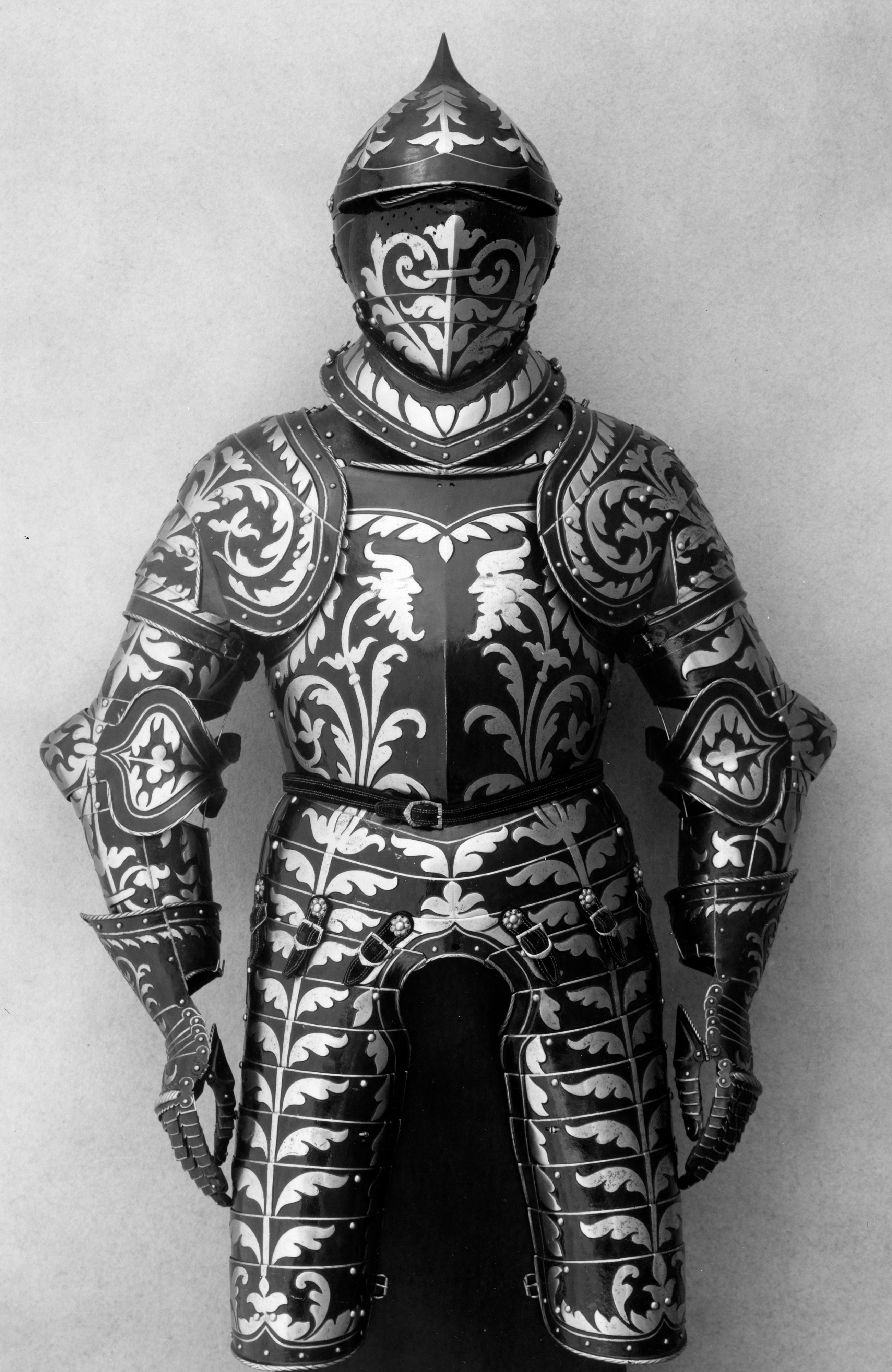
The object under examination—a half armor, likely originating from Innsbruck circa 1580—presents a paradox of material and form. Isolated from its functional context of warfare, it becomes a pure artifact of aesthetic archaeology. The steel, cold and reflective, is not merely a shield but a canvas for the interplay of light and shadow. The leather, supple and dark, serves as the structural counterpoint, a flexible spine that cradles the rigid metal. This duality—the unyielding and the yielding—is the foundational principle for 2026 luxury silhouettes. The armor’s classical elegance lies not in its ornamentation, but in its architectural logic: a system of articulated plates that define and protect the human form. For the contemporary atelier, this is not about replication but translation—extracting the grammar of protection and power to inform a new language of couture.
Materiality as Narrative: Steel and Leather in Dialogue
The steel of the Innsbruck half armor is a testament to controlled tension. Its surface, polished to a mirror-like sheen, captures the environment, creating a dynamic, ever-shifting exterior. In 2026, this translates to liquid metal finishes on structured evening gowns and tailored jackets. We are not forging armor, but weaving its essence: consider a gazar and metallic thread lamé that mimics the armor’s reflective properties while maintaining the fluidity required for a modern silhouette. The leather, in contrast, is the tactile anchor. Its grain, darkened by age and use, speaks of durability and intimacy. For the atelier, this informs the use of double-faced cashmere and nappa leather as interior linings and structural underlays—a secret luxury, felt but unseen. The interplay is a dialogue: the steel commands the gaze, the leather whispers of comfort. This materiality informs the 2026 silhouette by creating a visual and tactile hierarchy, where the exterior is a statement of power and the interior a sanctuary of ease.
Deconstructing the Armor’s Silhouette: From Protection to Poise
The half armor’s silhouette is defined by its articulated zones: the pauldron (shoulder), the cuirass (torso), and the tassets (hip). Each zone is a distinct geometric volume, yet they are connected by mobile joints—rivets and leather straps that allow for movement. For 2026, we deconstruct this into a modular silhouette.
The Pauldron Effect: The exaggerated, rounded shoulder of the armor is reinterpreted as a sculpted sleeve head in a men’s tailoring context. Using horsehair canvas and structured organza, we create a shoulder that projects outward, then softens into a draped sleeve. This is not a power shoulder of the 1980s; it is a poetic volume, a nod to the armor’s protective stance without the aggression.
The Cuirass Line: The torso of the armor is a single, continuous curve—a monocoque structure. In 2026, this informs the corset dress and the sheath coat. The silhouette is clean, unbroken, and architectural. The waist is not cinched but defined by negative space—a seam that creates a visual indentation without constriction. This is achieved through laser-cut leather panels fused to a fine mesh, creating a second-skin effect that holds the form.
The Tassets as Asymmetry: The tassets, which protect the hips, are layered and overlapping. This translates into asymmetric hem lines and layered panels on skirts and trousers. A floor-length skirt in crêpe de chine might feature a single, steel-grey leather panel cascading from the hip, echoing the armor’s protective layering. The asymmetry introduces a dynamic tension, a sense of motion arrested.
The 2026 Silhouette: A Synthesis of Steel and Leather
The final synthesis for 2026 is a silhouette that is both armored and ethereal. It is a study in contrasts: rigidity and fluidity, opacity and transparency, hardness and softness. The primary silhouette is the “Armored Column.” This is a long, uninterrupted line from shoulder to hem, constructed from a single, continuous material that mimics the steel’s reflective quality—a liquid silk satin with a metallic finish. The column is then punctuated by leather “articulations”: a belt that cinches the waist like a cuirass, a collar that rises like a gorget, or a train that falls like a tasset. These elements are not decorative; they are functional anchors that define the body’s geometry.
Another key silhouette is the “Soft Armor” suit. This is a two-piece ensemble—a jacket and a wide-leg trouser—constructed from double-faced wool on one side and nappa leather on the other. The jacket’s lapels are cut to mimic the armor’s pauldrons, but they are soft, draping over the shoulder. The trousers are cut with a high waist and a dropped crotch, echoing the tassets’ protective volume. The effect is one of deconstructed power—a silhouette that protects without constraining, that commands without shouting.
Technical Execution: Crafting the New Armor
The translation of this aesthetic archaeology into a 2026 collection requires advanced pattern engineering. The armor’s articulation is replicated through strategic seam placement and internal boning. For the “Armored Column,” we employ a spiral-seam technique, where a single, continuous seam spirals from the shoulder to the hem, creating a visual and structural tension. The seam is reinforced with a thin, flexible steel wire encased in silk thread, allowing the garment to hold its shape while remaining fluid.
The leather elements are laser-cut to precision, with edges left raw to emphasize materiality. They are attached using invisible magnetic closures and leather rivets, allowing for modularity—the wearer can adjust the silhouette by adding or removing panels. This is the ultimate luxury: control over one’s own form.
The finishing is paramount. The steel-grey palette is punctuated by deep oxblood and aged bronze, echoing the patina of the original armor. The interior of each garment is lined with suede or silk charmeuse, a secret luxury that references the leather’s intimate role. The final result is a collection that does not mimic armor but embodies its spirit: a synthesis of protection, power, and poise, reimagined for the modern woman who commands her own space.