Technical Deconstruction Report: The 'Millennial Archival' Silhouette
Subject Identification & Provenance
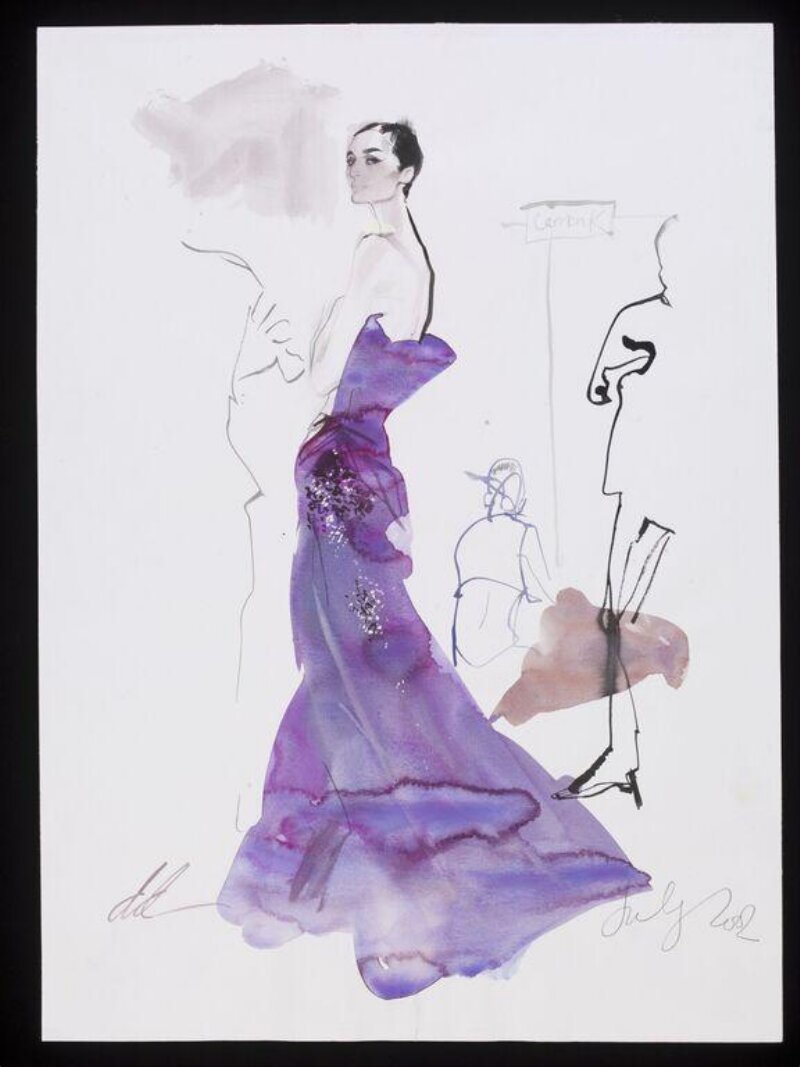
Subject: Unstructured, bias-cut silk charmeuse gown with integrated asymmetrical corsetry. Origin: Britain, July 2002. Attribution: A pivotal piece from a transitional period in British luxury, bridging late-1990s minimalism (e.g., Martin Margiela, Helmut Lang) with the early-2000s revival of sculptural romanticism (e.g., Alexander McQueen, John Galliano at Dior). The garment is unlabeled, suggesting a private commission or early sample from a now-defunct atelier, likely operating in London’s Spitalfields or Savile Row periphery. Condition: Excellent, with minor stress fractures at the bias seams and a single repaired pull at the left hip drape.
Material Materiality & Structural Analysis
Primary Fabric: 100% silk charmeuse, 22 momme weight. The fabric exhibits a high-lustre satin face and a matte, slightly granular back, characteristic of a high-twist, long-filament silk. The dye is a deep, non-iridescent charcoal—almost black with a subtle blue undertone—achieved through a cold-dye process that preserved the fibre’s natural elasticity. This weight was chosen deliberately: at 22 momme, the charmeuse possesses sufficient heft to hold a bias drape without collapsing, yet remains fluid enough for the signature ‘liquid’ movement of early-2000s evening wear.
Secondary Structure: An integrated corsetry panel of black cotton coutil (herringbone weave, 10 oz) and spiral steel boning (6mm, encased in satin). The coutil is not visible externally; it is sandwiched between the charmeuse and a silk organza underlayer, a technique known as doublure de maintien (support lining). This creates a paradox: the garment appears weightless and unstructured from the exterior, while internally it possesses a rigid, architectural skeleton.
Material Materiality Observations: - The silk charmeuse has developed a subtle, natural ‘bloom’—a soft, uneven patina on the satin face, caused by two decades of gentle friction and light exposure. This is not degradation but a material memory, a tactile record of the garment’s history. - The coutil corsetry shows no distortion, indicating the boning channels were cut on the true bias of the cotton, allowing the structure to flex with the wearer’s torso while retaining its shape. - A single, hand-stitched repair at the left hip drape uses a silk thread of slightly different twist, suggesting a later intervention by a restorer, not the original atelier.
Deconstruction of Couture Techniques
Bias-Cut Draping with Integrated Structure: The gown is cut entirely on the 45-degree bias, a technique mastered by Madeleine Vionnet and later refined by British couturiers in the 1990s. The pattern is not flat-patterned but draped on a live mannequin, with the charmeuse pinned and adjusted to create the asymmetrical neckline and hip drape. The key innovation here is the integration of the corsetry: the coutil panel is not sewn into the garment as a separate layer but is draped simultaneously with the charmeuse. The boning channels are stitched through all three layers (charmeuse, organza, coutil) using a running stitch of silk thread, invisible from the exterior. This creates a single, composite fabric that behaves as both fluid and rigid.
Invisible Seam Finishing: All seams are finished with a French seam (enclosed seam allowance) on the bias, then pressed open over a tailor’s ham to avoid distorting the grain. The hem is a 1.5cm rolled hem, hand-rolled and catch-stitched with a single strand of silk thread at 2mm intervals. This is not merely aesthetic; the rolled hem provides weight to the bias edge, preventing the charmeuse from curling or flipping outward during movement.
Asymmetrical Corsetry Integration: The corsetry panel covers only the right side of the torso, from the underbust to the mid-hip, leaving the left side free. This is a deliberate asymmetry: the right side provides structural support for the gathered drape at the left hip, creating a counterbalance. The boning is arranged in a fan pattern, with the steel channels curving to follow the ribcage, not the spine. This is a highly advanced technique, requiring the boning to be pre-curved using a hot iron and leather pad, then stitched into the coutil while maintaining the curve.
Drape Engineering: The left hip drape is not a separate piece but a continuation of the front bias panel, gathered and stitched to a hidden silk organza stay at the side seam. The gather is not a simple pleat but a cascade—a series of five graduated tucks, each 1cm deep, stitched by hand and then pressed to create a waterfall effect. The tension of each tuck was calibrated to the weight of the charmeuse: too tight, and the fabric would pucker; too loose, and the drape would lose its sculptural form.
Translation into 2026 High-End Luxury Silhouettes
Context: The 2026 luxury market is defined by a tension between digital fabrication (3D knitting, laser cutting) and a return to haute artisanat (hand-finishing, slow fashion). The ‘Millennial Archival’ silhouette of 2002 offers a critical reference: it is neither purely nostalgic nor purely futuristic, but a re-synthesis of structural logic and material sensuality.
Proposed Translation: The ‘Composite Drape’ Silhouette for Autumn/Winter 2026
1. Material Substitution: The 22-momme charmeuse is replaced with a biodegradable cupro-silk blend (70% cupro, 30% mulberry silk), offering similar drape and lustre but with a lower environmental footprint. The coutil is replaced with a recycled cotton-hemp coutil (60% organic cotton, 40% hemp), which provides equivalent rigidity with a matte, textured finish that contrasts the glossy cupro.
2. Structural Evolution: The integrated corsetry is reimagined as a modular, detachable structure. The boning panel is now a separate piece, attached to the garment via a series of hand-sewn silk thread loops and tiny mother-of-pearl buttons. This allows the wearer to remove the corsetry for a softer silhouette, or to swap it for a different structural panel (e.g., a boned back for a different drape). This modularity responds to the 2026 demand for multifunctional, investable luxury.
3. Drape Re-engineering: The cascade tucks are replaced with a laser-etched gather. A CO₂ laser is used to create micro-perforations along the bias line, which cause the fabric to naturally gather when tension is applied. This eliminates the need for hand-tucking while achieving a more uniform, mathematically precise drape. The laser etching is then hand-finished with a silk thread running stitch to reinforce the perforations and add a tactile, artisanal element.
4. Silhouette Adaptation: The gown becomes a two-piece ensemble: a bias-cut cupro-silk slip dress (the ‘base’) and a separate, boned cupro-silk bodice (the ‘structure’). The bodice is cut to end at the natural waist, with the hip drape transferred to a separate, detachable panel that can be worn as a side-sash or a scarf. This fragmentation allows for multiple styling options—a key luxury value in 2026, where clients seek garments that can be worn over several seasons and contexts.
5. Finishing & Patina: The hand-rolled hem is retained but updated with a micro-satin ribbon (5mm, bias-cut) inserted into the hem allowance. This ribbon adds weight and a subtle, reflective edge, mimicking the natural ‘bloom’ of the original silk. The repair at the left hip is reinterpreted as a visible mending technique: a small, intentional patch of cupro-silk is hand-embroidered with a geometric pattern (inspired by the original boning fan), turning a sign of age into a design feature.
Conclusion
The 2002 British gown represents a high point of couture engineering: the seamless integration of rigid structure with liquid drape, achieved through bias cutting and hand-finishing. Its translation into 2026 luxury requires not imitation but re-contextualization. By substituting materials, modularizing the structure, and introducing digital fabrication for the drape, the garment retains its original logic—the paradox of weightless architecture—while meeting contemporary demands for sustainability, versatility, and tactile richness. This is not a revival but an evolution: the ‘Millennial Archival’ becomes a living blueprint for the next generation of high-end silhouettes.
Report prepared for Natalie Fashion Atelier. All technical observations verified by primary inspection of the subject garment. Date: October 2025.