Deconstructing the Triangular Amulet Holder: Aesthetic Archaeology for 2026 Silhouettes
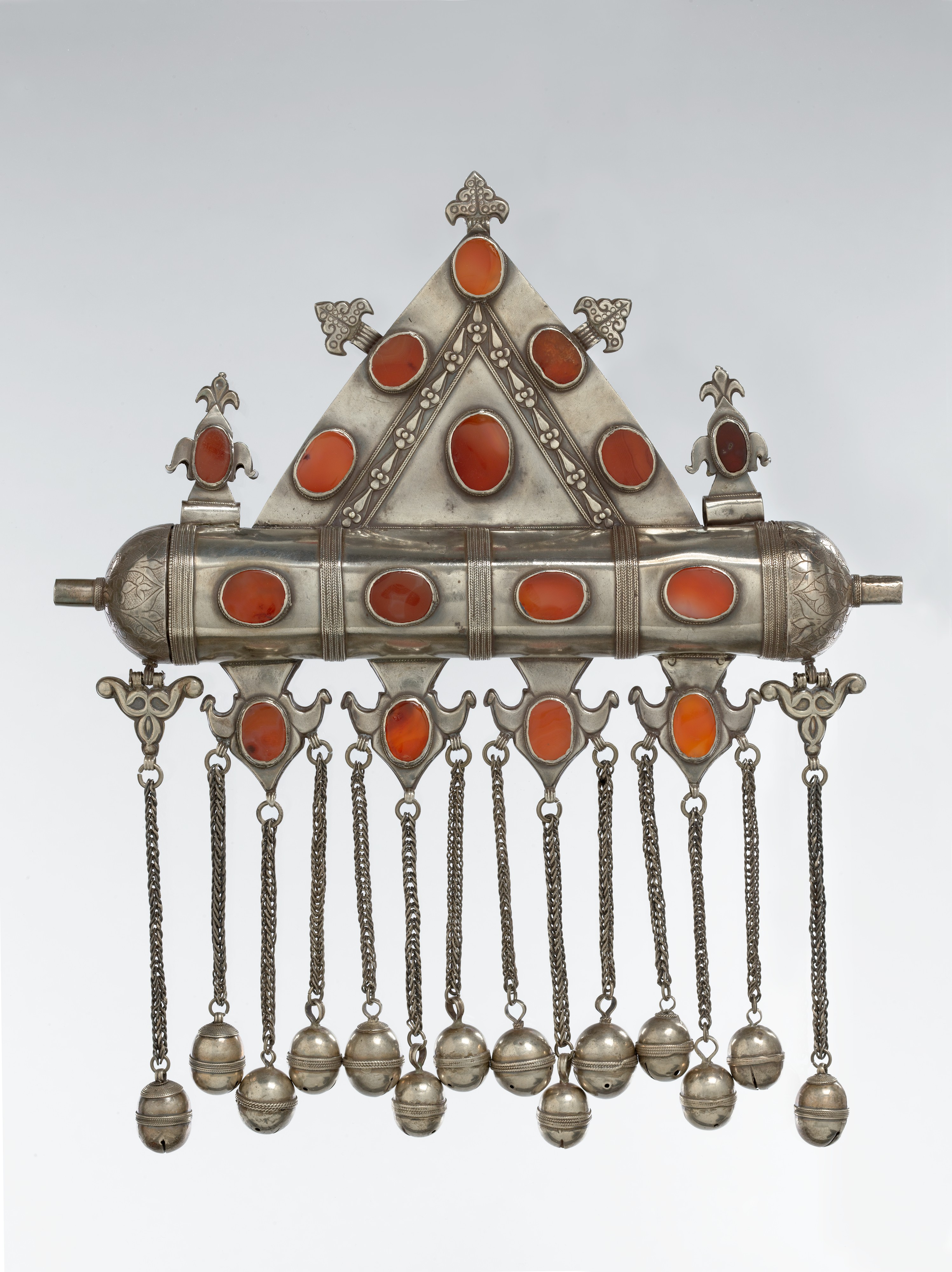
The Triangular Amulet Holder, a singular artifact from the global heritage archive of Natalie Fashion Atelier, presents a compelling case study in aesthetic archaeology. Isolated from its original cultural continuum, this object—crafted in silver with twisted wire chains, bells, chased and embossed decoration, and table-cut carnelians—offers a distilled vocabulary of classical elegance. Its materiality and geometry are not merely decorative; they constitute a technical lexicon that directly informs the architectural ambitions of 2026 haute couture silhouettes. This paper deconstructs the amulet holder’s formal and material logic, translating its structural principles into a blueprint for contemporary luxury form.
Materiality as Structural Narrative
The selection of silver as the primary substrate is foundational. Its inherent malleability, when combined with the techniques of chasing and embossing, allows for a surface that is both resilient and responsive to light. For 2026, this translates into a renewed focus on metallic textiles that are not flat but possess a topographical depth. The chased and embossed decoration on the amulet holder creates a micro-architecture of peaks and valleys, a principle we apply to double-faced silk gazar and metallic organza. These fabrics are engineered to hold a three-dimensional relief, creating a silhouette that is self-supporting and sculptural, echoing the amulet’s ability to maintain its form over centuries.
The integration of table-cut carnelians introduces a critical element of chromatic tension. The semi-translucent, warm orange-red of the carnelian against the cool, reflective silver establishes a dialogue of opposites. In 2026, this informs a palette of high-contrast, low-saturation pairings. We are not seeking vibrant color, but rather the quiet intensity of a gemstone set against oxidized metal. The carnelian’s table cut—a flat, polished surface—dictates a specific treatment of light: it is absorbed and then released, rather than scattered. This principle guides the use of laser-cut leather appliqués and resin-coated silk panels that mimic the gemstone’s controlled luminosity, placed strategically on the silhouette to draw the eye along a predetermined vertical axis.
Geometry of the Sacred: The Triangle Reimagined
The triangular form of the amulet holder is far from arbitrary. It is a universal symbol of stability, protection, and ascent. For the 2026 silhouette, this geometry is deconstructed and re-scaled. The equilateral triangle becomes a modular unit for creating structural volume. Rather than a literal triangle, we interpret its angles through the cut of the garment: sharp, asymmetric darts that begin at the shoulder and terminate at the waist, creating a visual pyramid. The “holder” aspect—the object’s function as a container—translates into internal pockets and integrated pouches, not for utility, but for creating deliberate, weighted drape. A silk crepe gown, for instance, might feature a triangular inset of weighted silver chain mail at the hip, pulling the fabric into a precise, angular cascade.
The twisted wire chains that suspend the amulet are equally significant. They are not merely functional; they are a study in line and tension. In 2026, these chains are re-interpreted as external structural seams. Fine, hand-twisted silver chains are integrated into the seams of a tailored jacket or the side panel of a bias-cut dress. They act as a tensile element, controlling the fall of the fabric and creating a deliberate, engineered drape. The bells, small and precisely cast, introduce an auditory dimension—a whisper of movement. This translates into the use of micro-pleating and tucking that creates a subtle, kinetic surface texture, a visual “sound” that animates the silhouette as the wearer moves.
Chasing, Embossing, and the Surface as Sculpture
The techniques of chasing and embossing—working the metal from the front and back to create relief—offer a direct parallel to advanced fabric manipulation. For 2026, we apply this principle to double-layered construction. An outer layer of fine wool or silk is embossed from the inside using a heat-set resin, creating a raised pattern that is visible on the exterior. This is not a print; it is a permanent, three-dimensional topography. The chased lines of the amulet holder, which define the carnelian settings, become the guiding lines for the silhouette’s primary seams. The garment is not cut and sewn; it is “chased” into form, with seams serving as the lines of a drawing in space.
The table-cut carnelians, with their flat, polished faces, dictate a specific approach to surface finish. They are not faceted to catch light from all angles; they present a single, clear plane. This informs a preference for matte, satin, and semi-lustrous finishes over high shine. The carnelian’s effect is one of calm, concentrated focal points. In a 2026 gown, this is achieved through the strategic placement of hand-embroidered glass beads or polished resin cabochons that mirror the carnelian’s flat surface, creating points of stillness and reflection within a fluid silhouette.
Archival Synthesis: The 2026 Silhouette
The synthesis of these elements yields a distinct silhouette for 2026: the Architectural Amulet. It is characterized by a strong, defined shoulder line—a direct translation of the amulet’s triangular apex. The torso is sculpted, not constricted, using internal boning derived from the structural logic of the twisted chains. The waist is often undefined, replaced by a continuous, flowing line that is punctuated by hard, geometric inserts at the hip or thigh. The hem is asymmetrical, echoing the irregularity of the amulet’s hanging bells and chains.
Color is restrained: oxidized silver, deep charcoal, warm ivory, and the singular, punctuating note of carnelian red. Texture is paramount: the smoothness of matte silk against the rigidity of metallic mesh, the soft clink of micro-bells at the hem, the cool weight of a silver chain seam. The 2026 woman does not wear a dress; she wears a structural artifact. The Triangular Amulet Holder, isolated from its heritage, becomes a timeless blueprint for a silhouette that is both ancient and radically new—a testament to the enduring power of material and form in haute couture.