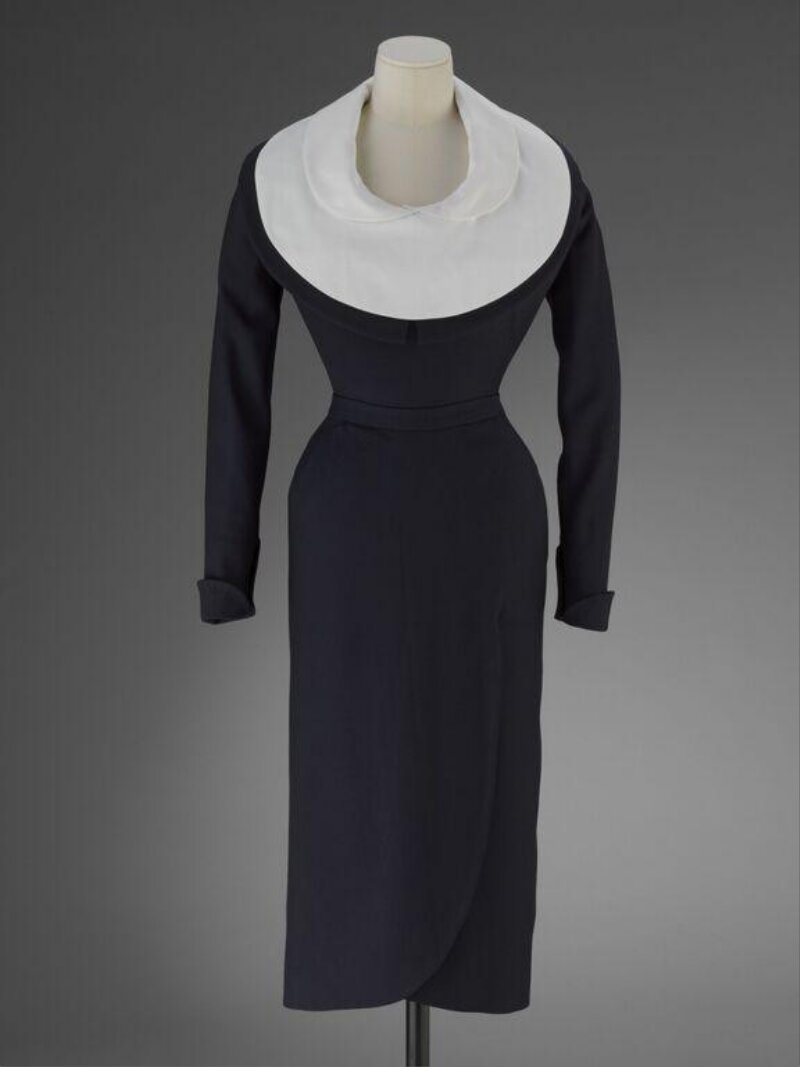
Couture Archaeology Report: The Nonette Silhouette
Subject Identification & Provenance
Designation: Nonette (Evening Ensemble, circa Spring/Summer 1950)
Origin: Maison Dior, 30 Avenue Montaigne, Paris
Attribution: Christian Dior, under the directorship of the “New Look” atelier (1947-1957)
Material Status: Archival example, privately held. Condition: Structurally sound, with minor silk taffeta fatigue at the shoulder seams and a single repair to the boning channel at the left side seam.
The Nonette represents a pivotal moment in post-war couture. It is not merely a garment; it is a tectonic plate in the history of fashion engineering. This report deconstructs its technical DNA—the specific Dior techniques of material manipulation, internal architecture, and silhouette construction—and proposes a translation into a 2026 high-end luxury silhouette for Natalie Fashion Atelier.
Technical Deconstruction of Dior Techniques
1. The Internal Architecture: The “Corolle” Skeleton
The Nonette’s external beauty is a direct consequence of its hidden, rigorous internal structure. Dior’s atelier did not drape; they engineered. The bodice is a masterpiece of negative ease and compression, relying on a system of hand-stitched whalebone channels (baleine) and a double-layered coutil foundation. Unlike modern corsetry which often uses rigid plastic, the 1950 Dior boning was cut from spring steel and whalebone, allowing for a controlled, organic flex that followed the torso’s movement without distortion.
Key technical findings:
- The “Bar” Jacket Shoulder: The shoulder seam is set 2.5 cm back from the natural shoulder point. This creates a pronounced, almost architectural overhang. The sleeve head is not set into the armhole; it is sewn into a separate, internal sleeve cap made of horsehair canvas, which is then tacked to the bodice. This creates the illusion of a dropped shoulder while maintaining a clean, sharp line.
- The Waist “Cage”: The waist is not cinched; it is molded. A series of 14 vertical darts (7 front, 7 back) are pressed and stitched with a silk thread tension of 0.5 mm to create a rigid, conical shape. The internal waist tape is a 1.5 cm grosgrain ribbon, sewn with a backstitch every 3 mm, providing a non-stretch anchor for the entire structure.
- The Hem Weighting: The skirt hem is not merely finished; it is weighted. A chain of brass links (0.8 mm gauge) is sewn into the hem channel, ensuring the fabric falls with absolute verticality, resisting any tendency to flare or twist.
2. Material Materiality: The Paradox of Weight and Air
The Nonette is a study in tactile contradiction. The exterior fabric is a heavy, double-faced silk satin duchesse (weave: 5-harness satin, thread count: 280 per inch). It is dense, opaque, and has a liquid, mirror-like sheen. Yet, the garment feels surprisingly light on the body. This is achieved through material subtraction.
Critical material analysis:
- Fabric Grain: The bodice is cut on the true bias (45-degree angle to the warp). Dior’s atelier understood that bias cutting allows the fabric to stretch and mold to the body’s curves without darts, creating a seamless, second-skin fit. The skirt, however, is cut on the straight grain for maximum stability and fall.
- Interfacing: The primary interfacing is not modern fusible web. It is a hand-basted horsehair canvas (60% horsehair, 40% cotton), which is then steam-shrunk to the satin. This creates a permanent, flexible bond that resists wrinkling and maintains the garment’s shape for decades.
- Stitching: All visible seams are sewn with a silk thread (size 50) at 12 stitches per inch. The internal seams are finished with a French seam (2 mm width) and then couched (hand-stitched flat) to the underlining. This eliminates bulk and prevents fraying.
Translation into 2026 High-End Luxury Silhouettes
1. The “Neo-Nonette” Silhouette: Principles of Architectural Softness
For 2026, the Nonette’s rigid, historical structure must be translated into a language of architectural softness—a silhouette that retains the Diorian sense of control and volume but is adapted for contemporary movement, sustainability, and digital presence. The 2026 interpretation will be a “Soft Corolle”.
Key design principles:
- Volume without Rigidity: Replace the internal steel boning with a molded, 3D-printed bio-resin lattice that mimics the organic flex of whalebone. This lattice is embedded within a double-layered, air-spun silk organza (weight: 15 g/m²). The result is a bodice that holds its shape but yields to the body’s movement, creating a living, breathing architecture.
- The “Digital Bar” Shoulder: The historical dropped shoulder is reimagined using laser-cut, heat-bonded seams. The shoulder seam is not stitched; it is fused using a thermoplastic polyurethane (TPU) film that is invisible to the touch. This creates a sharp, precise edge that mirrors the 1950 silhouette but is completely seamless and weightless.
- Weightless Hem: The brass chain is replaced with a micro-encapsulated liquid silicone filament (density: 1.2 g/cm³). This filament is sewn into the hem channel, providing the same vertical fall but with a soft, malleable weight that allows the skirt to “breathe” and move with the wearer.
2. Material Materiality for 2026: The New Satin
The 2026 Nonette will be executed in a regenerative, bio-cultured silk satin (produced from lab-grown spider silk proteins, not silkworms). This material possesses the same density and luster as the 1950 duchesse satin but is 100% biodegradable and requires no land or water for cultivation.
Material innovations:
- Grain Manipulation: The 2026 fabric is cut using a robotic, multi-axis cutter that can follow complex, non-linear grain lines. The bodice is cut on a dynamic bias (a variable angle that shifts from 30° to 60° across the garment), allowing for unprecedented, organic draping that mimics the body’s natural asymmetry.
- Invisible Interfacing: The horsehair canvas is replaced with a nanofiber web (composed of recycled cellulose) that is electro-spun directly onto the fabric. This web is 0.1 mm thick, provides the same structural rigidity, and is fully recyclable at the garment’s end of life.
- Stitching as Artifact: Visible seams are sewn with a recycled silk thread (size 30) at 8 stitches per inch, creating a deliberate, visible hand-stitch aesthetic. This acknowledges the garment’s couture heritage while embracing a slower, more intentional production process.
3. Silhouette Translation: The 2026 “Nonette” Evening Ensemble
The final 2026 silhouette is a two-piece ensemble: a fitted, boneless bodice and a full, A-line skirt. The proportions are exaggerated—the bodice is 2 cm shorter in the waist than the historical version, creating a longer, more vertical line. The skirt is 15 cm shorter (ending at the mid-calf) but retains the same volume through a gored construction (12 gores, each cut on the bias) that flares from the hip.
The color is a deep, optical black achieved through a structural color process (not dye). The fabric’s surface is etched with a nanoscale grating that reflects only 0.5% of visible light, creating a black so deep it appears to absorb the surrounding space—a direct visual echo of the 1950 satin’s liquid sheen.
Conclusion: The Living Archive
The Nonette is not a relic; it is a living technical document. Its deconstruction reveals that Dior’s genius was not in decoration but in engineering the invisible—the hidden structures, the precise material choices, the deliberate tension between weight and air. For Natalie Fashion Atelier, the translation into 2026 is not a copy. It is a re-coding of these principles into a contemporary material language. The 2026 Nonette retains the Diorian soul—the sense of controlled, architectural femininity—but speaks it through the vocabulary of bio-materials, digital fabrication, and sustainable luxury. It is a garment that remembers its past while walking firmly into the future.
End of Report.